Johnny Frisble's Story
pp. 49-66 · Read in the full issue
Book Review
IN April, 1946, we were told that Florence Frisbie (Johnny to her friends), of the Cook Islands, and daughter of Robert Dean Frisbie, author-trader, was writing a book. Then it had no name, and no publisher; it was just an idea. Now it has a name (“Miss Ulysses from Puka-Puka”), and a pub lisher (Macmillan); it is an accomplished fact.
Since that early announcement, there have been a few people, who shall be nameless, who have looked down their un believing noses and, in effect, have said, “Flapdoodle.” That is the penalty Johnny Frisbie will have to pay for having an established writer-father. The remark was inevitable.
These people can be dismissed. At all events, few, if any, young writers have made the grade without being guided and advised by an experienced hand; Miss Ulysses herself says that her father polishes everything she writes and did much of the translating from the original Puka-Pukan and Rarotonga in which the first part of the book was written.
MOST readers of Pacific authors have followed the story of the Frisbie clan, with Frisbie the father. But in Johnny’s story there is none of the impressionist quality that characterises much of RDF’s writing; it is the work of a young realist, the straight-forward story of an Island girl of mixed parent age, influenced by her environment, her gentle Island mother, her unorthodox European father, and the warring elements of the close-knit Polynesian family set-up. It is at once naive, wise, devastating in its penetration, at times deep in feeling, and wholly amusing. It is not just a novelty book, to be read simply because it is written by a girl of the Islands. It has real entertainment value and a unique insight into the inner life of these Pacific people.
Finally, it reads like Johnny’s letters.
It probably sounds like Johnny sounds to those who know her. When a book has such personality, it is a good book.
But, considering the general parochial ism of the isolated communities of the South and Central Pacific, it will be amazing Indeed, if Miss Ulysses is hailed by all dwellers therein as the book of the century; or if no pet toes have been trodden upon. It might even be as well if some of the well-known Pacific char acters (known to most of us by name) of whom she disposes with such youthful candour, are decently dead. But no doubt her publishers have seen to that.
Into this category comes the well-known government official of her childhood on Puka Puka —a man of little account, in her estimation, no matter what he thought of himself or with what regard his government held him. As well as an official, he was a sort of lay preacher, she explains. “He liked that job best of all;* it gave him a chance to dress up in his flashy clothes, climb up in the high pulpit and preach about adultery.”
This, of course, is well known in the Cook Islands, where the “Blue Laws” still operate and the face of the Law is set strongly against the adulterer; but, she alleges, this bible-bashing character was known to be the worst adulterer on the Island! One day they had even seen him blackening his white canvas shoes —and every child on the atoll knew that a man
does that only when he plans to sneak through the bush to an assignation. White shoes are so conspicuous on a dark night!
ON her mother’s side, Johnny is de scended from a long line of Mangaia war-lords. Johnny herself was born in Tahiti. She already had a brother.
Charlie, but in Polynesian fashion, he had been adopted by a female relative soon after birth and plays only a small part in her narrative. Jakey also was born in Tahiti, and soon after the family sailed for Puka Puka where in due course they were joined by Elaine and, lastly, Nga. After Nga’s birth their mother de veloped tuberculosis and less than 18 months later she came back from hospital in Apia to die on Puka-Puka.
Her relatives immediately started quarrelling over her possessions and over her children. When they went to the length of approaching the Government Agent on Puka-Puka and the Resident Commissioner in Rarotonga, that was the last straw as far as Papa Frisbie was concerned. He determined to take his children away from the island and their family, for good.
He did, eventually, but not until some yeais later. However, when Nga was three and he had almost finished his book about their mother he took Johnny for several months’ holiday in Fiji—to the Puka-Pukans, a land of black cannibals who figured largely as the villains of their stories and legends.
When the trip was first proposed, Johnny did not quite believe it. Papa was full of fine dreams—like going to South America or the Arctic or building a ship and sailing round the world. But. says Johnny, something usually happened to spoil things; like not having enough money. But finally it seemed that they were going to Fiji, sure enough—she and Papa and Araipu. Araipu was a store keeper, and also a vicar in the local LMS church, all of which made him. in the Islands sense, a “big man,” that is, im portant.
He appears to have been included in the party through a whim of RDF who wished to see the reactions of the old man to the civilised world, as represented by Fiji and Samoa. Araipu’s reactions were simple enough; nothing, in his estimation, came up to Puka-Puka. The things he saw abroad were pale imitations of the wonders of home. He was com pletely homesick from the moment he left Puka-Puka until he returned. He de veloped a neurosis about the whole busi ness, was impressed by nothing (with the possible exception of a milking cow) and continually bewailed the tame duck, the young breadfruit tree and his wife, Toia all of which he had left behind on the atoll.
He was scared half out of his wits most of the time —by Fiji’s giant toads, the Fijians themselves, and most of all by the coastal batteries that had a practice shoot in the dead of night. On that occasion, Johnny and Araipu leapt right out of bed and lit out for the hills at top speed, thinking that the Japs had attempted a landing. They stopped only when a passing Fijian woman assured them that it was “gammon.”
A few days later, when some coconuts fell on the roof, Araipu thought they were at it again and had a heart attack.
BUT he lived to return to his atoll and there on the Sunday following Com munion, preached a sermon that has now become a sort of milestone in the history of the place. He opened pro ceedings with greetings in Fijian, Samoan and English. That settled it! He had come home speaking three languages and therefore everything that he said must, indeed, be gospel truth.
“All the foreigners are brands for the burning,’’ he shouted. “Only the people of Puka-Puka have seen the light of God’s way. In the foreign lands you starve like pigs and sleep on the bare, cold ground unless you have bags of gold to pour into the hands of money changers. No one meets you on the beach with a drinking nut in his hand and a word of welcome on his lips. .. . Your nights are made hideous by the thundering of great cannons, the whining of shells, the croak ing of demons, the crash of bombs on your roof, the whispering of cannibals plotting for your life! It was only through terror of the name of Puka-Puka and prayer to the Almighty that I lived to look once again on my happy home. .
BUT the Frisbies did not stay long on Puka-Puka. Their mother was gone; the war had put an end to most trad ing. There seemed little to stay for.
In 1942, they sailed in Captain Cam bridge’s “Taipi”—more sieve than ship— for Rarotonga, via Suwarrow. It was on Suwarrow, where they stayed for two months while Captain Cambridge made an abortive attemp to reach Nassau, that they were caught in that father of all hurricanes that blew all but six of the 26 islets of the atoll into the ocean. They were saved by lashing themselves to the branches of the largest tree while the boiling seas dragged furiously at its roots, finally to uproot it also, with the largest but last wave to wash across the islet.
There followed months of caveman existence, tough even for atoll children, to whom food foraging appears to be a natural gift. Papa cured their coughs and gave them vim by feeding them shark-liver oil which he produced from the bountiful supply of the monsters that haunt Suwarrow waters. They made one more attempt to get away to Rarotonga with Captain Cambridge when he returned after his two months wander but “Taipi” sprang a leak and they found themselves again marooned on Suwarrow.
(Continued on Page 63.)
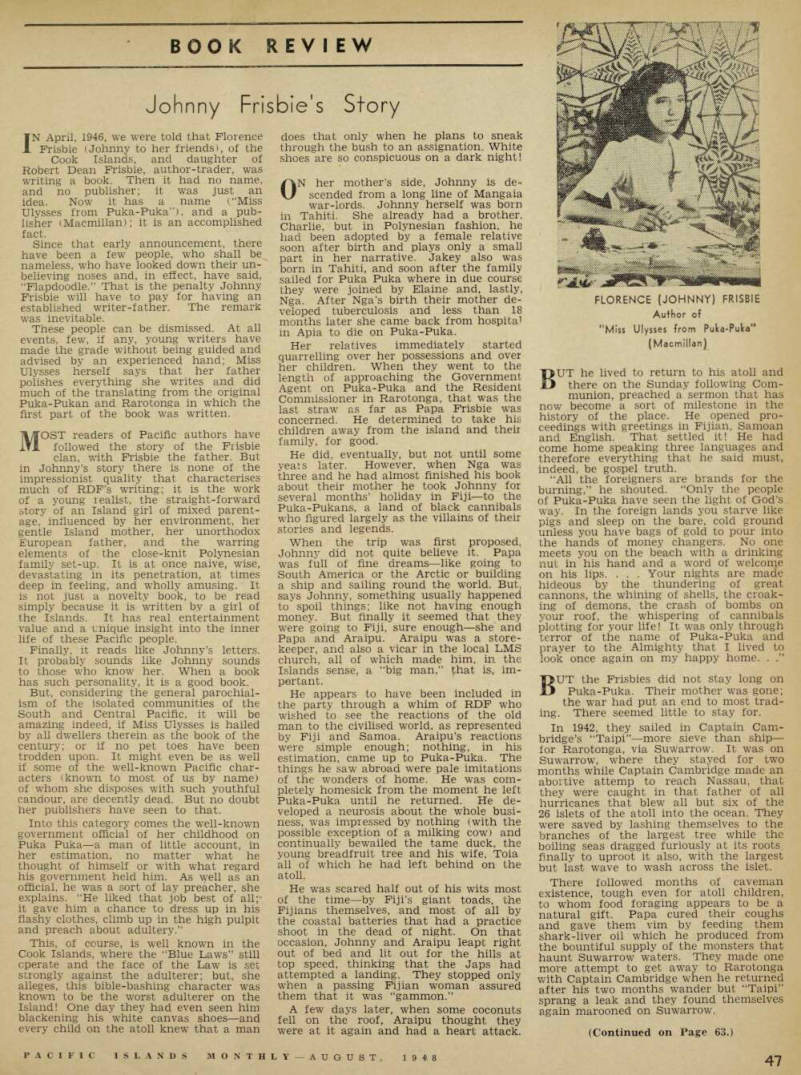
Florence (Johnny) Frisbie
Author of "Miss Ulysses from Puka-Puka" (Macmillan)
TAGUA” finally took them off—to Manihiki, where they were received like Royalty, in spite of the rags to which they had been reduced, and the fact that they had lost all their ready cash in the hurricane. Here they taught the Manihikians the songs and dances of Puka-Puka, Fiji and Samcia, made the acquaintance of Abel Williams and his good wife, and learned what war meant to the atolls.
For it was while they were at Mani hiki that Superman dropped in from the skies and, soon afterwards, a transport came and picked up most of the able bodied men on the atoll for work on nearby Penrhyn, where the Americans were building an aerodrome. (James Norman Hall based his story, “Lost Island” upon this piece of war-time destructive construction).
Superman was, of course, an American, He arrived unexpectedly in a seaplane while young Jakey and a party of Manihikians were headed sedately by sail-boat to a wedding party across the lagoon. Jakey alone had seen a plane but no one lost any time leaping over board, wedding finery and all.
When the plane landed, the hatch opened and Superman’s head popped out.
He was looking for a gent named Abel Williams. Did he happen to be swim ming around there any place?
“No, sir,” said Jakey, who was the only one who could speak English, but who also was hanging onto a coral head, up to his neck in water. “He’s in the village.’’
“Well, son, tell these bathing beauties to bring their boat up alongside before I get mad and start laying eggs.”
When Jakey translated this information literally there was complete panic. No
one had heard bombs referred to as eggs and they were more than ready to be lieve that a man who could appear out of the clouds in a plane might well be capable of making a nest on one of their bird islets and start laying eggs in it.
That seemed terrifying for some reason and they all stayed where they were.
“What in hell’s the matter?” yelled Superman, and Jakey replied: “They’re afraid you’ll lay those eggs, Mister. They never saw a man lay an egg before!”
Superman burst into laughter and the party relaxed. They retrieved their boat and rowed him ashore, where they got as close as possible to killing him with
kindness. Next day he signed on 120 men for work on Penrhyn Island.
(Continued Next Page)
SUPERMAN did his publicity work well oc Penrhyn and the fame of Manihiki hospitality was thus spread throughout the US Navy. When the Manihikians returned home after their three months’ labour, 11 American officers came with them. On this occasion, says Johnny, the celebration that followed made the welcome to Superman and the welcome to themselves, even added together and multiplied by 10, seem like a
funeral. One hundred and twenty Mani hikians had returned to their love-starved wives and sweethearts; eleven millionaires (the Americans) had landed with them Result: an explosion, Next morning. Johnny’s disillusionment was complete. The village was dead; the eleven officers almost so. They struggled to Abel’s place for their last meal. They were unshaven, their eyes bloodshot, their jaws hung down. They drank strong
coffee laced with rum, and every one of them “had his elbows on the table, which is very bad manners. Maybe they thought that no one would know the dif ference on a primitive island like Mani hiki. They must have been badly brought up. One of them ate with his mouth open, another one held his fork in his fist as though it was a fish spear, and a third one knocked his coffee cup over be cause he had left his spoon in his cup.
“We could see that Mrs. Williams was ashamed of her guests; but, nevertheless, after the meal, she gave them each a beautiful hat and a fan. We could hear them thanking her and promising to send her all kinds of wonderful presents; and we could see her weary smile. She had been hearing those kinds of promises since she was a little girl, but seldom had she received any of the fine presents. The same applies to my family.”
WE’LL leave Johnny there. If you are not narrow-minded you will like her book. Some day, perhaps there will be an English edition on sale in the South Pacific. We hope that it will sell a million copies—or at least sumcient to let her look at real civilisation, as she says she wishes to do. But just to look, and then return to her South Seas. We have nothing worth a damn for Johnny Prisbie in our set-up. There should be an important place for such a youngster in the New
Pacific.-
J.T.
(“Miss Ulysses from Puka-Puka.” Published by The Macmillan Company, New York. Price $3.)