Tropicalities
p. 47 · Read in the full issue
NUKUALOFA’S famous long-lived tortoise, which is supposed to have seen Captain Cook, has a rival, which apparently saw Napoleon. The following is from “Crown Colonist,” of June: “This is a most interesting Island, with a courteous and kindly people most of whom are very poor,” writes a corre spondent from St. Helena. “The climate is excellent —rather like an English summer, though rather wetter in the hill areas. It is all hills and valleys. Gov ernment House is 1,900 feet above sea level —an old English mansion built in 1779. It was occupied by Sir Hudson Lowe, the first Colonial Governor appointed to look after Napoleon. Long wood, the residence of Napoleon, is about to be restored by the French Government.
The house and grounds are French pro perty and are looked after by a French Consul de carriere; it is somewhat dilapidated at present. At Government House there is a tortoise that was here in Napoleon’s time. He’s Jonathan, a huge fellow, weighing about half-a-ton, and he wanders around the grounds, formid able to look at but very quiet. * ♦ ♦ MRS. ALICE BOWRING, of Edie Creek, New Guinea, takes us to task for giving her credit for being Direc tor of the American Ail Services Club in Noumea during the Pacific war. She writes to say: “I was never Director . . . but helped Madame Saxton, a resident of Noumea, to run the Club’s cafeteria.
It was a fine club, and I wish I could claim credit for directing it —but a New Yorker, Mrs. Renee Guthman, was my first boss and she was followed by Mrs.
Adelaide Moise, a Navy Commander’s wife. The whole credit for the cafeteria belonged to Madame Saxton—she had the cafeteria running like a well-regu lated clock long before my advent.”
Mrs. Bowring protests that hers really wasn’t a job at all. The American lads whom she was supposed to “keep happy” treated her like the Queen of Sheba and spoiled her. Altogether she had a most interesting and happy 18 months with them in New Caledonia.
She also upbraids us for the photo we printed of her. “It is so misleading— taken when I was only a flapper of 52!” * ♦ * WHEN we were in Wellington, NZ, re cently we had the pleasure of renewing our acquaintance with Mr. Eric Ramsden and meeting his wife.
Remembering how Mr. Ramsden had worked to make the Pacific Islands Society a success when he lived in Syd ney, we were not surprised to find that he is a keen leader of the Ngati Poneke
Club—Maori Youth Centre—in Welling ton.
It was through his good offices that we were taken to the Club. It takes its name originally from the early name of Wellington, Port Nick (short for Nichol son) which the local Maoris rendered as “Poneke.” The Ngati Poneke to-day is the cultural meeting place for any Maori or Pakeha who is interested in Maori history.
Our first visit there coincided with a reception to Maori welfare officers from all over New Zealand. Mr. Ramsden’s speech of welcome had to be extended to embrace the Prime Minister (Mr. Fraser) and an official party when they arrived to compliment the welfare officers. Some complimentary things were also said about the Ngati Poneke’s activities.
Mrs. Ramsden took a prominent part as hostess and also led dance groups.
At our second visit to the club, the lovely Canoe Chant was sung for me.
Then came complimentary speeches of welcome. But, alas, I fear I let my host and hostess down sadly with my feeble response, for I am no orator. I was however, touched by the friendliness of our old Pacific Islands Society president, Mrs. Ramsden, and the group of talented members of the Ngati Poneke Club of Wellington.—A. A. INNES. * * ♦ ALTHOUGH the Education Depart ment’s magic-lantern show proved too tame, with its “still” views of New Zealanders engaged in the genteel mystery of shoemaking, etc., for the Bright Young People of the villages, the winter of youthful discontent is now made glonous summer by the “talkie” outfit of Mr. Dick Brown of Rarotonga, which ar rived here on April 30 and was in opera tion the same night.
This portable, up-to-the-minute cinema outfit, with “sound on film,” has made a real hit with the islanders, and admis sion is not as high as was expected—l d being charged, as compared' with the shilling that used to be paid to see our older silent” show, run bv Mr. George ( v -'me; seme ) bstween 1932 and 1935. » Th ? miracle of sight - and - sound movies, bringing civilisation to the native eye and ear together, may have a profound influence on Mangaian youth Especially on the fair sex! We may ex- American to supnlant “school Eng —fiat A’s are already in evidence.
And female coiffures imitate carefully the lady stars. We traders are considering the laying-in of a stock of Mr. Max Factor’s well-known aids to (Hollywood) beauty. * * * THE photograph of the two Papuan X natives taking tea in Brisbane, pub lished in July issue of “PIM” was originally featured in the Brisbane Courier-Mail.”
The fact that the natives were beino' waited on by a woman aroused the wrath of Mr. Percy Wood, who had been a resident of Panua for over 30 years. He is now living permanently in Brisbane.
Mr. Wood said that he believed in up holdmg the prestige of the white man, but at the same time, being just. He
maintained that the native was unable to understand such familiarity on the part of Europeans, and he had no idea how far he could go. He thought it would be much better for the Papuan native if such things did not take place.
Mr. Wood’s opinion of the white man’s prestige was refuted by a protagonist of the native. The correspondent, under the pen-name of “Fuzzy-Wuzzy Angel’s Debtor,” justified the cafe incident on the grounds of brotherly love; and, as the cafe referred to was run as a Chris tian organisation, it would be distinctly contradictory and hypocritical to treat the Papuans as inferiors “by the women who gave up much valuable time volun tarilv to help in the cafe, so as to raise funds for the purpose of helping to take the gospel of brotherly love to their coloured brethren.”
Natives, Mr. Wood’s adversary con tended, soon picked up all the tricks of unscrupulous white men. True follow ers of Christ, he said, need not think of
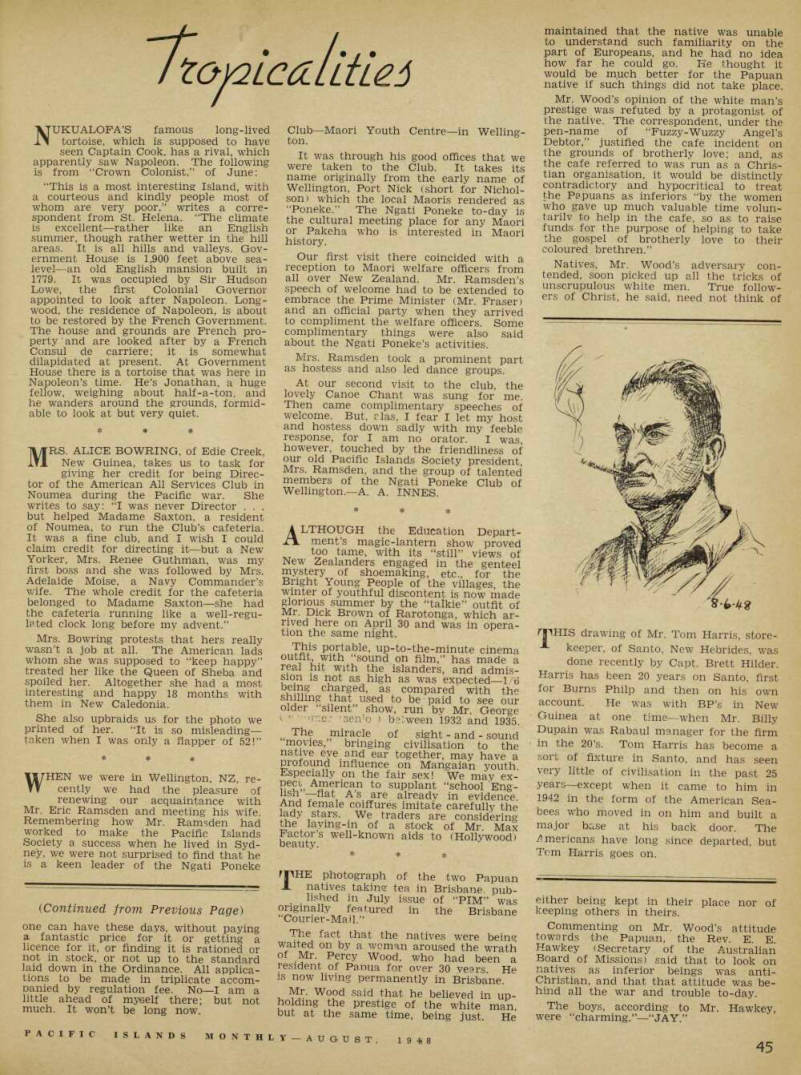
7TIHIS drawing of Mr. Tom Harris, store “*■ keeper, of Santo, New Hebrides, was done recently by Capt. Brett Hilder.
Harris has been 20 years on Santo, first for Burns Philp and then on his own account. He was with BP’s in New Guinea at one time—when Mr. Billy Dupain was Rabaul manager for the firm in the 20’s. Tom Harris has become a sort of fixture in Santo, and has seen very little of civilisation in the past 25 years—except when it came to him in 1942 in the form of the American Sea bees who moved in on him and built a major base at his back door. The Americans have long since departed, but Tcm Harris goes on.
either being kept in their place nor of keeping others in theirs.
Commenting on Mr. Wood’s attitude towards the Papuan, the Rev. E. E.
Hawkey (Secretary of the Australian Board of Missions) said that to look on natives as inferior beings was anti- Christian, and that that attitude was be hind all the war and trouble to-day.
The boys, according to Mr. Hawkey,
were “charming.”