Vegetables
p. 42 · Read in the full issue
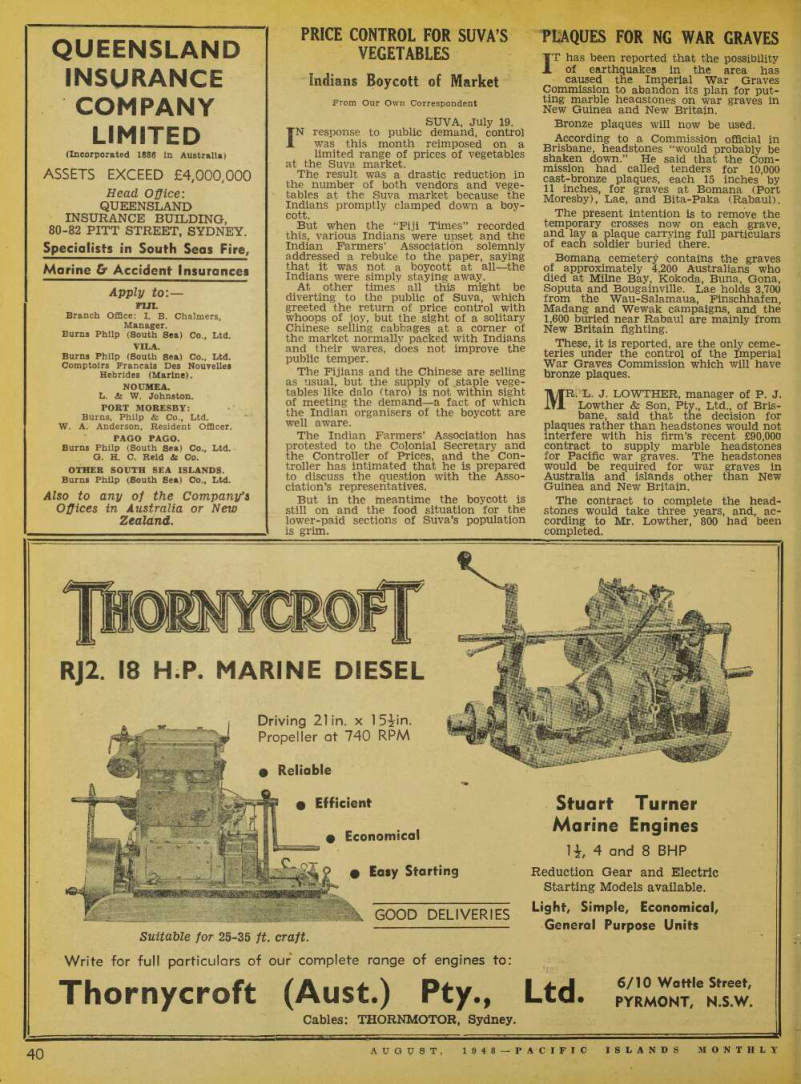
Price Control For Suva’S
Indians Boycott of Market
Prom Our Own Correspondent SUVA, July 19.
IN response to public demand, control was this month reimposed on a limited range of prices of vegetables at the Suva market.
The result was a drastic reduction in the number of both vendors and vege tables at the Suva market because the Indians promptly clamped down a boy cott.
But when the “Fiji Times” recorded this, various Indians were unset and the Indian Farmers’ Association solemnly addressed a rebuke to the paper, saying that it was not a boycott at all—the Indians were simply staying away.
At other times all this might be diverting to the public of Suva, which greeted the return of price control with whoops of joy, but the sight of a solitary Chinese selling cabbages at a corner of the market normally packed with Indians and their wares, does not improve the public temper.
The Fijians and the Chinese are selling as usual, but the supply of staple vege tables like dalo (taro) is not within sight of meeting the demand—a fact of which the Indian organisers of the boycott are well aware.
The Indian Farmers’ Association has protested to the Colonial Secretary and the Controller of Prices, and the Con troller has intimated that he is prepared to discuss the question with the Asso ciation’s representatives.
But in the meantime the boycott is still on and the food situation for the lower-paid sections of Suva’s population is grim.
Plaques For Ng War Graves
IT has been reported that the possibility of earthquakes in the area has caused the Imperial War Graves Commission to abandon its plan for put ting marble heaastones on war graves in New Guinea and New Britain.
Bronze plaques will now be used.
According to a Commission official in Brisbane, headstones “would probably be shaken down.” He said that the Com mission had called tenders for 10,000 cast-bronze plaques, each 15 inches by 11 inches, for graves at Bomana (Port Moresby), Lae, and Bita-Paka (Rabaul).
The present intention is to remove the temporary crosses now on each grave, and lay a plaque carrying full particulars of each soldier buried there.
Bomana cemetery contains the graves of approximately 4,200 Australians who died at Milne Bay, Kokoda, Buna, Gona, Soputa and Bougainville. Lae holds 3,700 from the Wau-Salamaua, Finschhafen, Madang and Wewak campaigns, and the 1,600 buried near Rabaul are mainly from New Britain fighting.
These, it is reported, are the only ceme teries under the control of the Imperial War Graves Commission which will have bronze plaques.
MR. L. J. LOWTHER, manager of P. J.
Lowther & Son, Pty., Ltd., of Bris bane, said that the decision for plaques rather than headstones would not interfere with his firm’s recent £90,000 contract to supply marble headstones for Pacific war graves. The headstones would be required for war graves in Australia and islands other than New Guinea and New Britain.
The contract to complete the head stones would take three years, and, ac cording to Mr. Lowther, 800 had been completed.