Port Moresby Public Servants Review Progress
pp. 13-80 · Read in the full issue
of Fight Against Bad Conditions
From a Special Correspondent
Port Moresby. August 6.
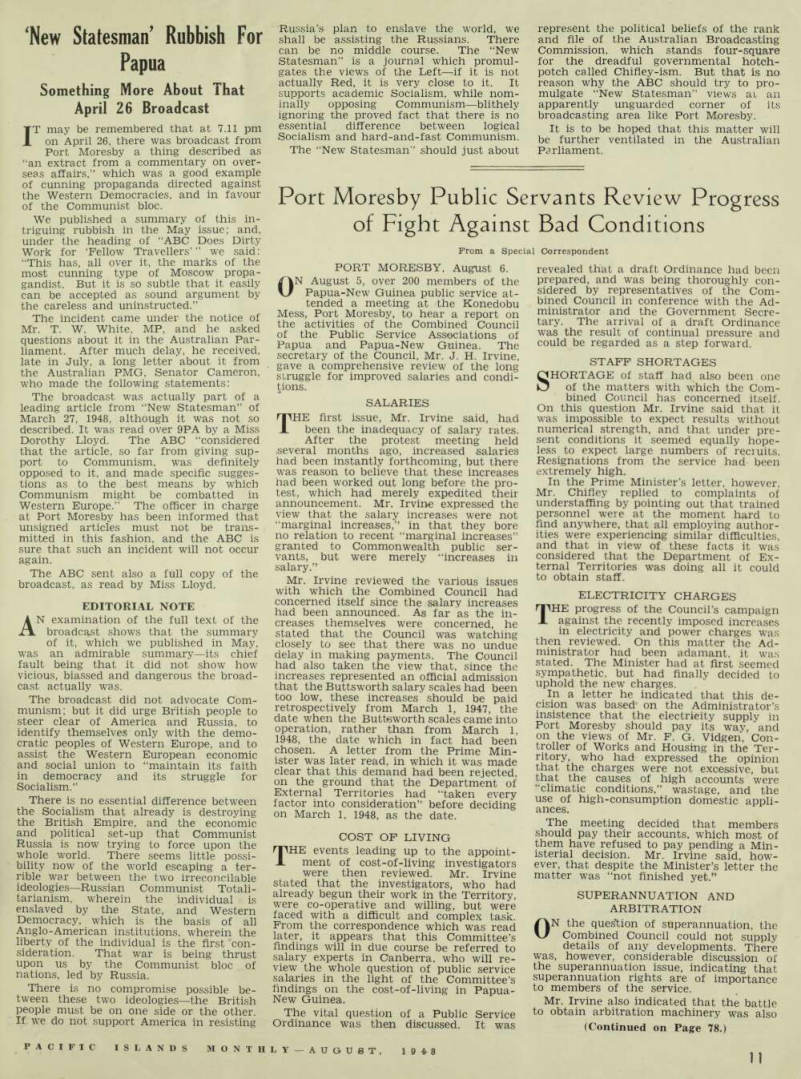
ON August 5, over 200 members of the Papua-New Guinea public service at tended a meeting at the Konedobu Mess, Port Moresby, to hear a report on the activities of the Combined Council of the Public Service Associations of Papua and Papua-New Guinea. The secretary of the Council. Mr. J. H. Irvine, gave a comprehensive review of the long struggle for improved salaries and condi tions.
Salaries
THE first issue, Mr. Irvine said, had been the inadequacy of salary rates.
After the protest meeting held several months ago, increased salaries had been instantly forthcoming, but there was reason to believe that these increases had been worked out long before the pro test, which had merely expedited their announcement. Mr. Irvine expressed the view that the salary increases were not “marginal increases,” in that they bore no relation to recent “marginal increases” granted to Commonwealth public ser vants, but were merely “increases in salary.”
Mr. Irvine reviewed the various issues with which the Combined Council had concerned itself since the salary increases had been announced. As far as the in creases themselves were concerned, he stated that the Council was watching closely to see that there was no undue delay in making payments. The Council had also taken the view that, since the increases represented an official admission that the Buttsworth salary scales had been too low, these increases should be paid retrospectively from March 1, 1947, the date when the Butteworth scales came into operation, rather than from March 1, 1948, the date which in fact had been chosen. A letter from the Prime Min ister was later read, in which it was made clear that this demand had been rejected, on the ground that the Department of External Territories had “taken every factor into consideration” before deciding on March 1, 1948, as the date.
Cost Of Living
THE events leading up to the appoint ment of cost-of-living investigators were then reviewed. Mr. Irvine stated that the investigators, who had already begun their work in the Territory, were co-operative and willing, but were faced with a difficult and complex task.
From the correspondence which was read later, it appears that this Committee’s findings will in due course be referred to salary experts in Canberra, who will re view the whole question of public service salaries in the light of the Committee’s findings on the cost-of-living in Papua- New Guinea.
The vital question of a Public Service Ordinance was then discussed. It was
revealed that a draft Ordinance had been prepared, and was being thoroughly con sidered by representatives of the Com bined Council in conference with the Ad ministrator and the Government Secre tary. The arrival of a draft Ordinance was the result of continual pressure and could be regarded as a step forward.
Staff Shortages
SHORTAGE of staff had also been one of the matters with which the Com bined Council has concerned itself.
On this question Mr. Irvine said that it was impossible to expect results without numerical strength, and that under pre sent conditions it seemed equally hope less to expect large numbers of recruits.
Resignations from the service had been extremely high.
In the Prime Minister’s letter, however, Mr. Chifley replied to complaints of understaffing by pointing out that trained personnel were at the moment hard to find anywhere, that all employing author ities were experiencing similar difficulties, and that in view of these facts it was considered that the Department of Ex ternal Territories was doing all it could to obtain staff.
Electricity Charges
progress of the Council’s campaign . against the recently imposed increases in electricity and power charges was then reviewed. On this matter the Ad ministrator had been adamant, it was stated. The Minister had at first seemed sympathetic, but had finally decided to uphold the new charges.
In a letter he indicated that this de cision was based- on the Administrator’s insistence that the electricity supply in Port Moresby should pay its way, and on the views of Mr. F. G. Vidgen, Con troller of Works and Housing in the Ter ritory, who had expressed the opinion that the charges were not excessive, but that the causes of high accounts were “climatic conditions,” wastage, and the use of high-consumption domestic appli ances.
The meeting decided that members should pay their accounts, which most of them have refused to pay pending a Min isterial decision. Mr. Irvine said, how ever, that despite the Minister’s letter the matter was “not finished yet.”
Superannuation And
Arbitration
ON the question of superannuation, the Combined Council could not supply details of any developments. There was, however, considerable discussion of the superannuation issue, indicating that superannuation rights are of importance to members of the service.
Mr. Irvine also indicated that the battle to obtain arbitration machinery was also
(Continued on Page 78.)
not much further advanced. The Gov ernment Secretary had announced that an Ordinance was being prepared, based on Australian legislation. The views of the Associations on the question of abri tration machinery had been sought, but it was stated that the Combined Council wished to wait until it could view the draft Ordinance before expressing its detailed views.
The demand for the immediate appoint ment of a Commonwealth * Conciliation Commissioner until arbitration machinery could be permanently introduced had been rejected by the Prime Minister, largely on legal grounds.
Secondary School Education
MR. IRVINE then announced that assistance for parents sending their children to Australia for secondary schooling had at last been obtained, but the details were at some points obscure.
It was known, however, that fares of children from the Territory to Brisbane would be paid once a year, and that an allowance of £5O would be paid for main tenance of the children in Australia. It was not known whether this allowance would include the £26 at present being
paid for all children of public servants.
Nor were the age or qualifications for assistance yet known. Six bursaries will also be open to children of any residents of the Territory, whether they are public servants or not.
Housing
FINALLY, the vexed question of housing was discussed. It was, said Mr.
Irvine, “beyond a joke,” and yet he could not personally see a solution. The houses are simply not being built, partly because of the difficulty of obtaining materials from the Australian state authorities. The situation had been worsened by a farcical series of in efficient and semi-autocratic institu tions known as “Housing Boards.” The Housing Committee had recently been reconstituted, however, and some improve ment was expected.
Considerable discussion ensued, and speakers emphasised that the speedy erec tion of houses, rather than the improved functioning of the Housing Committee, must ultimately be the solution. A sug gestion was made that pressure be applied to the Forestry Department to enable timber to be cut from the stands in the Brown River area for use in Po:t Moresby.
At the conclusion of the meeting a vote of thanks was enthusiastically carried for Mr. Irvine’s work on behalf of public servants, and Mr. Rich and Mr. Nicholas were elected to act as joint-secretaries during the absence on leave of Mr. Irvine, who will be leaving for Australia shortly.