Trusteeship Council Approves Papua-New Guinea Plan
p. 10 · Read in the full issue
Comment Shows Amusing Ignorance of Conditions in Primitive Melanesia
THE plan for an “administrative mer ger” of the old Australian Territory of Papua and the Trust Territory of New Guinea was finally approved by the Trusteeship Council of the United Nations, on August 2, after it had been under discussion since July 8. (See article on page 9of July “PIM.”) The matter now goes to the Assembly.
The Council voted 8 to 1 (Russia dis senting, of course) in favour of the plan.
France, Belgium and Australia did not vote.
The plan is contained in a Bill which was presented to the Australian Parlia ment in June, and which- will be further dealt with in September. The Bill was reviewed on page 19 of July “PIM.”
The Bill cannot be proceeded with until it has been approved by the General Assembly of UNO. But that is a formal ity—the crucial vote was that taken by the Trusteeship Council. A small body of Australian advisers, led by Mr. R. J.
Halligan, secretary of the Department of External Territories (who returned by air late in July) presented the Australian case to the Council. According to frag mentary newspaper accounts, they met quite a lot of criticism.
MR. SAYRE (United States) said the merger plan was political in essence.
The Australians replied that the merger was merely administrative—the two ter ritories would definitely retain their separate identities. It was not a political union.
Philippines delegate wanted to know why there was no provision for native education. Mr. Halligan explained that provision for native education on a large scale would come from the machinery that the new Bill would create.
A suggestion by the Philippines delegate that Papua also be brought under Trustee Council control was promptly quashed.
Iraq and other delegates thought the proposed union was political, and chal lenged Australia’s right to proceed with the plan.
Russia could not see how the Council would be able to keep a close watch on New Guinea under the proposed union with Papua. Mr. Halligan gave an assur ance that separate statistics would be kept of each Territory, Some delegates said that the provision made for curfews between 9 p.m. and 6 a.m. indicated hatred and oppression of natives. This suggestion (very amusing to those who know the true position in New Guinea) was repudiated by Mr. Hal ligan and Mr. Forsyth.
Another discussion (also amusing to Territories residents) centred on native wages. Some delegates thought that the wage rate now provided by Australia (£AI per month) was far too low; and the Australian delegates (who so often have been cursed in the past two years for raising the rates) were at pains to explain to the Council why it is unneces sary and unwise to pay more to these primitive workers. They used almost the same arguments as were used against them, two years ago, when they were raising the natives’ wages.
United States urged greater participa tion by natives in the higher branches of government, and said the native labour indenture system should be abolished as soon as possible.
Philippines said that Australia should model her administration of New Guinea on the United States administration of Philippines, which was “a shining example of colonial administration.”
In its final report, the Council empha sised the need for maintaining the separ ate identity of the two territories, united for administrative purposes only; said that the wage rate for natives was still inadequate: commented on the illiteracy and political backwardness of the natives; and recommended that existing pro grammes for advancement of the terri tory should be extended and co-ordinated to comprise a general long-range plan for the progressive development of the inhabitants as a whole on an appropriate
constitutional foundation toward self government or independence.
Editorial Note.
MR. WARD and Mr. Halligan probably will agree with the “Sydney Morn ing Herald” comment that the Council’s references to native conditions are “unrealistic,” and that the report, though well-meaning in its comments, “discloses imperfect understanding of the primitive nature of the country and its inhabitants.”
The irony of the thing is that the ill informed and impractical statements of members of the Trusteeship Council are on all-fours with the views expressed, on various occasions, by the starry-eyed gentlemen who, in the shape of a Research Council, advised Mr. Ward on Territories policy in 1943-45. Mr. Ward accepted those views, four or five years ago, despite the jeers of people who really knew Territories conditions. Now Mr.
Ward’s men, in process of implementing his policy, are forced to defend them selves against the same kind of stupid, ignorant and impractical criticism.
The million or so natives in Papua and New Guinea are only one generation re moved from the headhunters and the naked savagery of most primitive Melan esia. In two or three generations more they may be sufficiently advanced to be entitled to European rates of wages and a dominating voice in their own govern ment. In the meantime—as Mr. Ward is now finding out, with every passing month—sympathetic care of them must be supplemented with practical common sense, and strict control. There was not much wrong with the policy of 1920-40, upon which Mr. Ward and his bunch of Research enthusiasts danced so furiously in 1942-43.
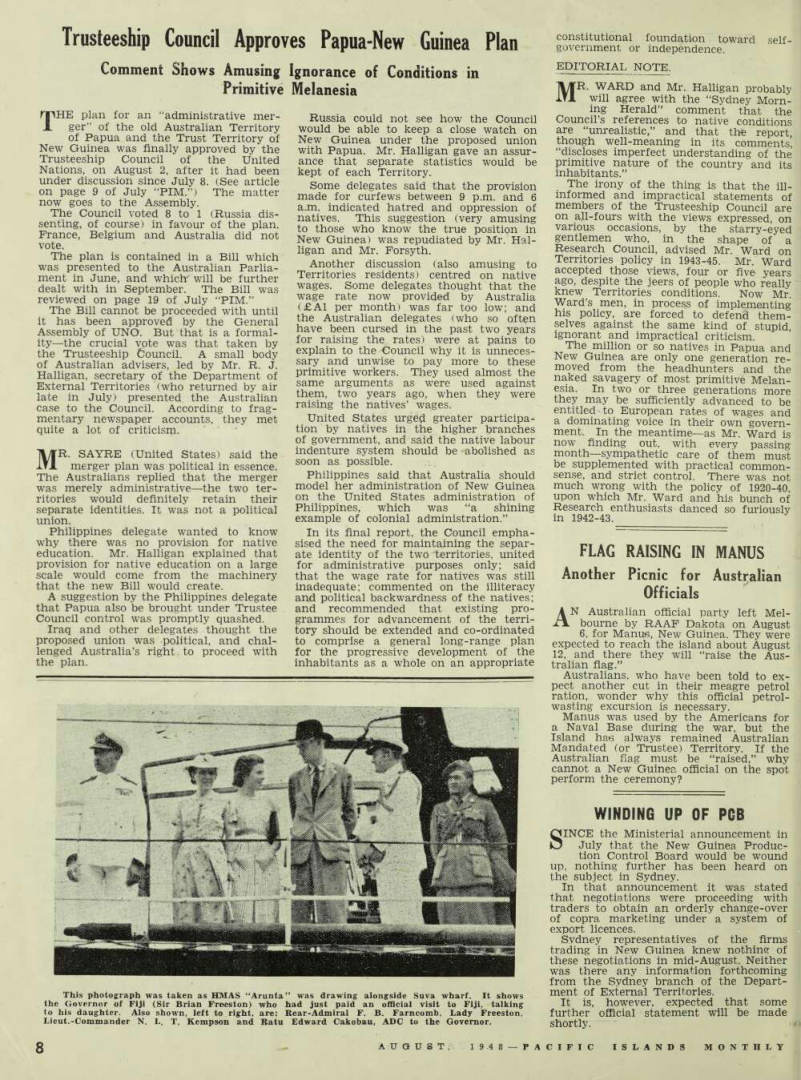
This photograph was taken as HMAS “Arunta” was drawing alongside Suva wharf. It shows the Governor of Fiji (Sir Brian FReeston) who had just paid an official visit to Fiji, talking to his daughter. Also shown, left to right, are: Rear-Admiral F. B. Farncomb, Lady Freeston, Lieut.-Commander N. L. T. Kempson and Ratu Edward Cakobau, ADC to the Governor.