N. Guinea
p. 57 · Read in the full issue
Better Radio For
New Short-Wave Station At Port Moresby
P. Moresby. June 30.
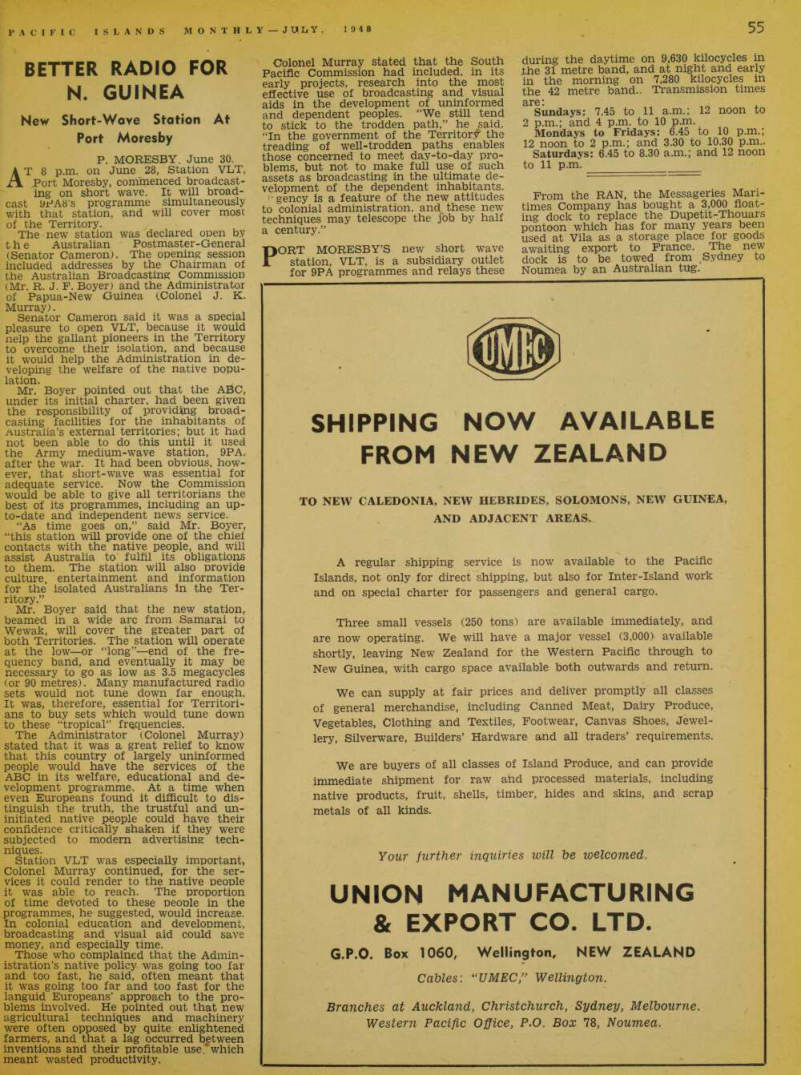
AT 8 p.m. on June 28, Station VLT, Port Moresby, commenced broadcast ing on short wave. It will broad cast 9PAB’s programme simultaneously with that station, and will cover most of the Territory.
The new station was declared open by the Australian Postmaster-General (Senator Cameron). The opening session included addresses by the Chairman of the Australian Broadcasting Commission (Mr. R. J. F. Boyer) and the Administrator of Papua-New Guinea (Colonel J. K.
Murray).
Senator Cameron said it was a special pleasure to open VLT, because it would nelp the gallant pioneers in the Territory to overcome their isolation, and because it would help the Administration in de veloping the welfare of the native popu lation.
Mr. Boyer pointed out that the ABC, under its initial charter, had been given the responsibility of providing broad casting facilities for the inhabitants of Australia’s external territories: but it had not been able to do this until it used the Army medium-wave station, 9PA. after the war. It had been obvious, how ever, that short-wave was essential for adequate service. Now the Commission would be able to give all territorians the best of its programmes, including an up to-date and independent news service.
“As time goes on,” said Mr. Boyer, “this station will provide one of the chief contacts with the native people, and will assist Australia to fulfil its obligations to them. The station will also provide culture, entertainment and information for the isolated Australians In the Ter ritory.”
Mr. Boyer said that the new station, beamed in a wide arc from Samarai to Wewak, will cover the greater part of both Territories. The station will operate at the low—or “long”—end of the fre quency band, and eventually it may be necessary to go as low as 3.5 megacycles (or 90 metres). Many manufactured radio sets would not tune down far enough.
It was, therefore, essential for Territori ans to buy sets which would tune down to these “tropical” frequencies.
The Administrator (Colonel Murray) stated that it was a great relief to know that this country of largely uninformed people would have the services of the ABC in its welfare, educational and de velopment programme. At a time when even Europeans found it difficult to dis tinguish the truth, the trustful and un initiated native people could have their confidence critically shaken if they were subjected to modern advertising tech niques.
Station VLT was especially important, Colonel Murray continued, for the ser vices it could render to the native people it was able to reach. The proportion of time devoted to these people in the programmes, he suggested, would increase.
In colonial education and development, broadcasting and visual aid could save money, and especially time.
Those who complained that the Admin istration’s native policy was going too far and too fast, he said, often meant that it was going too far and too fast for the languid Europeans’ approach to the pro blems involved. He pointed out that new agricultural techniques and machinery were often opposed by quite enlightened farmers, and that a lag occurred between inventions and their profitable use "which meant wasted productivity.
Colonel Murray stated that the South Pacific Commission had included, in its early projects, research into the most effective use of broadcasting and visual aids in the development of uninformed and dependent peoples. “We still tend to stick to the trodden path,” he said.
“In the government of the Territory the treading of well-trodden paths enables those concerned to meet day-to-day pro blems, but not to make full use of such assets as broadcasting in the ultimate de velopment of the dependent inhabitants. gency is a feature of the new attitudes to colonial administration, and these new techniques may telescope the job by half a century.”
PORT MORESBY’S new short wave station, VLT, is a subsidiary outlet for 9PA programmes and relays these
during the daytime on 9,630 kilocycles in the 31 metre band, and at night and early in the morning on 7,280 kilocycles in the 42 metre band.. Transmission times are: Sundays: 7.45 to 11 a.m.: 12 noon to 2 p.m.; and 4 p.m. to 10 p.m.
Mondays to Fridays: 6.45 to 10 p.m.; 12 noon to 2 p.m.; and 3.30 to 10.30 p.m..
Saturdays: 6.45 to 8.30 a.m.; and 12 noon to 11 p.m.
From the RAN, the Messageries Mari times Company has bought a 3,000 float ing dock to replace the Dupetit-Thouars pontoon which has for many years been used at Vila as a storage place for goods awaiting export to France. The new dock is to be towed from Sydney to Noumea by an Australian tug.