South, By Clipperton
pp. 49-64 · Read in the full issue
Book Reviews
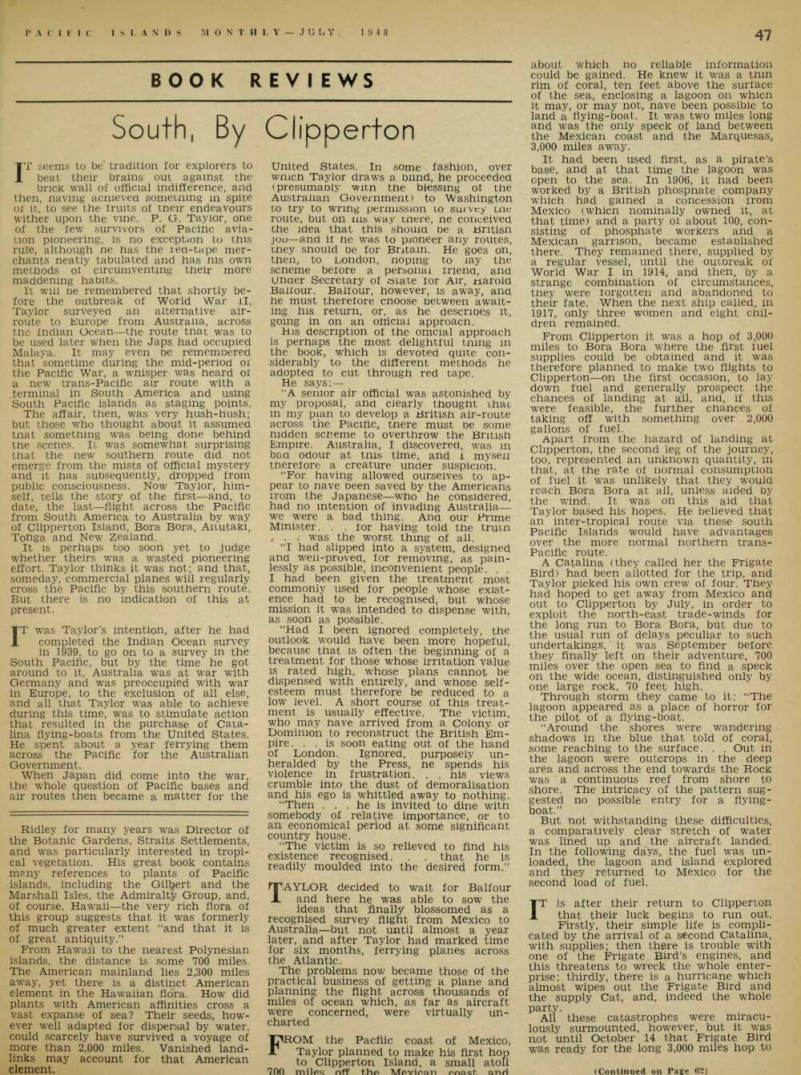
IT seems to be'tradition for explorers to beat their brains out against the brick wall of official indifference, and then, naving acnievea sometnmg in spite of it, to see the fruits of tneir endeavours wither upon the vine. P. G. Taylor, one of the few survivors of Pacific avia tion pioneering, is no exception to this rule, although ne has the rea-tape mer chants neatly tabulated and has ms own methods of circumventing their more maddening habits.
It will he remembered that shortly be fore the outbreak of World War il, Taylor surveyed an alternative air route to Europe from Australia, across the Indian Ocean —the route that was to be used later when the Japs had occupied Malaya. It may even be remembered that sometime during the mid-period of the Pacific War, a whisper was heard of a new trans-Pacific air route with a terminal in South America and using South Pacific islands as staging points.
The affair, then, was very hush-hush; but those who thought about it assumed that something was being done behind the scenes. It was somewhat surprising that the new southern route did not emerge from the mists of official mystery and it has subsequently, dropped from public consciousness. Now Taylor, him self, tells the story of the first—and, to date, the last—flight across the Pacific from South America to Australia by way of Clipperton Island, Bora Bora, Anutaki, Tohga and New Zealand.
It is perhaps too soon yet to judge whether theirs was a wasted pioneering effort. Taylor thinks it was not; and that, someday, commercial planes will regularly cross the Pacific by this southern route.
But there is no indication of this at present.
IT was Taylor’s intention, after he had completed the Indian Ocean survey in 1939, to go on to a survey in the South Pacific, but by the time he got around to it, Australia was at war with Germany and was preoccupied with war in Europe, to the exclusion of all else, and all that Taylor was able to achieve during this time, was to stimulate action that resulted in the purchase of Cata lina flying-boats from the United States.
He snent about a year ferrying them across the Pacific for the Australian Government.
When japan did come into the war, the whole question of Pacific bases and air routes then became a matter for the
United States. In some fashion, over wmcn Taylor draws a blind, he proceeded (presumably wnn tfie blessing of tne Australian Government) to Washington to try to wring permission to survey tne route, but on ms way tnere, ne conceived the idea that this should be a Bntisn jou—and if ne was to pioneer any routes, tney should be for Britain. He goes on, then, to London, nopmg to lay the scneme before a personal friend, and Under Secretary of State lor Air, narold Baliour. Balfour, however, is away, and he must therefore cnoose between await ing his return, or, as he describes it, going in on an official approacn.
His description of the omcial approach is perfiaps the most delightful tnmg m the book, which is devoted quite con siderably to the different methods he adopted to cut through red tape.
He says:— “A senior air official was astonished by my proposal, and clearly thougnt that m my pian to develop a British air-route across the Pacific, tnere must be some hidden scheme to overthrow the British Empire. Australia, I discovered, was in bad odour at this time, and i mysen therefore a creature under suspicion.
“For having allowed ourselves to ap pear to nave been saved by the Americans from the Japanese—who he considered, had no intention of invading Australia— we were a bad thing. And our Prime Minister. . . for having told the trutn . . . was the worst thing of all.
“I had slipped into a system, designed and wen-proved, for removing, as pain lessly as possible, inconvenient people. . .
I had been given the treatment most commonly used for people whose exist ence had to be recognised, but whose mission it was intended to dispense with, as soon as possible.
“Had I been ignored completely, the outlook would have been more hopeful, because that is often the beginning of a treatment for those whose irritation value is rated high, whose plans cannot be dispensed with entirely, and whose self esteem must therefore be reduced to a low level. A short course of this treat ment is usually effective. The victim, who may have arrived from a Colony or Dominion to reconstruct the British Em pire. . . is soon eating out of the hand of London. Ignored, purposely un heralded by the Press, ne spends his violence in frustration. . . his views crumble into the dust of demoralisation and his ego is whittled away to nothing.
“Then ... he is invited to dine with somebody of relative importance, or to an economical period at some significant country house.
“The victim is so relieved to find his existence recognised. . . that he is readily moulded into the desired form.”
TAYLOR decided to wait for Balfour and here he was able to sow the ideas that finally blossomed as a recognised survey flight from Mexico to Australia—but not until almost a year later, and after Taylor had marked time for six months, ferrying planes across the Atlantic.
The problems now became those of the practical business of getting a plane and planning the flight across thousands of miles of ocean which, as far as aircraft were concerned, were virtually un charted FROM the Pacific coast of Mexico, Taylor planned to make his first hop to Clipperton Island, a small atoll 700 miles off the Mevieno mnst. n.nd
about which no reliable information could be gained. He knew it was a tnm rim of coral, ten feet above the surface of the sea, enclosing a lagoon on whicn it may, or may not, nave been possible to land a flying-boat. It was two miles long and was the only speck of land between the Mexican coast and the Marquesas, 3,000 miles away.
It had been used first, as a pirate’s base, and at that time the lagoon was open to the sea. In 1906, it flad been worked by a British phospflate company which had gamed a concession from Mexico (whicn nominally owned it, at that time) and a party of about 100, con sisting of phosphate workers and a Mexican garrison, became established there. They remained there, supplied by a regular vessel, until the outbreak of World War I in 1914, and then, by a strange combination of circumstances, tney were forgotten and abandoned to their fate. When the next ship called, in 1917, only three women and eight chil dren remained.
From Clipperton it was a hop of 3,000 miles to Bora Bora where the first fuel supplies could be obtained and it was therefore planned to make two flights to Clipperton—on the first occasion, to lay down fuel and generally prospect the chances of landing at all, and, if this were feasible, the further chances of taking off with something over 2,000 gallons of fuel.
Apart from the hazard of landing at Clipperton, the second leg of the journey, too, represented an unknown quantity, in that, at the rate of normal consumption of fuel it was unlikely that they would reach Bora Bora at all, unless aided by the wind. It was on this aid that Taylor based his hopes. He believed that an inter-tropical route via these south Pacific Islands would have advantages over the more normal northern trans- Pacific route A Catalina (they called her the Frigate Bird) had been allotted for the trip, and Taylor picked his own crew of four. They had hoped to get away from Mexico and out to Clipperton by July, in order to exploit the north-east trade-winds for the long run to Bora Bora, but due to the usual run of delays peculiar to such undertakings, it was September before they finally left on their adventure, 700 miles over the open sea to find a speck on the wide ocean, distinguished only by one large rock, 70 feet high.
Through storm they came to it: “The lagoon appeared as a place of horror for the pilot of a flying-boat.
“Around the shores were wandering shadows in the blue that told of coral, some reaching to the surface. . . Out in the lagoon were outcrops in the deep area and across the end towards the Rock was a continuous reef from shore to shore. The intricacy of the pattern sug gested no possible entry for a flying boat.”
But not withstanding these difficulties, a comparatively clear stretch of water was lined up and the aircraft landed.
In the following days, the fuel was un loaded, the lagoon and island explored and they returned to Mexico for the second load of fuel.
IT is after their return to Clipperton that their luck begins to run out.
Firstly, their simple life is compli cated by the arrival of a second Catalina, with supplies; then there is trouble with one of the Frigate Bird’s engines, and this threatens to wreck the whole enter prise: thirdly, there is a hurricane which almost wipes out the Frigate Bird and the supply Cat, and, indeed the whole party.
All these catastrophes were miracu lously surmounted, however, but it was not until October 14 that Frigate Bird was ready for the long 3,000 miles hop to
(Continued on Page 62)
Bora Bora. Even then, no adequate run way had been found through the maze of reefs, weed and coral-heads and the whole plan was based on the unorthodox But it had, Taylor believed, to be then' or never. For weeks they had battled against adverse influences until it seemed that the aircraft was bogging down, if she were not got out quickly, then her bones would rest forever in Clipperton lagoon.
The aircraft had a clear run of a mile before coming to the Great Reef which cut the lagoon in two parts, but by going into a turn on the water it was possible to increase this run. if she did not take off in this distance, then Taylor was gambling on the ship being sufficiently airborne to cross the reef without damage and gain the deep water on the further side, where it would be possible to cut power and pull up.
The whole plan was crazy but, as an alternative, Taylor imagined himself sending a signal to his headquarters say ing: “Regret unable to take off from Clipperton.”
After his years of beating down the forest pf official disapproval, after all he and his crew had been through since leaving Mexico? No, crazy or not, the Frigate Bird had to be got off Clipper ton lagoon, somehow.- And this too, they finally accomplished, clawing their way up over the reef and out to sea, headed for Bora Bora 3,000 miles away to the south-westward. From there it became a battle for range, a matter of utilising every favourable breath of wind and air-current.
Twenty-seven hours later they sighted the high mountains of Bora Bora.
From Bora Bora the flight became a matter of routine, of finding suitable bases, of consolidating the victory they had already achieved in that 3,700 miles of open skyways they had travelled from the Mexican coast.
In November they reached Sydney— their task complete; and the following week were on their way north again. ’
Taylor was keen to hear about progress on Clipperton Island carrying tools and engineers. Three weeks had passed since Dakotas were to fly out to Clipperton to a cleared landing strip that had been made on the old phosphate workings. In his mind’s eye, he could see reefs being blasted for take-off lanes and graders smoothing off the air-strip. In a few months, he thought, they would be using the route as a people who had contri buted something to present security and future Pacific air communications.
THE Dakotas were still standing for- Inr-niv on airfield at Dorval.
Canada, loaded with equipment for Clipperton. “International complications” had arisen; there were dinlomatic dis cussions. Then the US Navy went in and occupied the Island—and issued a warning that any aircraft or ship that approached within 50 miles would be fired upon. . . .—J.T. (“Forgotten Island,” by P. G. Taylor.
Australian price: 18/6.) Mr. J. P. Barron, has been appointed an Executive Engineer in the Colonial Engineering Service and has been posted to Fiji. He will leave the United King dom for the Colony shortly.
“I have learned that conditions in the New Guinea territory are most unsatis factory and white residents are dissatis fied with the way in which affairs are being conducted.” Ward said that in the House on June 26, 1941. What a joker history can be!—From “Sydney Bulletin.”