Papain
p. 39 · Read in the full issue
Imperial Institute Surreys the World Position
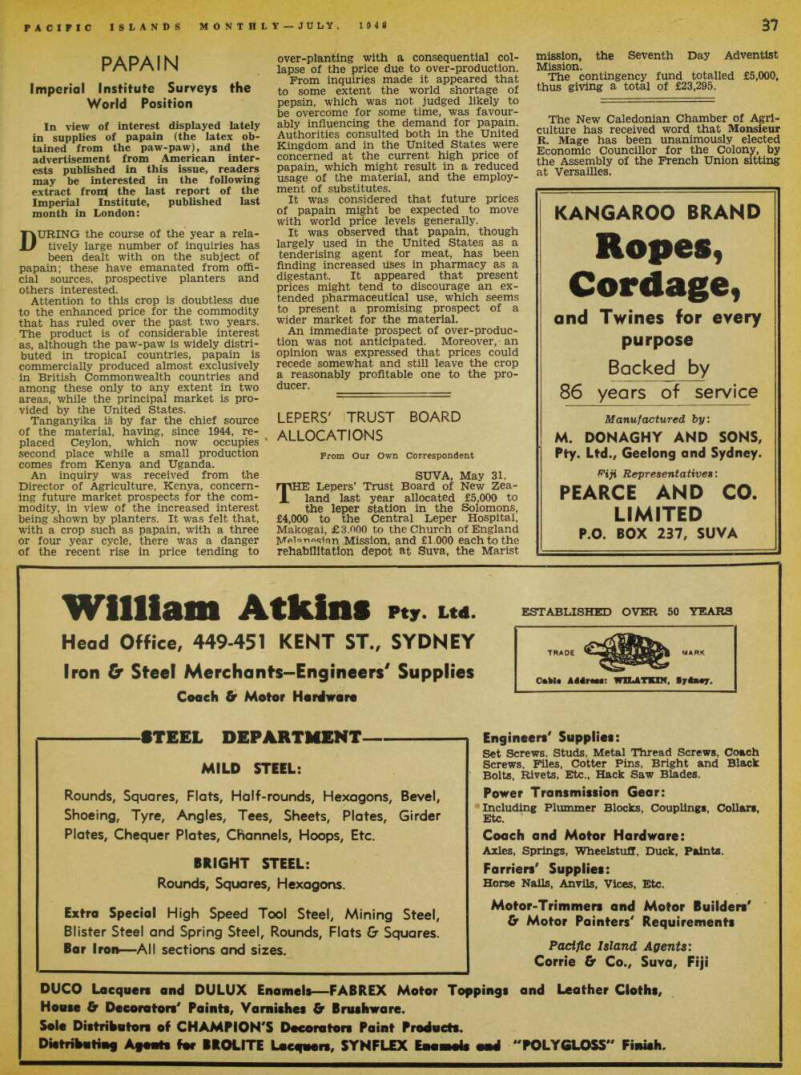
In view of interest displayed lately in supplies of papain (the latex ob tained from the paw-paw), and the advertisement from American inter ests published in this issue, readers may be interested in the following extract fron* the last report of the Imperial Institute, published last month in London: DURING the course of the year a rela tively large number of inquiries has been dealt with on the subject of papain; these have emanated from offi cial sources, prospective planters and others interested.
Attention to this crop is doubtless due to the enhanced price for the commodity that has ruled over the past two years.
The product is of considerable interest as, although the paw-paw is widely distri buted in tropical countries, papain is commercially produced almost exclusively in British Commonwealth countries and among these only to any extent in two areas, while the principal market is pro vided by the United States.
Tanganyika is by far the chief source of the material, having, since 1944, re placed Ceylon, which now occupies second place while a small production comes from Kenya and Uganda.
An inquiry was received from the Director of Agriculture, Kenya, concern ing future market prospects for the com modity, in view of the increased interest being shown by planters. It was felt that, with a crop such as papain, with a three or four year cycle, there was a danger of the recent rise in price tending to
over-planting with a consequential col lapse of the price due to over-production.
From inquiries made it appeared that to some extent the world shortage of pepsin, which was not judged likely to be overcome for some time, was favour ably influencing the demand for papain.
Authorities consulted both in the United Kingdom and in the United States were concerned at the current high price of papain, which might result in a reduced usage of the material, and the employ ment of substitutes.
It was considered that future prices of papain might be expected to move with world price levels generally.
It was observed that papain, though largely used in the United States as a tenderising agent for meat, has been finding increased uses in pharmacy as a digestant. It appeared that present prices might tend to discourage an ex tended pharmaceutical use, which seems to present a promising prospect of a wider market for the material.
An immediate prospect of over-produc tion was not anticipated. Moreover, an opinion was expressed that prices could recede somewhat and still leave the crop a reasonably profitable one to the pro ducer.