How "Yorky" Booth Was Treated by Officialdom
p. 48 · Read in the full issue
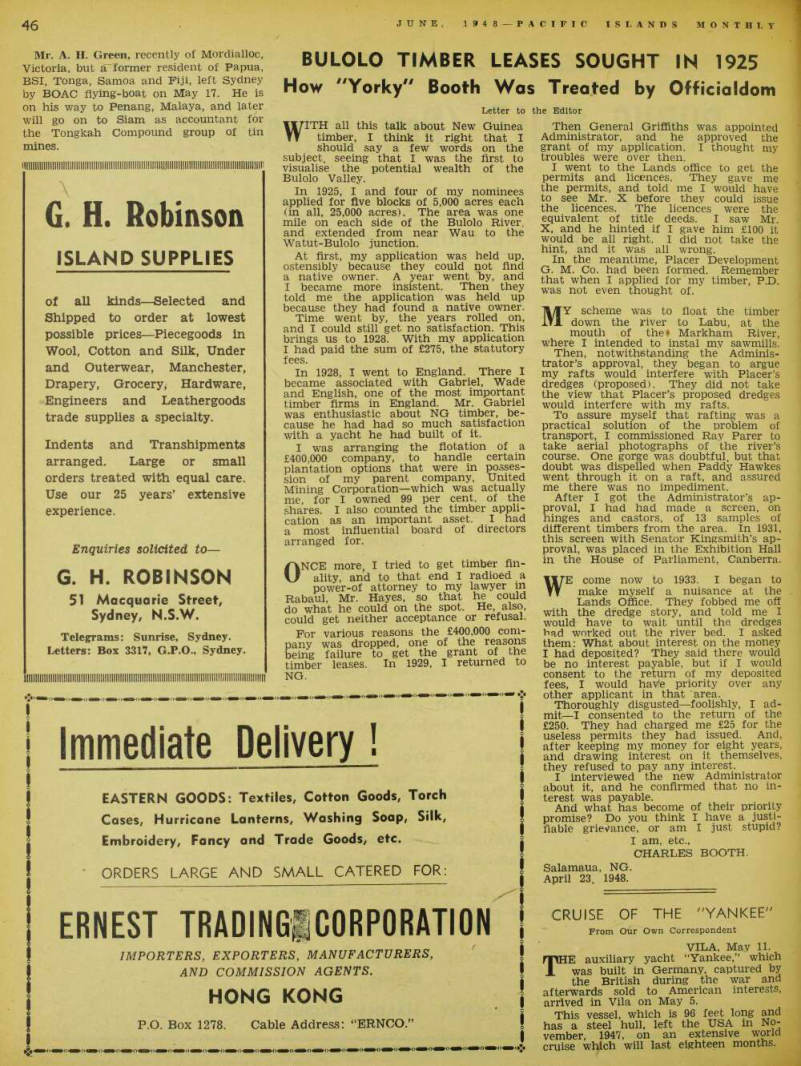
Bulolo Timber Leases Sought In 1925
Letter to the Editor
WITH all this talk about New Guinea timber, I think it right that I should say a few words on the subject, seeing that I was the first to visualise the potential wealth of the Bulolo Valley.
In 1925, I and four of my nominees applied for five blocks of 5,000 acres each (in all, 25,000 acres). The area was one mile on each side of the Bulolo River, and extended from near Wau to the Watut-Bulolo junction.
At first, my application was held up, ostensibly because they could not find a native owner. A year went by, and I became more insistent. Then they told me the application was held up because they had found a native owner.
Time went by, the years rolled on, and I could still get no satisfaction. This brings us to 1928. With my application I had paid the sum of £275, the statutory fees.
In 1928, I went to England. There I became associated with Gabriel, Wade and English, one of the most important timber firms in England. Mr. Gabriel was enthusiastic about NG timber, be cause he had had so much satisfaction with a yacht he had built of it.
I was arranging the flotation of a £400,000 company, to handle certain plantation options that were in posses sion of my parent company, United Mining Corporation—which was actually me, for I owned 99 per cent, of the shares. I also counted the timber appli cation as an important asset. I had a most influential board of directors arranged for.
ONCE more, I tried to get timber fin ality, and to that end I radioed a power-of attorney to my lawyer in Rabaul, Mr. Hayes, so that he could do what he could on the spot. He also, could get neither acceptance or refusal.
For various reasons the £400,000 com pany was dropped, one of the reasons being failure to get the grant of the timber leases. In 1929. I returned to NG.
Then General Griffiths was appointed Administrator, and he approved the grant of my application. I thought my troubles were over then.
I went to the Lands office to get the permits and licences. They gave me the permits, and told me I would have to see Mr. X before they could issue the licences. The licences were the equivalent of title deeds. I saw Mr.
X, and he hinted if I gave him £lOO it would be all right. I did not take the hint, and it was all wrong.
In the meantime, Placer Development G. M. Co. had been formed. Remember that when I applied for my timber, P.D. was not even thought of.
MY scheme was to float the timber down the river to Labu, at the mouth of the* Markham River, where I intended to instal my sawmills.
Then, notwithstanding the Adminis trator’s approval, they began to argue my rafts would interfere with Placer’s dredges (proposed). They did not take the view that Placer’s proposed dredges would interfere with my rafts.
To assure myself that rafting was a practical solution of the problem of transport, I commissioned Ray Parer to take aerial photographs of the river’s course. One gorge was doubtful, but that doubt was dispelled when Paddy Hawkes went through it on a raft, and assured me there was no impediment.
After I got the Administrator’s ap proval, I had had made a screen, on hinges and castors, of 13 samples of different timbers from the area. In 1931, this screen with Senator Kingsmith’s ap proval, was placed in the Exhibition Hall in the House of Parliament, Canberra.
WE come now to 1933. I began to make myself a nuisance at the Lands Office. They fobbed me off with the dredge story, and told me I would have to wait until the dredges had worked out the river bed. I asked them: What about interest on the money I had deposited? They said there would be no interest payable, but if I would consent to the return of my deposited fees, I would hav/e priority over any other applicant in that area.
Thoroughly disgusted—foolishly, I ad mit—l consented to the return of the £250. They had charged me £25 for the useless permits they had issued. And, after keeping my money for eight years, and drawing interest on it themselves, they refused to pay any interest.
I interviewed the new Administrator about it, and he confirmed that no in terest was payable.
And what has become of their priority promise? Do you think I have a justi fiable grievance, or am I just stupid?
I am, etc.,
Salamaua, NG.
April 23. 1948.