One Lone Czech
pp. 45-46 · Read in the full issue
Two German Warships
By James E. Carmack
IT was early on September 14. The day promised to be as any other— hot, numid, enervating, with perhaps a downpour or two to relieve the monotony. Soon we could expect the usual gathering of sick for its daily dose of quinine and tonic; there would be squirming youngsters to inject and malo derous ulcers to dress. After that the routine chores of the mission for the day.
I was shaving when it happened— shaving and thinking. World War II was 11 days old and our minds were still confused with the vagueness of our posi tion. A little news and a lot of ill-founded rumour had reached us by way of that remarkable medium of South Sea islands communication, the “coconut wireless,”
The source of our sensational war news will ever remain one of the mysteries of the local intelligence system, but it served to keep us on our toes during those early days of uncertainty.
The world pattern of war had not yet resolved itself clearly and we felt the insecurity of our isolated little Solomon Islands home. We knew of Hitler’s un provoked attack on Poland, of the bomb ing of defenceless cities, the slaughter of innocents; and news had reached us of the cowardly sinking of ocean liners with heavy loss of civilian life. The world was suffering the birth-pangs of total war.
These things I pondered as I shaved; and I felt a patriotic enthusiasm to do my part to help the cause of freedom and justice.
I awakened from my reverie to the realisation of excited voices approaching.
As the babble grew louder, the machine gun speed of native tongues and the high-pitched voices indicated an unusual state of agitation among the villagers.
My wife called from the kitchen that the entire village was there to see me and the folk were in a state of uproar. I had better come out and read the Riot Act.
I kept on shaving. There was another waggle of tongues and my wife came into the bathroom excitedly.
“We are in for it now,” she exclaimed.
“There are two German battleships lying off the island! What are you going to do about it?”
“I’m going to finish my shave!” But my heart missed a beat in spite of my gallant attempt at sang-froid. “Sounds interesting, doesn’t it! Anyway, how do they know they are German ships? Wow!
Just look at tnat —I’ve gashed my face.”
“Keep calm,” cautioned my wife as she returned to the babble outside, in a few moments she was back with the reassur ing news that it was only one battle ship, not two. However, I failed to see how the jeopardy of our position was altered for I felt as vulnerable to one enemy battle-ship as to two. it would not require the armed might of a floating fortress to apprehend a couple of de fenceless missionaries.
“r>UT, my dear, what makes the folk J 3 so sure that it is a German ship? hopefiUl™ ay °“ e ° £ OUrS '” 1 replled> “Just look at your face! You’ve cut it up like a piece of raw meat! Are vou scared? she asked quietly. j lst hurr y in g,” I responded, with doubtful conviction.
In a few moments I joined the folk outside. As they beheld me dabbing at my face wiuh a blood-spattered handker chief ! am sure they must have thought ?w n ?S ge 2 entire nlvy and that the battle was now over As it w* 1 "?? 581 ? 6 obtaln a coherent story from two hundred and fifty gibbering tongues I took the village chief aside How do you know it is a German ship? flag? ” 1 was determined to thrash that one out, for it seemed incomprehensible that a lot of primitive islanders would recognise the nationality of a v » ssel lymg off the coast. se- a’ the , chief ’ “ we did not German.” g Bt we know that it is a “Sn d guns on the vessel?”
No, we couldn t see any guns on it ” and my informant gave me a quee? look.
“Was it a large ship?” I asked.
‘‘Oh no, just a small one.” ■Old see °f men on the ship?”
“No, not lots. There is only one man in it. You know, that German spy.”
“What, a man-o-war with ?nly one man in it?” I asked,
incredulously.
Oh, it’s not a man-o-war, it s a canoe,” confessed the bewildered chief. “We are sure it’s that German spy.”
“Just a canoe!” I had an oddly mixed feeling of relief and chagrin. “Then why all the fuss and excitement?
What has bitten everyone?
The whole village is here, old and young, men and women, even sick and infirm are here acting as though the end of the world has come. Why all this fuss about one man in a canoe?”
“But don’t you understand, Master?” He was amazed at my stupidity. “He is a Ger man spy and there is a war on. We are afraid. We do not know what he will do to us.”
“Coconut wireless” had it that a Ger man spy had been seen making his way down the coast of Bougainville and across to Choiseul, mapping coast lines, cnarting harbours, villages, watering places, etc.
We had heard this before war was de clared. And now, it seemed, he had come to Ranonga.
“And wnere is he now?” I asked quickly.
“He came across from Vella Lavella this morning and is now making along the coast in the direction of Buri Har bour, and he should be tnere soon.” The chief seemed anxious that I do something.
Had tne hour arrived for me to show my patriotism? He would, most likely, be armed, but we could at least have a look at nim and perhaps detain him while a messenger went off to Gizo to bring the District Officer and a squad of native constables.
On calling for a couple of volunteers to accompany me on the hazardous un dertaking I was overwhelmed with an eager response from all the men present.
I chose two sturdy young men wno im mediately gave a blood-curdling whoop and ran for my private canoe.
Ten dinutes’ brisk paddling brought us to the harbour mouth, just as the object of our quest hove’ into view.
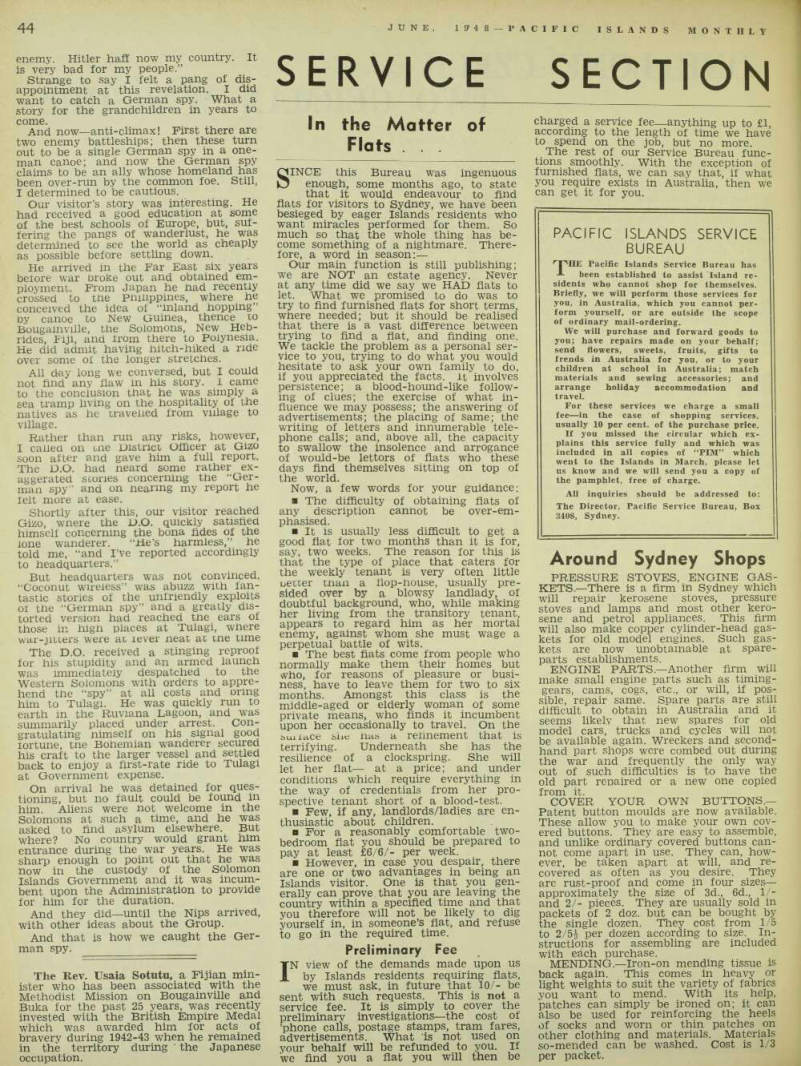
It was certainly no battleship that we saw rounding yonder point. Instead, we beheld a small white canoe with out riggers on both sides, and with the stem and stern divided into watertight com partments, leaving a cockpit amidships just large enough for one man. A short mast, rigged forward, added to the strange appearance of the unusual craft, which soon became a curiosity in those waters where the canoes are built without outriggers at all.
As our canoes converged I made out a pair of naked sun-tanned shoulders surmounted by a large, square-shaped head, with a shock of flaxen hair, a pair of double-thickness spectacles added to the Teutonic appearance.
I was still pondering my studied little speech of introduction when a pleasant gutteral voice greeted us across the water with: “Goot morning, andt vere are you koing?”
“Oh-er-good morning, and where are you going?” came the weak response from somewhere in our canoe.
“Veil, I look at von redt roof up on yonder hill andt I know straight avay dot somevone do liff dere. I ko to see, yes.”
“That is our mission station,” i replied.
“You had better come with me and have something to eat.”
“I am delighted for from four o’clock dis morning I vork hardt to pull my canoe and the vindt it did not come andt my sail it is off no use.”
IN half an hour our German spy was seated with us at the breakfast table doing hearty justice to the repast.
We found him to be pleasant, courteous, and an excellent conversationalist. He noticed the wireless and asked eagerly for war news. He had called at a planter’s home on Vella Lavella and had been given hasty exit.
“And what part of Germany do you come from?” I asked bluntly.
“Oh, I’m not a Sherman!” he ex claimed, disgustedly, “I kome from Czechoslovakia, yes. My name is Rudolf Cikanek. Mv home it is in Bohemia and the Shermans are my
Rudolf Cikanek and the 12 ft. canoe he paddled around the Pacific.
enemy. Hitler haff now my country. It is very bad for my people.”
Strange to say I felt a pang of dis appointment at this revelation. I did want to catch a German spy. What a story for the grandchildren in years to come.
And now—anti-climax! First there are two enemy battleships; then these turn out to be a single German spy in a one man canoe; and now the German spy claims to be an ally whose homeland has been over-run by the common foe. Still, I determined to be cautious.
Our visitor’s story was interesting. He had received a good education at some of the best schools of Europe, but, suf fering the pangs of wanderlust, he was determined to see the world as cheaply as possible before settling down.
He arrived in the Far East six years belore war broke out and obtained em ployment. From Japan he had recently crossed to the Pfiifippines, where he conceived the idea of “inland hopping” by canoe to New Guinea, thence io Bougainville, the Solomons, New Heb rides, Fiji, and from there to Polynesia.
He did admit having hitch-hiked a ride over some of the longer stretches.
All day long we conversed, but I could not find any flaw in his story. 1 came to the conclusion that he was simply a sea tramp living on the hospitality of the natives as he travelled from village to village.
Rather than run any risks, however, I called on tne District Officer at Gizo soon after and gave him a full report.
The D.O. had neard some rather ex aggerated scones concerning the “Ger man spy” and on nearing my report he felt more at ease.
Shortly after this, our visitor reached Gizo, wnere the D.O. quickly satisfied himself concerning the bona fides of the lone wanderer. “He’s harmless,” he told me, “and I’ve reported accordingly
to headquarters.”
But headquarters was not convinced.
“Coconut wireless” was abuzz with fan tastic stories of the unfriendly exploits of the "German spy” and a greatly dis torted version had reached tne ears of those in hign places at Tulagi, wnere war-jliters were ac lever neat at cne time The D.O. received a stinging reproof for his stupidity and an armed launch was immediately despatched to the Western Solomons with orders to appre hend the “spy” at all costs and ormg him to Tulagi. He was quickly run to earth in the Ruviana Lagoon, and was summarily placed under arrest. Con gratulating nimself on his signal good lortune, tne Bohemian wanderer secured his craft to the larger vessel and settled back to enjoy a first-rate ride to Tulagi at Government expense.
On arrival he was detained for ques tioning, but no fault could be found in him. Aliens were not welcome in the Solomons at such a time, and he was asked to find asylum elsewhere. But where? No country would grant him entrance during the war years. He was sharp enough to point out that he was now in the custody of the Solomon Islands Government and it was incum bent upon the Administration to provide for him for the duration.
And they did—until the Nips arrived, with other ideas about the Group.
And that is how we caught the Ger man spy.
The Rev. Usaia Sotutu, a Fijian min ister who has been associated with the Methodist Mission on Bougainville and Buka for the past 25 years, was recently invested with the British Empire Medal which was awarded him for acts of bravery during 1942-43 when he remained in the territory during * the Japanese occupation.