Japanese Goods Soon?
p. 34 · Read in the full issue
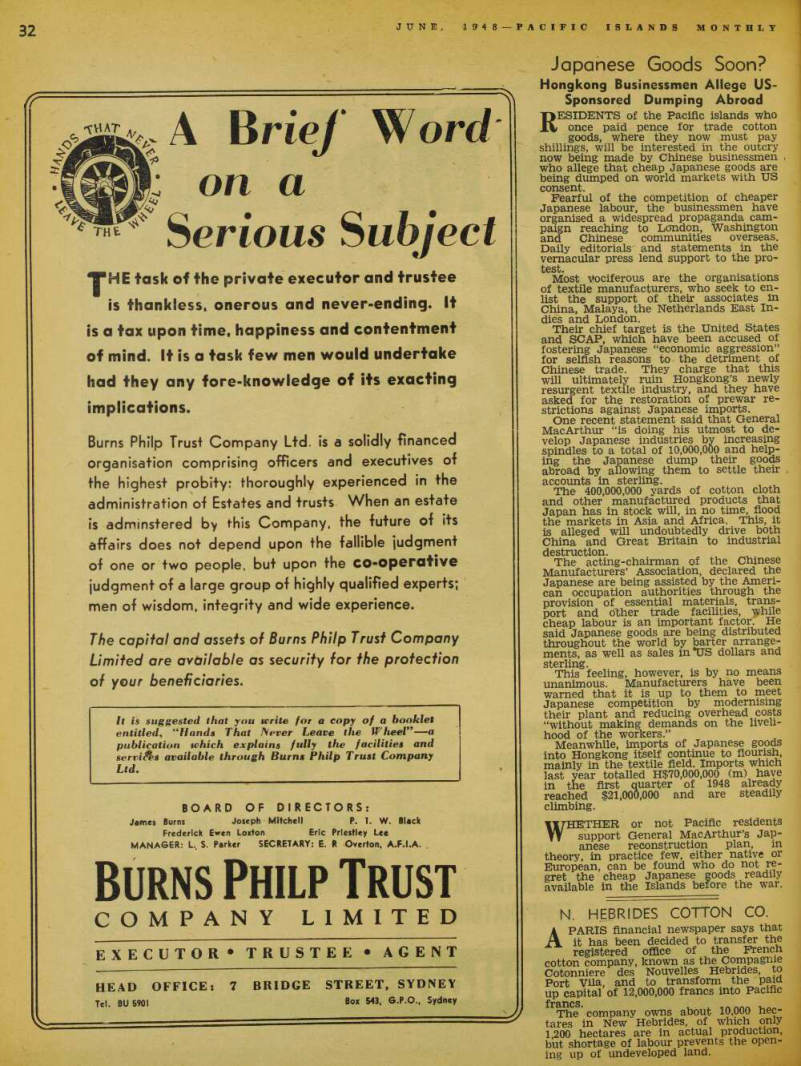
Hongkong Businessmen Allege US- Sponsored Dumping Abroad
RESIDENTS of the Pacific islands who once paid pence for trade cotton goods, where they now must pay shillings, will be interested in the outcry now being made by Chinese businessmen who allege that cheap Japanese goods are being dumped on world markets with US consent.
Fearful of the competition of cheaper Japanese labour, the businessmen have organised a widespread propaganda cam paign reaching to London, Washington and Chinese communities overseas.
Daily editorials and statements in the vernacular press lend support to the pro test.
Most vociferous are the organisations of textile manufacturers, who seek to en list the support of their associates in China, Malaya, the Netherlands East In dies and London.
Their chief target is the United States and SCAP, which have been accused of fostering Japanese “economic aggression” for selfish reasons to the detriment of Chinese trade. They charge that this will ultimately ruin Hongkong’s newly resurgent textile industry, and they have asked for the restoration of prewar re strictions against Japanese imports.
One recent statement said that General MacArthur “is doing his utmost to de velop Japanese industries by increasing spindles to a total of 10,000,000 and help ing the Japanese dump their goods abroad by allowing them to settle their accounts in sterling.
The 400,000,000 yards of cotton cloth and other manufactured products that Japan has in stock will, in no time, flood the markets in Asia and Africa. This, it is alleged will undoubtedly drive both China and Great Britain to industrial destruction. „ The acting-chairman of the Chinese Manufacturers’ Association, declared the Japanese are being assisted by the Ameri can occupation authorities through the provision of essential materials, trans port and other trade facilities, while cheap labour is an important factor. He said Japanese goods are being distributed throughout the world by barter arrange ments, as well as sales in*US dollars and sterling.
This feeling, however, is by no means unanimous. Manufacturers have been warned that it is up to them to meet Japanese competition by modernising their plant and reducing overhead costs “without making demands on the liveli hood of the workers.”
Meanwhile, imports of Japanese goods into Hongkong itself continue to flourish, mainly in the textile field. Imports which last year totalled H 570,000,000 (m) have in the first quarter of 1948 already reached $21,000,000 and are steadily climbing.
WHETHER or not Pacific residents support General Mac Arthur’s Jap anese reconstruction plan, in theory, in practice few, either native or European, can be found who do not re gret the cheap Japanese goods readily available in the Islands before the war.