TOA Fiying-Boat
pp. 28-29 · Read in the full issue
Passengers in Fiji Praise for Antilles Crew
From Our Own Correspondent
Suva, May 11.
AN adventure, but, at times, rather too much of a good thing, was the im pression which passengers in the Trans-Oceanic Airways Sunderland fly ing-boat “Antilles” gave when they ar rived at Laucala Bay, Fiji, on May 8 after an eventful flight from Tahiti by way of Samoa.
The general manager of the airline (Mr. B. W. Monkton), who was piloting the plane on the trip from Papeete to Apia, said that trouble occurred first in one engine, but the plane was able to continue quite comfortably on the re maining three. A second engine, how ever, showed signs of giving trouble and he decided to alight on the water near Tau Island, 75 miles from Pago Pago and 150 miles from the seaplane base near Ania. rather than cross the long ocean stretch to Western Samoa.
The passengers were landed on Tau in a longboat and after a stiff climb reached the house of the only Europeans at the island, Mr. and Mrs. Anderson.
Mr. Anderson is a former pharmacist’s mate in the United States Navy.
They were hospitably welcomed and next morning set off for Apia in an American patrol boat which had been sent from Pago Pago.
The American vessel stopped about eignt miles shore of the Upolu coast near .Apia, and the passengers again trans ferred to a launch, which towed a dinghy for the luggage, and ultimately arrived at Apia alter midnight.
The High Commissioner for Western Samoa (Lieutenant-Colonel F. W.
Voelcker) who was one of the passengers, provided accommodation at his official residence, Vailima, for the whole party.
In the meantime the flying-boat had been repaired at Tau, and next day it arrived in Apia, leaving for Suva on the following day. mHE passengers all gave the highest praise to Mr. Monkton’s skilful handling of the plane and said that complete confidence in the crew resulted in the absence of any suggestion of panic in the plane at any time.
The Sunderland’s flight to Tahiti was made primarily (as reported in the April “PIM”) to pick up a London Film unit of Sir Alexander Korda’s organisation which had been in Tahiti for a month making preliminary investigations for the filming in colour of Pierre Loti’s “Mar riage of Loti.”
There seems to have been a hold-up due to the fact that it has been impos sible to arrange for the exposed negative to be sent to California at regular inter vals—and colour film, it is said, has to be processed within 14 days.
This, incidentally, was one reason why the “Blue Lagoon” people worked in the Yasawa Group of Fiji. It was within fairly easy reach of Nadi airport and pro gress reports on the processed film from London were received throughout the unit’s stay in the islands. (See Photo., next Page.) The “Sagittaire,” which reached Papeete on April 23. landed 100 soldiers from Prance to reinforce the local garrison The move was considered necessary by the need to maintain order following recent incidents.
The Government in New Caledonia has increased the tax on those employing immigrant workers from 10 to 25 francs per month per head. The increase is due to the deficit amounting to 1,007,495 francs in the operation of the Colony’s Immigration Dept.
Madame Veuve Rose, who was born Marea Richmond, and who was well known and highly respected in Tahiti, died at her home in Papeete, in March, at the age of 91. Her grand-daughter is Mrs. Norman Hall, wife of the famous American writer.
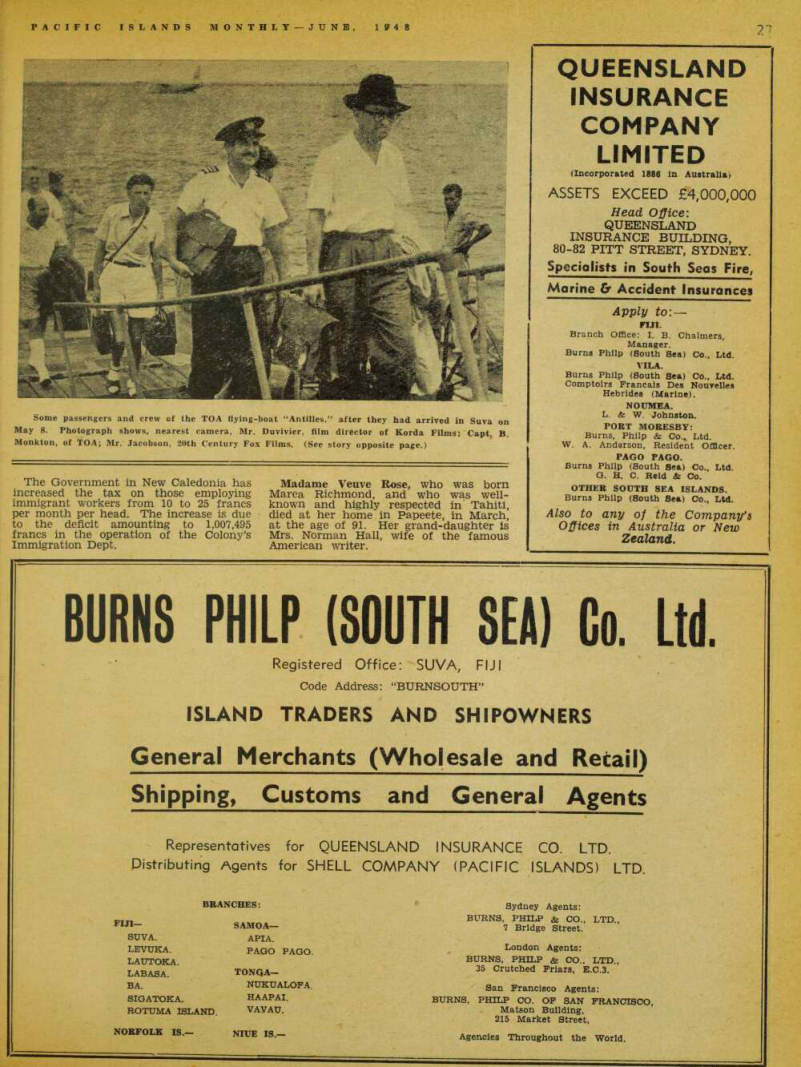
Some passengers and crew of the TOA flying-boat “Antilles,” after they had arrived in Suva on May 8. Photograph shows, nearest camera, Mr. Duvivier, film director of Korda Films; Capt. B.
Monkton, of TOA; Mr. Jacobson, 20th Century Fox Films. (See story opposite page.)