Oil Soon From Dutch New Guinea
p. 12 · Read in the full issue
Important New Industry to be Established
IT was announced in Batavia, NEI, on May 31, that it was expected that the New Guinea Petroleum Company would begin oil production in Dutch New Guinea next year.
The New Guinea Petroleum Co., was formed in 1934. It represents the Stan dard Oil Company, the Shell Company and the Atlantic Oil Company. It is therefore Dutch, British and American owned. In October, 1934, it was given a 75-years concession over the Vogelkop Peninsula, and it commenced immedi ately an intensive search for oil, using modern aid, including amphibious planes.
The area in which production will be gin is the extreme western tip of the Vogelkop Peninsula —that is, as far away as it is possible to be from the areas in which oil prospecting has been carried on in the Australian-New Guinea ter ritories.
It is encouraging, however, to know that oil in commercial quantities has been discovered in the great island of New Guinea and there is a reasonable hope that it will eventually be dis covered on the Australian side of the border.
Australian companies have been searching for oil, both in Papua and New Guinea, for the past 12 years. Oil Search Ltd., made extensive explorations in the Aitape-Torricelli area, and as far west as the Dutch border, from the mid
thirties right up until the Japanese in vasion. This work, which was finally in terrupted by enemy occupation of North ern New Guinea, has not been resumed since the war.
However, oil exploration work was re sumed after the war in western Papua, under the direction of the Australian Petroleum Co., Ltd. Drilling on the ex ploratory bore at Kariava, Papua, finally ceased on March 25, 1948, after it had reached a depth of almost 2 h miles. The company is now preparing to put down three other bores in Papua, at Hohoro, Upoia and Oroi.
THE importance of finding oil in New Guinea —Dutch or Australian —cannot be over-emphasised. Austra lasia and the South Pacific cannot any longer look with confidence to the USA or Mexico for supplies as supplies from those countries can be used in the Americas. Nor, while the present unrest exists in the Middle Eastern countries, can we hope to receive much oil from that quarter. At present, our only sure sources of supply are the Persian Gulf, Borneo and Sumatra.
The Dutch, in the Netherlands Indies, are doing all they can to get their oil industry back to its pre-war efficiency, after the fearful hiding it took during and immediately prior to the Japanese occupation. Reconstruction has been de layed by political unrest in the NEI, and
has not been helped by the Australian Government which permitted its wharfies to ban Dutch shipping from Australian ports. This ban has now been lifted and Australian manufacturers are graci ously permitted to supply the Indies with manufactured goods. Whether or not the NEI are still interested remains to be seen.
THE New Guinea Petroleum Company, which has had, it is believed, the assistance of the Dutch Govern ment, has had between 6,000 and 8,000 labourers and 300 Europeans employed at its bases at Sorong, Steenkool and Klamono. Four tanks, each of 5,000 tons capacity, will be built immediately to store crude oil for shipment.
It has been rumoured for years that oil in commercial volume had been dis covered in Dutch New Guinea and that the companies concerned could bring in new wells, whenever they wanted.
It is disappointing that no oil has been discovered in the Australian half of New Guinea which would, with the exception of North Borneo, be the only major oil field in the world on exclusively British territory. Nonetheless, oil production in Dutch New Guinea will be a step nearer that goal—and the nearer the oil field is to Australia and New Zealand at the present time, the more chances we have of getting supplies of this vital com modity.
A daughter was born on June 2, in Adelaide, South Australia, to Mrs. Ann Deland, wife of Dr. C. M. Deland of New Guinea.
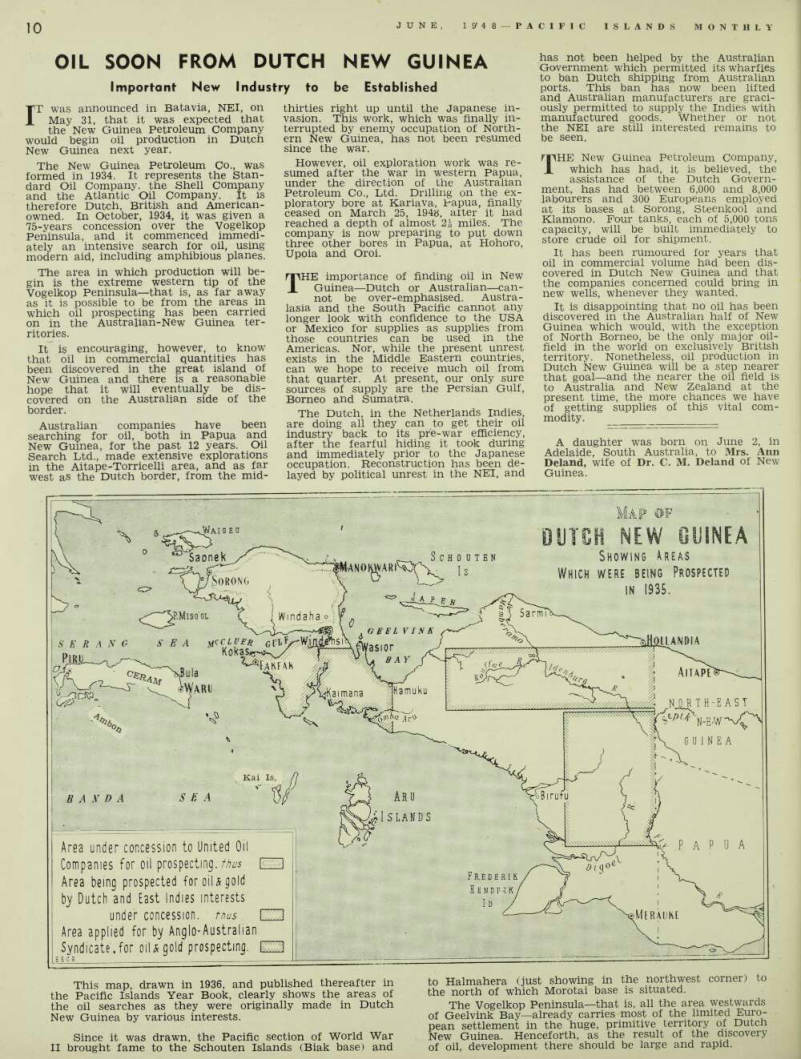
This map, drawn in 1936, and published thereafter in the Pacific Islands Year Book, clearly shows the areas of the oil searches as they were originally made in Dutch New Guinea by various interests.
Since it was drawn, the Pacific section of World War II brought fame to the Schouten Islands (Biak base) and
to Halmahera (just showing in the northwest corner) to the north of which Morotai base is situated.
The Vogelkop Peninsula—that is, all the area westwards of Geelvink Bay—already carries most of the limited Euro pean settlement in the huge, primitive territory of Dutch New Guinea. Henceforth, as the result of the discovery of oil, development there should be large and rapid.