Book Review
p. 47 · Read in the full issue
They Lived in Tahiti
READERS will probably remember the story (published during the war years in “PIM,” and later reprinted in “Where the Trade Winds Blow”) of how Mr. Eastham Guild introduced birds to birdless Tahiti.
If that story interested them, they will find added entertainment in the book, just published, by Caroline Guild (not pronounced in the British fashion, Guild, as in gilding the lily; but, according to Boston, Mass., as Guild, to rhyme with child), which gives full details of their many other hobbies globe-trotting, house-building, chicken raising, the tam ing of tropical plants for garden use; sailing; big game fishing.
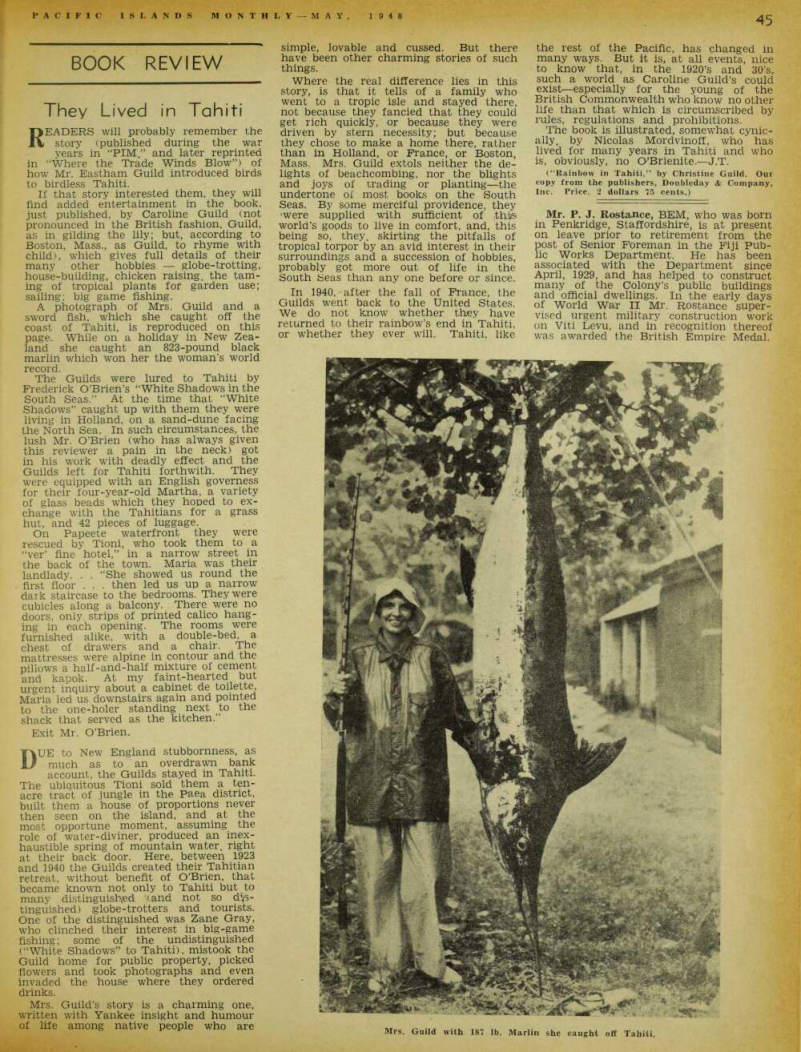
A photograph of Mrs. Guild and a sword fish, which she caught off the coast of Tahiti, is reproduced on this page. While on a holiday in New Zea land she caught an 823-pound black marlin which won her the woman’s world record.
The Guilds were lured to Tahiti by Frederick O’Brien’s “White Shadows in the South Seas.” At the time that “White Shadows” caught up with them they were living in Holland, on a sand-dune facing the North Sea. In such circumstances, the lush Mr. O’Brien (who has always given this reviewer a pain in the neck) got in his work with deadly effect and the Guilds left for Tahiti forthwith. They were equipped with an English governess for their four-year-old Martha, a variety of glass beads which they hoped to ex change with the Tahitians for a grass hut, and 42 pieces of luggage.
On Papeete waterfront they were rescued by Tioni, who took them to a “ver’ fine hotel,” in a narrow street in the back of the town. Maria was their landlady. . . “She showed us round the first floor . . . then led us up a narrow dark staircase to the bedrooms. They were cubicles along a balcony. There were no doors, only strips of printed calico hang ing in each opening. The rooms were furnished alike, with a double-bed, a chest of drawers and a chair. The mattresses were alpine in contour and the pillows a half-and-half mixture of cement and kapok. At my faint-hearted but urgent inquiry about a cabinet de toilette, Maria led us downstairs again and pointed to the one-holer standing next to the shack that served as the kitchen.”
Exit Mr. O’Brien.
DUE to New England stubbornness, as much as to an overdrawn bank account, the Guilds stayed in Tahiti.
The übiquitous Tioni sold them a ten acre tract of jungle in the Paea district, built them a house of proportions never then seen on the island, and at the most opportune moment, assuming the role of water-diviner, produced an inex haustible spring of mountain water, right at their back door. Here, between 1923 and 1940 the Guilds created their Tahitian retreat, without benefit of O’Brien, that became known not only to Tahiti but to many distinguished '(and not so dis tinguished) globe-trotters and tourists.
One of the distinguished was Zane Gray, who clinched their interest in big-game fishing; some of the undistinguished (“White Shadows” to Tahiti), mistook the Guild home for public property, picked flowers and took photographs and even invaded the house where they ordered drinks.
Mrs. Guild’s story is a charming one, written with Yankee insight and humour of life among native people who are
simple, lovable and cussed. But there have been other charming stories of such things.
Where the real difference lies in this story, is that it tells of a family who went to a tropic isle and stayed there, not because they fancied that they could get rich quickly, or because they were driven by stern necessity; but because they chose to make a home there, rather than in Holland, or France, or Boston, Mass. Mrs. Guild extols neither the de lights of beachcombing, nor the blights and joys of trading or planting—the undertone of most books on the South Seas. By some merciful providence, they ‘were supplied with sufficient of ithio world’s goods to live in comfort, and, this being so, they, skirting the pitfalls of tropical torpor by an avid interest in their surroundings and a succession of hobbies, probably got more out of life in the South Seas than any one before or since.
In 1940, after the fall of France, the Guilds went back to the United States.
We do not know whether they have returned to their rainbow’s end in Tahiti, or whether they ever will. Tahiti, like
the rest of the Pacific, has changed in many ways. But it is, at all events, nice to know that, in the 1920’s and 30's, such a world as Caroline Guild’s could exist—especially for the young of the British Commonwealth who know no other life than that which is circumscribed by rules, regulations and prohibitions.
The book is illustrated, somewhat cynic ally, by Nicolas Mordvinofi. who has lived for many years in Tahiti and who is, obviously, no O’Brienite. —J.T. (“Rainbow in Tahiti,” by Christine Guild. Our copy from the publishers, Doubleday & Company, Inc. Price, 2 dollars 75 cents.) Mr. P. J. Rostance, BEM, who was born in Penkridge, Staffordshire, is at present on leave prior to retirement from the post of Senior Foreman in the Fiji Pub lic Works Department. He has been associated with the Department since April, 1929, and has helped to construct many of the Colony’s public buildings and official dwellings. In the early days of World War II Mr. Rostance super vised urgent military construction work on Viti Levu, and in recognition thereof was awarded the British Empire Medal.
Mrs. Guild with 187 1b. Marlin she caught off Tahiti.