Tropicalities
p. 46 · Read in the full issue
MONSIEUR V. VERLAET, trader, of Aleipata, Western Samoa, was in Sydney in April. He had just re turned from Europe on the “Orion.”
Monsieur Verlaet, who is a Belgian and has been visiting his brothers in Ant werp, described himself to newspaper re porters as being frightened of civilisation, terrified of cars and hating noises. He said he had exiled himself on a lonely reef in Western Samoa for the past 40 years, where there are none of these things. He wanted to get back there as soon as possible and had no intention of remaining in Sydney (which has noise, cars and “civilisation” in abundance) any longer than necessary. * * * l]mTH imported grocery lines going-up ff in nrice a little higher each season, it behoves the Islands dweller to seek as many local substitutes as he can devise.
Excellent vinegar may be made from “slushy” bananas, at a cost of perhaps a penny a Dint!
You take a clean fifty-pound flour-bag, fill it with over-ripe bananas (the “red” variety is not of anv use) and then hang the bag, up by one corner on a hook.
Beneath the lowest corner of the bag you place a jar. After a time, the bag begins to “drip” at the lowest corner, and the drip falls into the jar. When full, empty into a larger container and cover lightly. Repeat when jar fllls-up again! (A few cokes will assist the fermentation of the slush in the bag.) In due time, you have the large jar full of a liquid resembling sour wine. A little “professional” vinegar mav now be added, and the product, covered over and left to work.
During the working process the brew needs to be strained and decanted a num ber of times; a second large jar is use ful then. At the final stage, which takes a couple of weeks or more, a pure food acid, of the “acetic” persuasion, is found to have replaced the banana-juice you started out with. This is as pure a vine gar as you could buy; it has been made with tropical fruit, at an immense saving in cost;'and, in use, is superior to the bottled, dilute acetic acid that is occa sionally available in the store.
Admittedly, it is a horribly sticky job; and the pulp in the bag is revolting to behold. But look at the saving !—E.G. * * * THE “Tiare Taporo,” well known trad ing schooner of Rarotonga, was leav ing on her last group trip of the year and the usual round of farewells
saw several of us soon viewing the world through rosy spectacles. Later that evening, however, with the schooner punching into a nasty sea, things were not so good, and the passengers were a most subdued company.
We were a full ship, with the overflow bedded down on settees in the main cabin.
But one of our number, an old ex-Army Major, was fortunate enough to have a berth in the trade-room, just forrard of the main cabin. Sometime in the early hours of the morning, the old Major, who was feeling very bad, decided that he must have a drink of water, and he started off to navigate his way aft, through our main cabin, to the bath room.
With the schooner rolling madly and with odd luggage and bits and pieces careering haphazardly across the cabin floor in the darkness, this took a bit of doing, and the Major’s temper became frayed. However, he was determined to have that drink and kept repeating, “Water! Water —I must have water!”
Suddenly out of a dim, dark corner of the cabin came another voice: “For Heaven’s sake shut up and go back to bed. We don’t want water —we want dry land!” * * * ANIGHT or two later the old Major again gave us a laugh. He suffered from a weak heart, and the unaccus tomed motion of the schooner was ap parently affecting him. He had been allocated a bottom berth, with the top berth occupied by a Reverend Father on transfer to another island. As the sea got rougher, Major lay in his bunk with his hand on his heart groaning away.
“Jesus, Jesus!” he said.
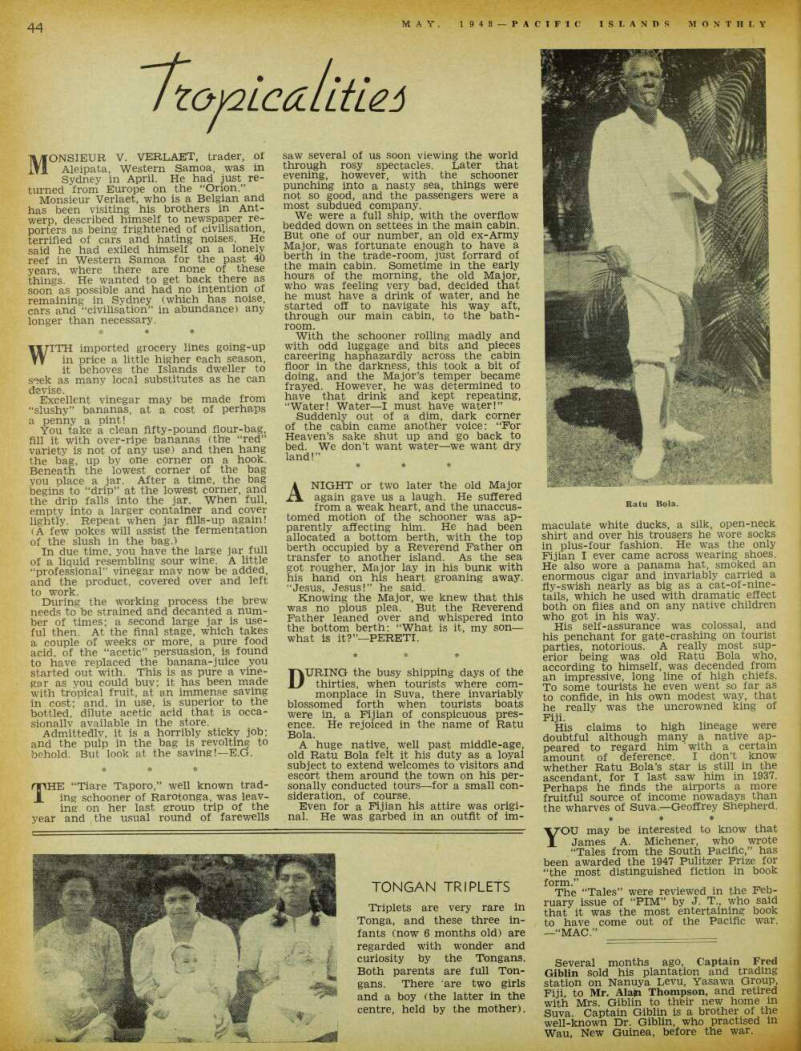
Knowing the Major, we knew that this was no pious plea. But the Reverend Father leaned over and whispered into the bottom berth; “What is it, my son— what is it?”—PERETI. * * * DURING the busy Shipping days of the thirties, when tourists where com monplace in Suva, there invariably blossomed forth when tourists boats were in, a Fijian of conspicuous pres ence. He rejoiced in the name of Ratu Bola.
A huge native, well past middle-age, old Ratu Bola felt it his duty as a loyal subject to extend welcomes to visitors and escort them around the town on his per sonally conducted tours—for a small con sideration, of course.
Even for a Fijian his attire was origi nal. He was garbed in an outfit of im-
maculate white ducks, a silk, open-neck shirt and over his trousers he wore socks in plus-four fashion. He was the only Fijian I ever came across wearing shoes.
He also wore a panama hat, smoked an enormous cigar and invariably carried a fly-swish nearly as big as a cat-of-nine tails, which he used with dramatic effect both on flies and on any native children who got in his way.
His self-assurance was colossal, and his penchant for gate-crashing on tourist parties, notorious. A really most sup erior being was old Ratu Bola who, according to himself, was decended from an impressive, long line of high chiefs.
To some tourists he even went so far as to confide, in his own modest way, that he really was the uncrowned king of Fiji.
His claims to high lineage were doubtful although many a native ap peared to regard him ‘with a certain amount of deference. I don’t know whether Ratu Bola’s star is still in the ascendant, for I last saw him in 1937.
Perhaps he finds the airports a more fruitful source of income nowadays than the wharves of Suva.—Geoffrey Shepherd. * * * YOU may be interested to know that James A. Michener, who wrote “Tales from the South Pacific,” has been awarded the 1947 Pulitzer Prize for “the most distinguished fiction in book form.”
The “Tales” were reviewed in the Feb ruary issue of “PIM” by J. T., who said that it was the most entertaining book to have come out of the Pacific war.
—“Mac.”
Several months ago, Captain Fred Giblin sold his plantation and trading station on Nanuya Levu, Yasawa Group, Fiji, to Mr. Alafci Thompson, and retired with Mrs. Giblin to thfeir new home m Suva. Captain Giblin is a brother of the well-known Dr. Giblin, who practised in Wau, New Guinea, before the war.
Ratu Bola.
Tongan Triplets
Triplets are very rare in Tonga, and these three in fants (now 6 months old) are regarded with wonder and curiosity by the Tongans.
Both parents are full Ton gans. There are two girls and a boy (the latter in the centre, held by the mother).