Hurricane of
pp. 44-46 · Read in the full issue
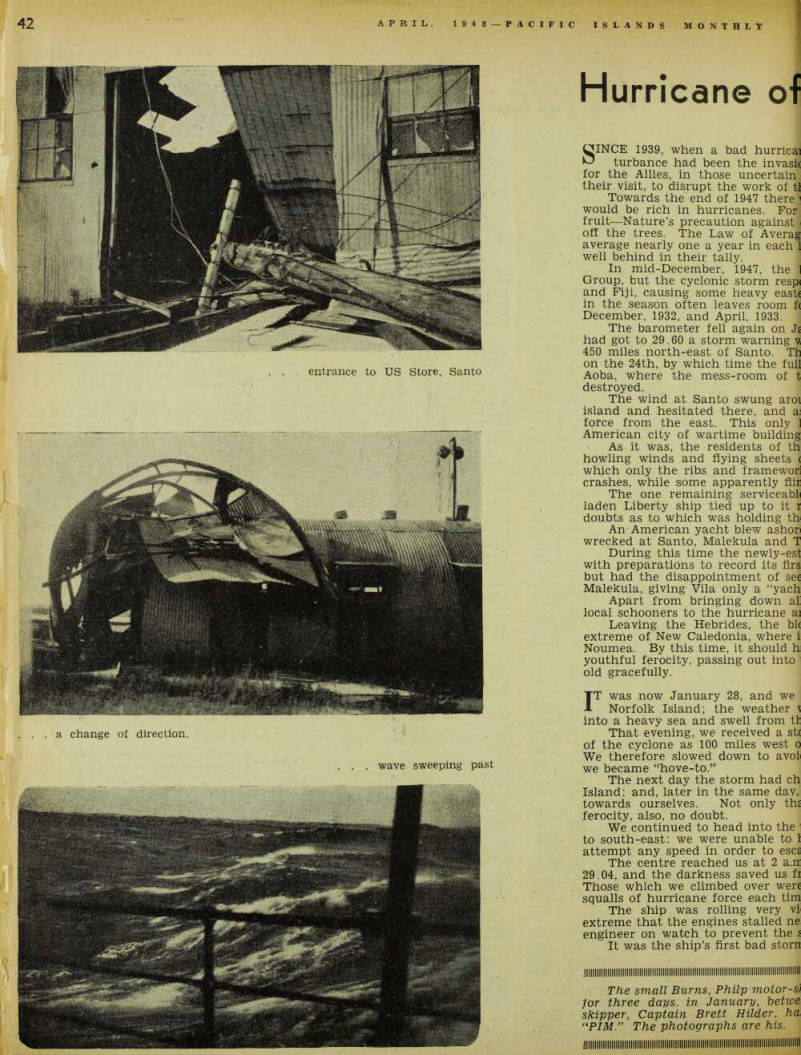
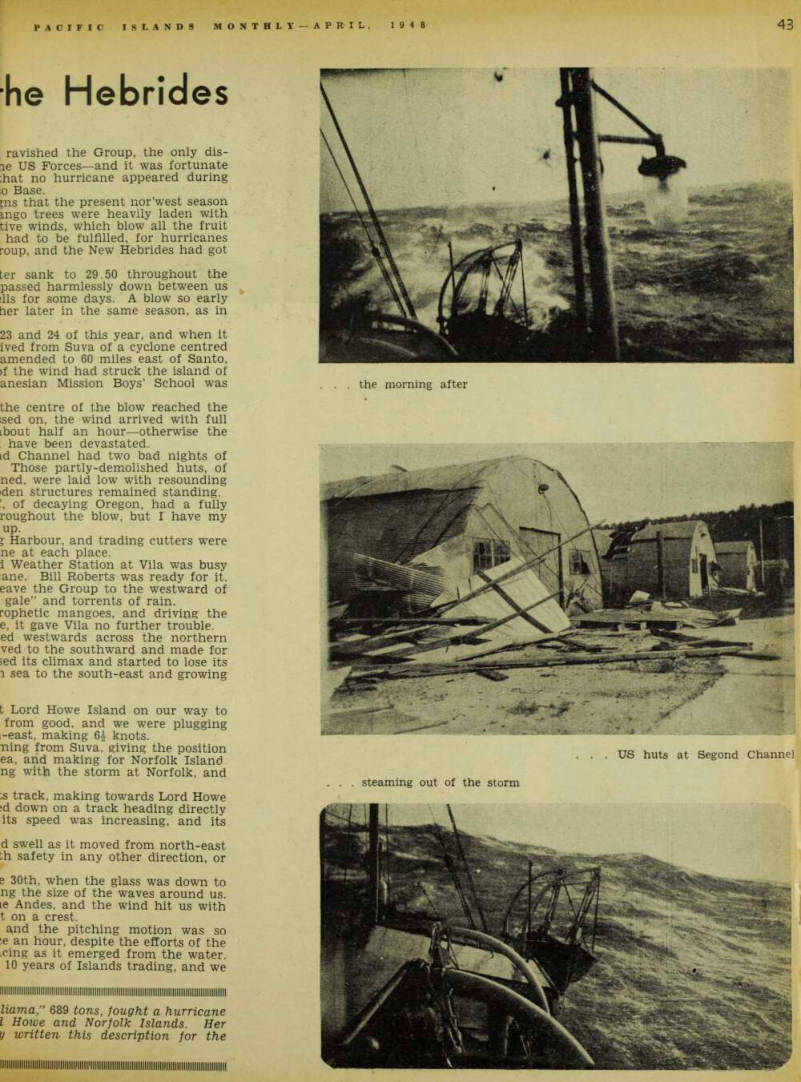
SINCE 1939, when a bad hurricai turbance had been the invasic for the Allies, in those uncertain their visit, to disrupt the work of tl Towards the end of 1947 there i would be rich in hurricanes. For fruit—Nature’s precaution against \ off the trees. The Law of Averag average nearly one a year in each 1 well behind in their tally.
In mid-December, 1947, the 1 Group, but the cyclonic storm resp< and Fiji, causing some heavy easte in the season often leaves room ft December, 1932, and April, 1933.
The barometer fell again on Ji had got to 29.60 a storm warning v 450 miles north-east of Santo. Th on the 24th, by which time the full Aoba, where the mess-room of t destroyed.
The wind at Santo swung aroi island and hesitated there, and a; force from the east. This only 1 American city of wartime building As it was, the residents of th howling winds and flying sheets ( which only the ribs and frameworl crashes, while some apparently flir The one remaining serviceabk laden Liberty ship tied up to it r doubts as to which was holding th An American yacht blew ashon wrecked at Santo, Malekula and T During this time the newly-est with preparations to record its firs but had the disappointment of see Malekula, giving Vila only a “yach Apart from bringing down all local schooners to the hurricane ai Leaving the Hebrides, the blc extreme of New Caledonia, where i Noumea. By this time, it should hi youthful ferocity, passing out into old gracefully.
IT was now January 28, and we Norfolk Island; the weather \ into a heavy sea and swell from tb That evening, we received a stc of the cyclone as 100 miles west o We therefore slowed down to avob we became “hove-to.”
The next day the storm had ch Island: and, later in the same day, towards ourselves. Not only tha ferocity, also, no doubt.
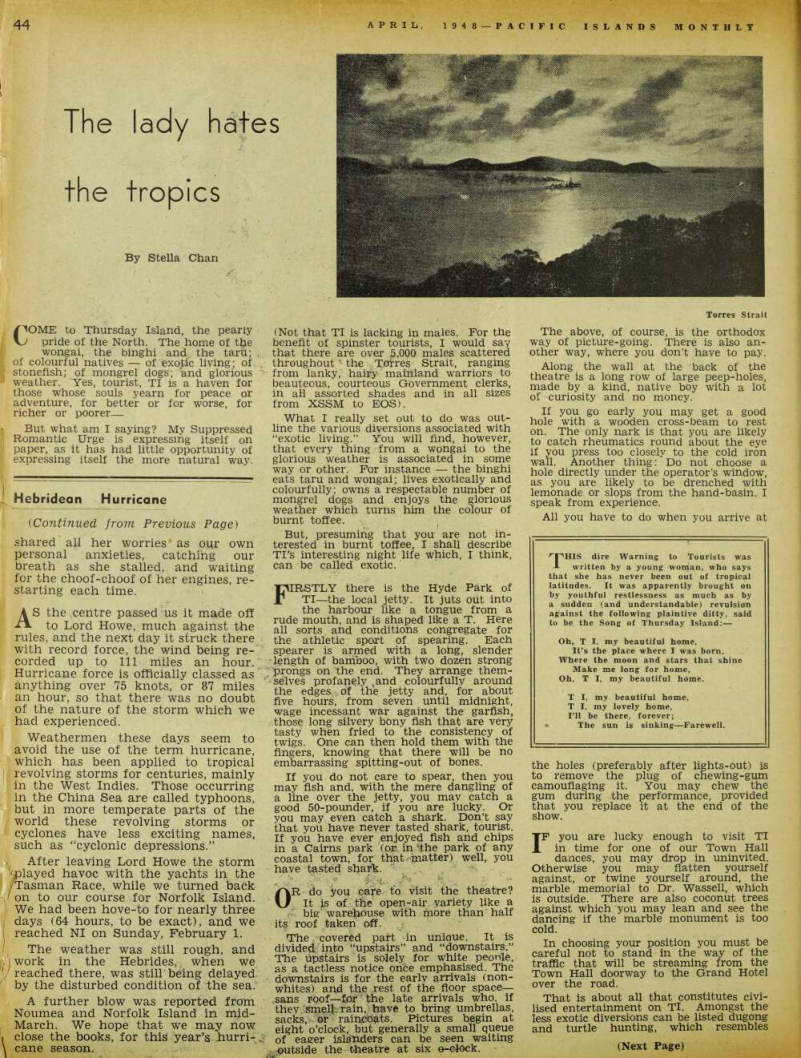
We continued to head into the ' to south-east: we were unable to 1 attempt any speed in order to esca The centre reached us at 2 a.ir 29.04, and the darkness saved us fr Those which we climbed over were squalls of hurricane force each tim The ship was rolling very vi< extreme that the engines stalled ne engineer on watch to prevent the s It was the ship’s first bad storn
The small Burns, Philp motors) for three days, in January, hetwe skipper, Captain Brett Hilder. ha, “PIM ” The photographs are his.
. . . entrance to US Store, Santo
... a change of direction.
. . . wave sweeping past
ravished the Group, the only dis le US Forces—and it was fortunate ;hat no hurricane appeared during 0 Base. pis that the present nor’west season ingo trees were heavily laden with tive winds, which blow all the fruit had to be fulfilled, for hurricanes roup, and the New Hebrides had got ter sank to 29.50 throughout the passed harmlessly down between us ills for some days. A blow so early her later in the same season, as in 23 and 24 of this year, and when it ived from Suva of a cyclone centred amended to 60 miles east of Santo, >f the wind had struck the island of anesian Mission Boys’ School was the centre of the blow reached the ised on, the wind arrived with full ibout half an hour—otherwise the have been devastated, id Channel had two bad nights of Those partly-demolished huts, of ned, were laid low with resounding den structures remained standing. :, of decaying Oregon, had a fully roughout the blow, but I have my up. £ Harbour, and trading cutters were ne at each place. 1 Weather Station at Vila was busy ane. Bill Roberts was ready for it. eave the Group to the westward of gale” and torrents of rain, rophetic mangoes, and driving the e, it gave Vila no further trouble, ed westwards across the northern ved to the southward and made for >ed its climax and started to lose its i sea to the south-east and growing fc Lord Howe Island on our way to from good, and we were plugging -east, making 6£ knots, ning from Suva, giving the position ea, arid making for Norfolk Island ng with the storm at Norfolk, and ;s track, making towards Lord Howe id down on a track heading directly its speed was increasing, and its d swell as it moved from north-east :h safety in any other direction, or s 30th, when the glass was down to ng the size of the waves around us. ie Andes, and the wind hit us with t on a crest. and the pitching motion was so :e an hour, despite the efforts of the ,cing as it emerged from the water. 10 years of Islands trading, and we
Hama,” 689 tons, fought a hurricane I Howe and Norfolk Islands. Her y written this description for the
. . . the morning after
... US huts at Segond Channel
. . . steaming out of the storm
shared all her worries as our own personal anxieties, catching our breath as she stalled, and waiting for the choof-choof of her engines, re starting each time.
AS the centre passed us it made off to Lord Howe, much against the rules, and the next day it struck there with record force, the wind being re corded up to 111 miles an hour.
Hurricane force is officially classed as' anything over 75 knots,, or 87 miles an hour, so that there was no doubt of the nature of the storm which we had experienced.
Weathermen these days seem to avoid the use of the term hurricane, which has been applied to tropical revolving storms for centuries, mainly in the West Indies. Those occurring in the China Sea are called typhoons, but in more temperate parts of the world these revolving storms or cyclones have less exciting names, such as “cyclonic depressions.”
After leaving Lord Howe the storm 'played havoc with the yachts in the /Tasman Race, while we turned back ' on to our course for Norfolk Island.
We had been hove-to for nearly three days (64 hours, to be exact), and we reached NI on Sunday, February 1.
The weather was still rough, and j work in the Hebrides, when we / reached there, was still being delayed by the disturbed condition of the sea.
A further blow was reported from Noumea and Norfolk Island in mid- March. We hope that we may now close the books, for this year’s hurri-. cane season.