FRESH FIELDS —and Quarantine
p. 42 · Read in the full issue
By “Amel”
AFTER residing there for seven years —years that were happy in spite of the heat and the isolation—we left Rotuma Island. In that cool hour between the dark and the dawn, we sailed away to Fiji. Snatches of plaintive Rotuman melodies and calls of farewell reached us across the water, and the tears came, for there is no joy in saying goodbve to those whom one loves and understands.
Our destination was Pago Pago, the Pacific paradise on the island of Tutuila, American Samoa, and, in the course of the 400-mile, 5-days’ journey to Suva on board the MV “Yanawai,” we thought .complacently of how we would hop nonchalantly from the “Yanawai” to the “Matua,” from the “Matua” to some other lugger, and there we would be— in Pago Pago. Simple. * We enjoved our trip on the “Yanawai” —made our plans by'day, studied a large comet bv night, rescued a stray cutter from death and starvation and towed it in to Levuka, and dulv arrived at Suva, to be welcomed by the news that “Matua” travel was off because of the infantile paralysis epidemic in New Zealand. The best-laid plans of mice and men. . . .
During the period of waiting for transport, I spent a month in Nausori, while my husband was banished to Ba.
Nausori is a long wav from Rotuma, and, on looking out of the window I saw, not the vivid seas and white beaches of an island mantled with coconut palms, but a vast area of country, rising in a op-pip*? nf hills to the distant craggv mountains. On the flatf there wele caneflelds, food gardens and fields of h?eT'a!r“could riCe ' And ° n hI “ S There were Mr, WitheroWs hill, Mr.
Yree S - aYd h mv MU, of h dhe OV WMmiX d ßVer m ThrstvXm was 40 vears old, and looked it. A banana tree and a paw-paw tree protruded from its rustv sagging corrugated-iron roof, while from itfmferiS?. at odd hours (but particularly in the stillness of the night) came a series of wheezes, shrieks, groans and bumps. sometlme°s rn a B he W av r y Tagging 'Yhe
sa* b,T«. K-afsi?. s
patient squawking of fowls, the meowing of cats, and the voice of an Indian yelling, “Giddup, you bloody damn!” as he
ploughed his rice field with a bullock.
Occasionally, when we wanted to pay a bill, visit a friend, or roar at the but cher, Aunty Polly and I ventured in to Suva about 20 miles distant by bus. We would make our respective wills, breathe a prayer and get into the first bus which was not crammed to the roof with perambulating Indians and Fijians. We needed a week to recover from these expeditions.
Then out of the blue came the news we were waiting for mv husband and I had been granted two passages on the “Marine Phoenix,” sailing direct from Suva to Pago Pago. It meant quaran tine at our destination, but at least we were on our way.
We caught the ship by the skin of our teeth she very inconsiderately sailed on the tick of her scheduled time, 12 noon and left Suva on January 12.
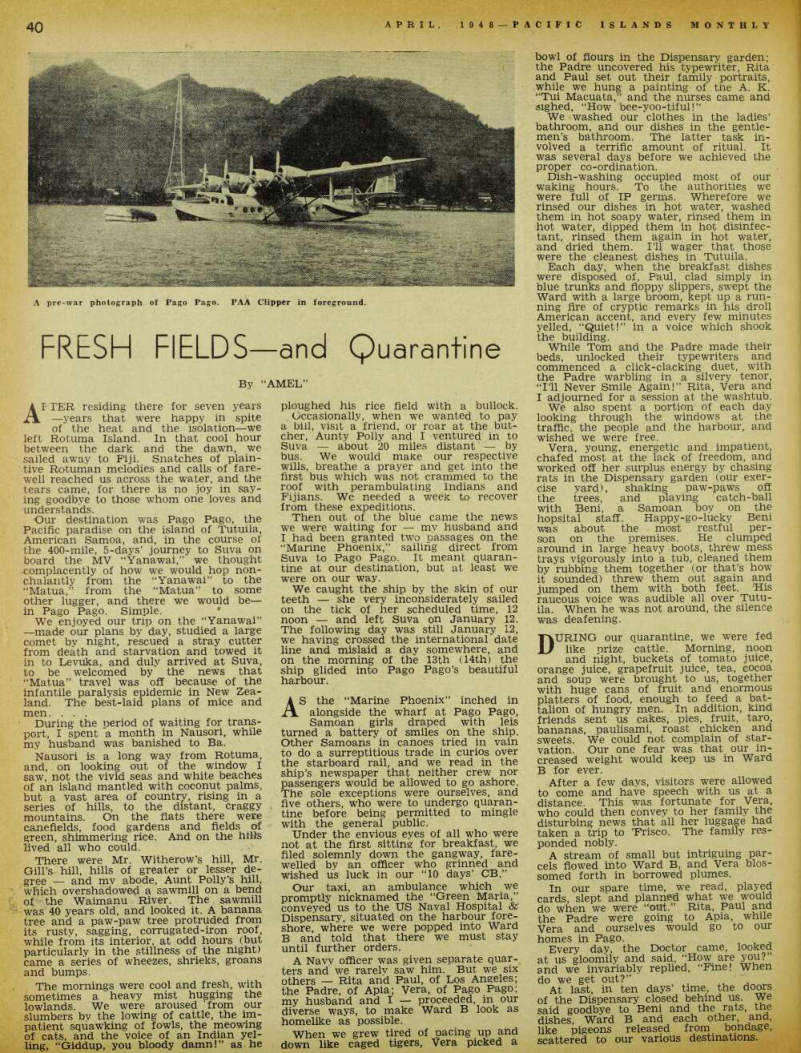
The following day was still January 12, we having crossed the international date line and mislaid a day somewhere, and on the morning of the 13th (14th) the ship glided into Pago Pago’s beautiful harbour.
AS the “Marine Phoenix” inched in alongside the wharf at Pago Pago, Samoan girls draped with leis turned a battery of smiles on the ship.
Other Samoans in cahoes tried in vain to do a surreptitious trade in curios over the starboard rail, and we read in the ship’s newspaper that neither crew nor passengers would be allowed to go ashore.
The sole exceptions were ourselves, and five others, who were to undergo quaran tine before being permitted to mingle with the general public.
Under the envious eyes of all who were not at the first sitting for breakfast, we filed solemnly down the gangway, fare welled by an officer who grinned and wished us luck in our “10 days’ CB,”
Our taxi, an ambulance which we promptly nicknamed the “Green Maria,” conveyed us to the US Naval Hospital &' Dispensary, situated on the harbour fore shore, where we were popped into Ward B and told that there we must stay until further orders.
A Navv officer was given separate quar ters and we rarelv saw him. But we six others Rita and Paul, of Los Angeles; the Padre, of Apia; Vera, of Pago Pago; my husband and I proceeded, in our diverse ways, to make Ward B look as homelike as possible.
When we grew tired of pacing up and down like caged tigers, Vera picked a
bowl of flours in the Dispensary garden; the Padre uncovered his typewriter, Rita and Paul set out their family portraits, while we hung a painting of the A. K.
“Tui Macuata,” and the nurses came and sighed, “How bee-yoo-tiful!”
We washed our clothes in the ladies’ bathroom, and our dishes in the gentle men’s bathroom. The latter task in volved a terrific amount of ritual. It was several days before we achieved the proper co-ordination.
Dish-washing occupied most of our waking hours. To the authorities we were full of IP germs. Wherefore we rinsed our dishes in hot water, washed them in hot soapy water, rinsed them in hot water, dipped them in hot disinfec tant, rinsed them again in hot water, and dried them. I’ll wager that those were the cleanest dishes in Tutuila.
Each day, when the breakfast dishes were disposed of, P'aul, clad simply in blue trunks and floppy slippers, swept the Ward with a large broom, kept up a run ning fire of cryptic remarks in his droll American accent, and every few minutes yelled, “Quiet!” in a voice which shook the building.
While Tom and the Padre made their beds, unlocked their typewriters and commenced a click-clacking duet, with the Padre warbling in a silvery tenor, “I’ll Never Smile Again!” Rita, Vera and I adjourned for a session at the washtub.
We also spent a portion of each day looking through the windows at the traffic, the people and the harbour, and wished we were free.
Vera, young, energetic and impatient, chafed most at the lack of freedom, and worked off her surplus energy by chasing rats in the Dispensary garden (our exer cise yard), shaking paw-paws off the trees, and playing catch-ball with Beni, a Samoan boy on the hopsital staff. Happy-go-lucky Beni was about the most restful per son on the premises. He clumped around in large heavy boots, threw mess trays vigorously into a tub, cleaned them by rubbing them together (or that’s how it sounded) threw them out again and jumped on them with both feet. His raucous voice was audible all over Tutu ila. When he was not around, the silence was deafening.
DURING our Quarantine, we were fed like prize cattle. Morning, noon and night, buckets of tomato juice, orange juice, grapefruit juice, tea, cocoa and soup were brought to us, together with huge cans of fruit and enormous platters of food, enough to feed a bat talion of hungry men. In addition, kind friends sent us cakes, pies, fruit, taro, bananas, paulisami, roast chicken and sweets. We could not complain of star vation. Our one fear was that our in creased weight would keep us in Ward B for ever.
After a few days, visitors were allowed to come and have speech with us at a distance. This was fortunate for Vera, who could then convey to her family the disturbing news that all her luggage had taken a trip to ’Frisco. The family res ponded nobly.
A stream of small but intriguing par cels flowed into Ward B, and Vera blos somed forth in borrowed plumes.
In our spare time, we read, played cards, slept and planned what we would do when we were “out.” Rita, Paul and the Padre were going to Apia, while Vera and ourselves would go to our homes in Pago.
Every day, the Doctor came, looked at us gloomily and said, “How are you?” and we invariably replied, “Fine! When do we get out?” . A At last, in ten days’ time, the doors of the Dispensary closed behind us. We said goodbye to Beni and the rats, the dishes, Ward B and each other, and, like pigeons released from bondage, scattered to our various destinations.
A pre-war photograph of Pago Pago. PAA Clipper in foreground.