The Muddles Of Milne Bay
pp. 35-36 · Read in the full issue
Extraordinary Story of CDC Sales In Eastern Papua
By "Waika"
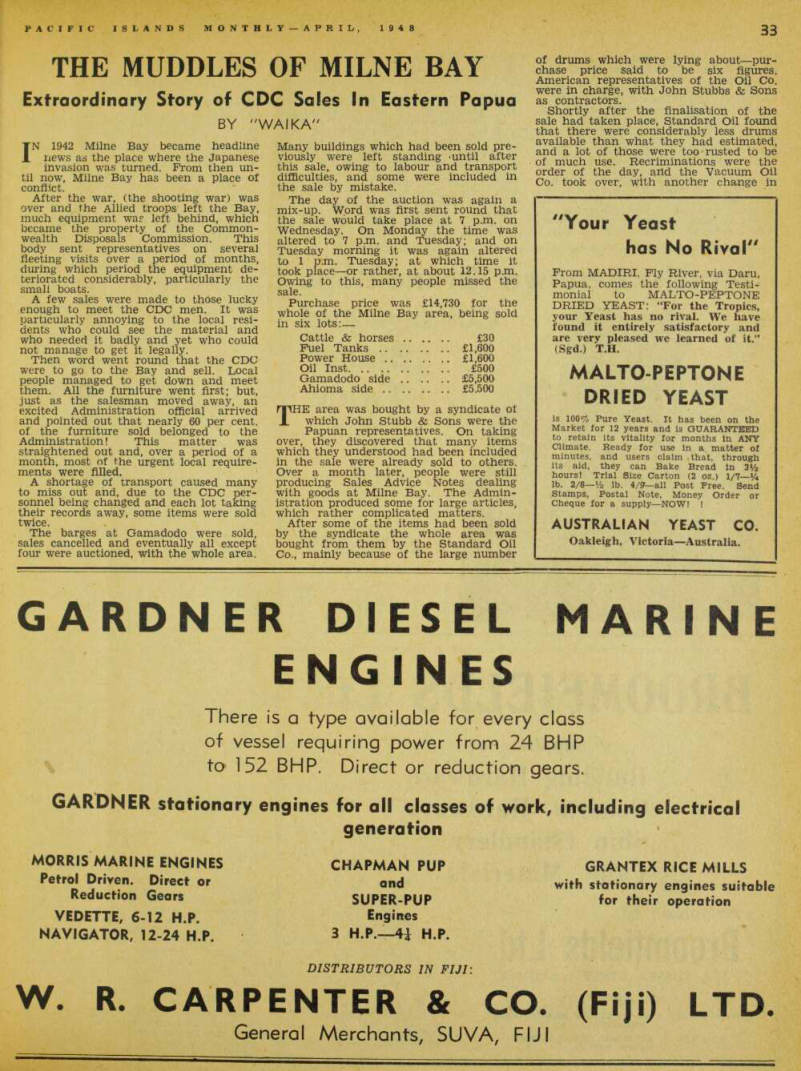
IN 1942 Milne Bay became headline news as the place where the Japanese invasion was turned. From then un til now, Milne Bay has been a place of conflict.
After the war, (the shooting war) was over and the Allied troops left the Bay, much equipment wa? left behind, which became the property of the Common wealth Disposals Commission. This body sent representatives on several fleeting visits over a period of months, during which period the equipment de teriorated considerably, particularly the small boats.
A few sales were made to those lucky enough to meet the CDC men. It was particularly annoying to the local resi dents who could see the material and who needed it badly and yet who could not manage to get it legally.
Then word went round that the CDC were to go to the Bay and sell. Local people managed to get down and meet them. All the furniture went first; but, just as the salesman moved away, an excited Administration official arrived and pointed out that nearly 60 per cent, of the furniture sold belonged to the Administration! This matter was straightened out and, over a period of a month, most of the urgent local require ments were filled.
A shortage of transport caused many to miss out and, due to the CDC per sonnel being changed and each lot taking their records away, some items were sold twice.
The barges at Gamadodo were sold, sales cancelled and eventually all except four were auctioned, with the whole area.
Many buildings which had been sold pre viously were left standing -until after this sale, owing to labour and transport difficulties, and some were included in the sale by mistake.
The day of the auction was again a mix-up. Word was first sent round that the sale would take place at 7 p.m. on Wednesday. On Monday the time was altered to 7 p.m. and Tuesday; and on Tuesday morning it was again altered to 1 p.m. Tuesday; at which time it took place—or rather, at about 12,15 p.m.
Owing to this, many people missed the sale.
Purchase price was £14,730 for the whole of the Milne Bay area, being sold in six lots:— Cattle & horses £3O Fuel Tanks £1,600 Power House £1,600 Oil Inst £5OO Gamadodo side £5,500 Ahioma side £5.500 THE area was bought by a syndicate of which John Stubb & Sons were the Papuan representatives. On taking over, they discovered that many items which they understood had been included in the sale were already sold to others.
Over a month later, people were still producing Sales Advice Notes dealing with goods at Milne Bay. The Admin istration produced some for large articles, which rather complicated matters.
After some of the items had been sold by the syndicate the whole area was bought from them by the Standard Oil Co., mainly because of the large number
of drums which were lying about—pur chase price said to be six figures.
American representatives of the Oil Co. were in charge, with John Stubbs & Sons as contractors.
Shortly after the finalisation of the sale had taken place, Standard Oil found that there were considerably less drums available than what they had estimated, and a lot of those were too rusted to be of much use. Recriminations were the order of the day, arid the Vacuum Oil Co. took over, with another change in
the administrative personnel, and John Stubbs & Sons retiring from the field as contractors Some equipment and 80,000 odd drums had been shipped away; and then a period of “active inactivity” took place, ending with the sale of the area to an Australian Co., Milne Bay Merchants, for something in the vicinity of £70,000.
This company again had the same trouble with items listed, and not there.
Also, one of the first actions was over some Sea Mules which had been sold and then the sale cancelled, but after the main auction had taken place. The company understood that the goods be longed to them, and were surprised when some workmen arrived representing a
Port Moresby firm, to remove them. In the subsequent action the Port Moresby firm was established as the owner.
Milne Bay Merchants Are At
present in the Bay trying to sell the remaining goods at a price sufficient to show them a profit. Just what the result of their battle will be is still unknown, but opinion is that odds are against Milne Bay Merchants.
Of the many incidents which took place, from the time of the sale until now quite a long story could be written.
Labour problems, fights, strikes, thieves, lunatics not a dull moment, all going towards making the history of Milne Bay interesting.