Red Hold-Up In Rarotonga Reduced To
pp. 21-65 · Read in the full issue
Farce
CIPA Sends In Petticoated Picket Line Against Surprise Plane-Load Of NZ Police
THE battle between the Cook Islands Progressive Association (more or less Communist, directed by Auckland watersiders) and the Cook Islands Workers’ Union (moderates, affiliated with NZ Federation of Labour), which seriously interfered with ship ping in December and January, was reduced to a farce in March, when the NZ Government sent a plane load of police to restore industrial order to the port of Avarua, in Raro tonga.
The story of the CIPA, led by a Mr. Albert Henry, has been told in recent issues of “PIM.”
The CIPA, becoming ever more arrogant and unruly, demanded the sole right to load and unload ships.
Not getting this, it interfered with the schedule of the MV “Maui Pomare” (Government-owned, which runs be tween NZ and Cook Is.).
The following account of latest developments has been supplied by a NZ resident who saw most of what occurred:— |7V3LLOWING the CIPA’s antics, and the 1: ensuing uproar in NZ, the “Maui Pomare’’ was temporarily withdrawn in January instead of going straight back with much-needed supplies.
Supplies were to go forward by the trans-Pacific ships “Wairuna” and “Wairata,” en route to the States.
The “Wairuna” arrived at Rarotonga on Monday, March 1, to land flour and sugar.
The CIPA had told its dupes that in future no ships could come to Rarotonga without its permission, and that only CIPA ships would be worked at Rarotonga.
When it was reported that two ships were definitely on their way, the CIPA de cided something would have to be done about it. , The NZ Federation of Labour and the Government instructed that Rarotonga was to work the ships with bona fide regular waterside workers, irrespective of whether they were CIPA or Workers’
Union men. The list was to be drawn up by Union Steam Ship Co. manager, as usual.
Any such list automatically includes a high percentage of CIPA workers. The CIPA answered they would neither work the “Wairuna” nor allow it to be worked.
ON Sunday evening, February 29, before the arrival of the ship, CIPA held a full rehearsal of wharf pickets.
Early next morning they took charge of the wharf, completely surrounding USS Co. property.
The “Wairuna” arrived at anchorage about 7 a.m. The USS Co. clerk called
names from a list that was about 75 per cent. CIPA. No CIPA men answered their names.
Leader Albert Henry agreed to call off the pickets while the parties negotiated; deadline to be 9.30 a.m.; satisfaction for CIPA or back to the pickets.
The Administration asked that on this occasion the Workers’ Union should with draw completely, and allow the CIPA men to work the ship, to avoid trouble and ensure discharge of biscuits, flour and sugar.
The Union leaders agreed, but their men
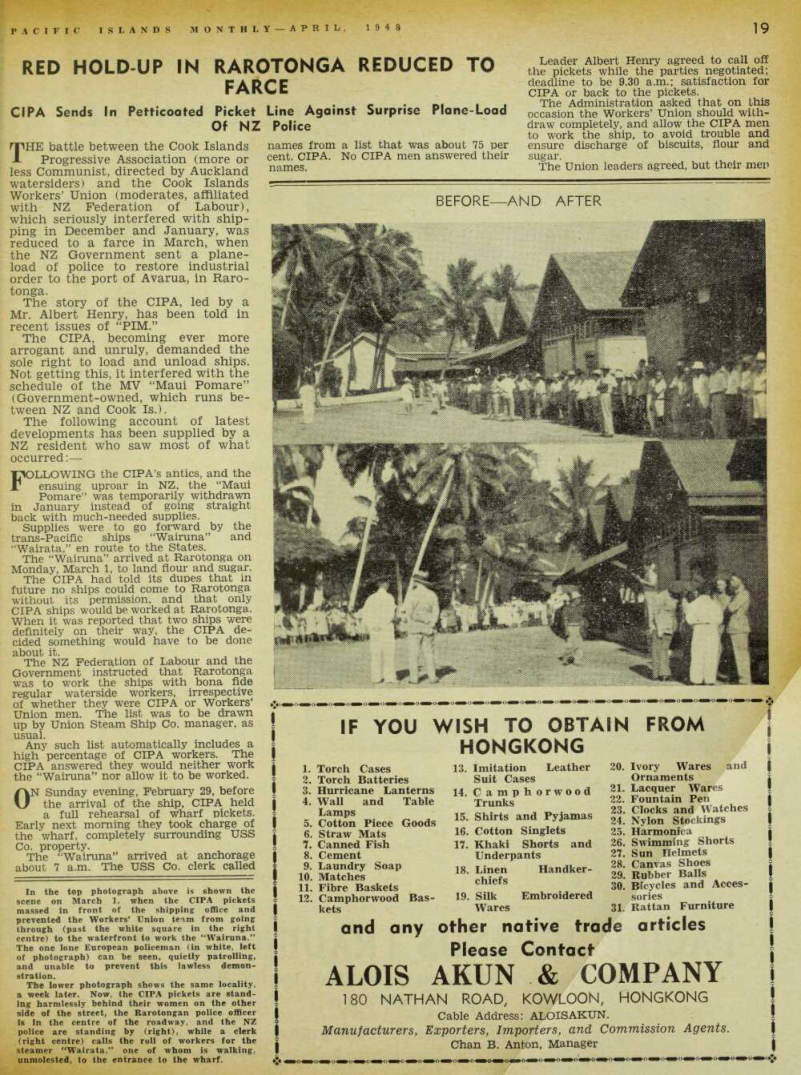
Before—And After
In the top photograph above is shown the scene on March 1, when the CIPA pickets massed in front of the shipping office and prevented the Workers’ Union team from going through (past the white square in the right centre) to the waterfront to work the “Wairuna.”
The one lone European policeman (in white, left of photograph) can be seen, quietly patrolling, and unable to prevent this lawless demon stration.
The lower photograph shows the same locality, a week later. Now. the CIPA pickets are stand ing harmlessly behind their women on the other side of the street, the Rarotongan police officer is in the centre of the roadway, and the NZ police are standing by (right), while a clerk (right centre) calls the roll of workers for the steamer “Wairata.” one of whom is walking, unmolested, to the entrance to the wharf.
were not pleased about it. However, the Workers’ Union withdrew.
But CIPA still were not satisfied. They now sought complete control—and would not start work unless handed the edulvalent of the sum of money paid out in wages to Workers’Union men for working the last Maui Pomare !
The deadline (9.30) came. The whistle tooted again and the pickets surrounded the wharf sheds and entrances. The USS Co. called out a new list—this time, Workers’ Union men.
The WU men collected in a group and, accompanied by the one lone European police officer, approached the picket line.
The pickets bunched up and refused a passage. The police officer called upon the pickets to allow the Union men to P ass - „ The request was refused and the officer then ordered the Union men to retire.
Shortly afterward the ship proceeded on her way, with the badly-needed foodstuffs aboard. u This was called a victory for the CIPA. The Union men were lumping rnad, and the Europeans gravely concerned. Were they to be simply handed over to the Communists?
What about the “Wairata” (due on Monday, March 8), and her 1,200 tons of
cargo 9 Rarotonga was now desperately
short'of foodstuffs, oil, motor fuel, etc.
The NZ Government was privately and urgently warned that a very ugly situation was developing.
CIPA meetings held every day were now very anti-European, and gloating over European discomfiture at foodshortage. “We can live on Maori kai and go barefooted—only the Europeans will suffer,” they said. Part of the CIPA basic plan was to make it as uncomfortable as
possible for the Europeans, and chase them out. .. “to be worked The? „ot know—no one in ex cept the Resident Commissioner, knew— tviot tbp isrz Government was now busv
to°be seS
by plane. (See March PIM.) on Wednesday, following departure of “Wairuna,” Mr. Tuaine Nicholas, secre tary of the Workers’ Union, approached Albert Henry and suggested peaceful co operation in working the “Wairata,” so as to supply food to women and children, Henry said that he personally agreed but he would have to see his People. The reply on Thursday was No —CIPA re fu P now Stffig tougher' and W |he to be the big showdown—but what was the Govem ment doing about it ? what could be done by the lone police officer (Superintendent Best) and his half-a-dozen Maori assist ants (all rather timid under the circum stances-and half of them CIPA!)?
Public tribute should be paid to that wb ite policeman—a fine, fearless type of British officer. Throughout all this Com munist trouble he was jumping mad at bis own en f o rced impotence, but he was under strict orders not to “start anything,” no matter what the provocation, and he was not even armed. All this, of course, for the benefit of the Red howlers in NZ.
One can imagine his anger at having to meekly turn away from that Maori picket, after being defied. He was quite ready and willing to deal with the arrogant lawbreakers single-handed—but he had his orders, and he loyally obeyed them, And what did he get for his restraint from the CIPA? Scorn and derision for being “scared of them —the whole several hundred of them! Yet, if he had laid a finger on one of them it would have been screeched over the length of NZ.
By Friday, March 5, there were per sistent reports that a plane was on the way. It was thought to be some sort of “delegation,” and CIPA was sure it would include some of “our men.” CIPA women started to prepare flower leis for the wel come visitors.
Out of the grey and rainy dusk, on Friday, a plane came in over the sea.
A small group at the airfield watched breathlessly as the door opened. Out stepped a very large policeman, and another, and another! Fourteen of them!
Thunderbolt! Never had the coconut radio worked so fast and furiously. Gen eral reactions: Europeans, Workers’ Union, and associates —astonishment, pleasure and relief. ClPA—amazement and vast anger.
On Saturday morning, March 6, there was a great CIPA meeting, and an extra ordinary exhibition of dramatics. “The government has sent guns against us, but we shall fight to the end.” The heroic leader stood up and squared his shoulders; “I am not afraid to die. I will take the first bullet!”
A female fanatic (since named Joan
of-Arc) in an impassioned outburst, said: “I will stand in front of Albert and take the first bullet!” She hysterically urged the women to fight to the bitter end. It was grand stuff for the Communist papers. Albert Henry told the people that if there were any present who wished to withdraw from the decision to fight to the bitter end they were free to do so, and nothing would be said or done to them. He called for those who wished to withdraw to raise their hands. Only three hands were raised —and the first was that of Mr. Henry.
The other two gentlemen who raised their hands had previously attempted to make appeals to reason, but had been told to “shut up or get out.” Henry him self made an appeal to his people to abandon their course of violence. These CIPA acrobatics are a bit puzzling, until you get used to them.
Mr. Henry then instructed the CIPA to gather at the waterfront at 4 a.m. on Monday for an important last word.
On Saturday morning there also arrived a further surprise in the public display of new official regulations, added to the Cook Islands Act. dated March 6, 1948, which made an offence of any act calcu lated to interefere with the peaceful pur suance of industry such as the working of a ship.
ON Monday, March 8, the police force was on duty at 3 a.m. The CIPA gathered at 4 a.m. The “Wairata” arrived at anchorage at 6 a.m.
The 14 policemen were placed along the wharf approaches, short-sleeved and empty-handed, nonchalantly leaning and smoking cigarettes. Facing the wharf sheds and police, from the opposite side of the road, the CIPA in a semi circle, with a large mass of spectators be hind. The Workers’ Union men were at rear of the crowd.
About 7 a.m., lust before the USS Co. clerk was to call the names of workers, CIPA women, at a given signal, charged across the road and formed a determined looking picket line, hemming in the still nonchalantly smoking policeman. So this was Henry’s trump card!
Now the crowd was on its toes. How were the police going to deal with these prim-looking women who. for days, had been screaming of fighting to the bitter end? . , , One policeman and a few quiet words supplied the answer. Officer-in-charge, Senior Sgt. Brown, went over to Albert Henry and in his best heavy, police sarcasm, remarked; “So this is your idea of a picket—hiding behind women’s skirts!”
Albert seemed angry and awkward.
Sergeant Brown then quietly asked the women if they were acquainted with the new regulations on the notice boards.
They admitted they were not The officer pointed out that all were liable to fines or imprisonment for being where they were, and suggested they move back to the other side of the road.
The ladies rather sheepishly retired.
And that was the end of the great CIPA rebellion.
The workers’ roll was called. The CIPA would not respond. Other men who an swered their names passed on to the wharf, and unloading commenced.
The CIPA moved away en masse to their meeting hall, for more theatricals.
Some workers of the ship’s crew (New Zealanders) attended the CIPA meeting, burned to the ship: and the whole crew ceased work. The ship was idle most of the day while the crew awaited instructions fl The instructions from the Federation of Labour were that the crew were to work with either Workers’ Union or CIPA men.
(Continued on page 63.)
Unloading was resumed at 6 p.m. There was no more trouble. But has anyone calculated the cost of all this—all caused by a few irresponsible Auckland agitators?
The CIPA continued to hold meetings and there was talk of refusal to pick oranges for ‘‘Maui Pomare.” due about Marcn 26. But the NZ police remained in Rarotonga until after the “Maui Pomare’’ had departed, and there was no intereference with ship or fruit gathering.
At a special court session on March 22, twenty members of the CIPA. including Albert Henry, were fined £1 each on the charge of obstructing the public highway on March 1 The prosecution was conducted by Senior Sgt. Brown. CIPA are naturally very annoyed at this affront— thev sav these are “Nazi methods ” “Re- SnTto' I force ar t e o deny pe"freed*m ° f -® P f e^,? nd freedom ° f aCtion ln their a , ' T , , , , , Albert Henry left Rarotonga by plane A/r „„ n v, oq on March 23.
The “captain of the CIPA ship”—ihat is, a gentleman said to be considering part-ownership with the CIPA of a vessel of 150 tons, the “Avow”—visited Rarotonga late in March. There is a report that he turned the proposition down flat when he saw the local situation.
Txm p. • rwi w U * fv,oT f Mrs- Eloua Lambert, widow'of that famous Dr. b. M. Lambert who conquered the hookworm disease, and whose name always will be held in honour in the Pacific Islands, is now living at 2854 Webster Street, Berkeley, USA. In a letter to the editor of the “PIM,” she sends greetings and good wishes to old friends in the South Seas.