Samoa
pp. 63-64 · Read in the full issue
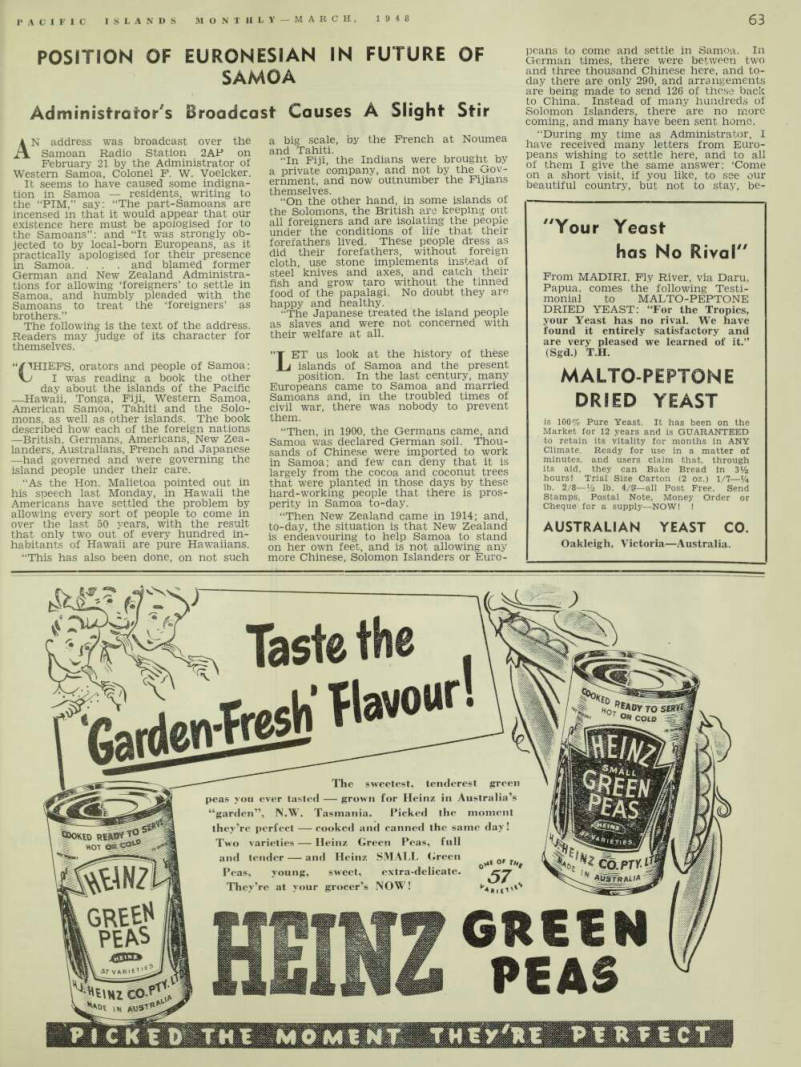
Position Of Euronesian In Future Of
Administrator's Broadcast Causes A Slight Stir
AN address was broadcast over the Samoan Radio Station 2AP on February 21 by the Administrator of Western Samoa, Colonel F. W. Voelcker.
It seems to have caused some indigna tion in Samoa residents, writing to the “PIM,” say: “The part-Samoans are incensed in that it would appear that our existence here must be apologised for to the Samoans”: and “It was strongly ob jected to by local-born Europeans, as it practically apologised for their presence in Samoa. . . . and blamed former German and New Zealand Administra tions for allowing ‘foreigners’ to settle in Samoa, and humbly pleaded with the Samoans to treat the ‘foreigners’ as brothers.”
The following is the text of the address.
Readers may judge of its character for themselves.
“/CHIEFS, orators and people of Samoa: I was reading a book the other day about the islands of the Pacific —Hawaii, Tonga, Fiji, Western Samoa, American Samoa, Tahiti and the Solo mons, as well as other islands. The book described how each of the foreign nations —British, Germans, Americans, New Zea landers, Australians, French and Japanese —had governed and were governing the island people under their care.
“As the Hon. Malietoa pointed out in his speech last Monday, in Hawaii the Americans have settled the problem by allowing every sort of people to come in over the last 50 years, with the result that only two out of every hundred in habitants of Hawaii are pure Hawaiians.
“This has also been done, on not such
a big scale, by the French at Noumea and Tahiti.
“In Fiji, the Indians were brought by a private company, and not by the Gov ernment, and now outnumber the Fijians themselves.
“On the other hand, in some islands of the Solomons, the British are keeping out all foreigners and are isolating the people under the conditions of life that their forefathers lived. These people dress as did their forefathers, without foreign cloth, use stone implements instead of steel knives and axes, and catch their fish and grow taro without the tinned food of the papalagi. No doubt they are happy and healthy.
“The Japanese treated the island people as slaves and were not concerned with their welfare at all. ”T ET us look at the history of these 1 1 islands of Samoa and the present position. In the last century, many Europeans came to Samoa and married Samoans and, in the troubled times of civil war, there was nobody to prevent them.
“Then, in 1900, the Germans came, and Samoa was declared German soil. Thou sands of Chinese were imported to work in Samoa; and few can deny that it is largely from the cocoa and coconut trees that were planted in those days by these hard-working people that there is pros perity in Samoa to-day.
“Then New Zealand came in 1914; and, to-day, the situation is that New Zealand is endeavouring to help Samoa to stand on her own feet, and is not allowing any more Chinese, Solomon Islanders or Euro
peans to come and settle in Samoa. In German times, there were between two and three thousand Chinese here, and to day there are only 290, and arrangements are being made to send 126 of these back to China. Instead of many hundreds of Solomon Islanders, there are no more coming, and many have been sent home.
“During my time as Administrator, I have received many letters from Euro peans wishing to settle here, and to all of them I give the same answer: ‘Come on a short visit, if you like, to see our beautiful country, but not to stay, be
cause this country belongs to the Samoans,’
“The past has, however, left behind many problems to settle. We have stopped any more people wbo are not of the Samoan race from coming, but there are still rne descendants ot tnose who came in the past ana who now call Samoa tneir home, These children of Europeans —(German, American and Bntisn —and oi other races, Chinese, Solomon islands and others, all had Samoan motners, and therefore have a claim lor sympathy and understanding.
“Surely Samoa nas a big enough heart to take all these people and to absorb them into her family. Samoa nas much to thank New Zealand lor, in that, as 1 have explained, she has taken seeps to ensure that tne problem does not be come more confused by allowing more foreigners to come in.
“But let us face the present situation as wise and Christian people. Tne past has left us with two mam problems — people and land.
“As the result of lack of unity in the past, we have here in Samoa over 5,000 people of mixed blood. As the result of the foolishness of our forefathers, much of the best land in Samoa is not owned by the bamoan people, but has been sola to foreigners.
“I tell you that time and understanding will put these things right, and Samoa can gain and is gaining advantages from both these things, which at first might appear misfortunes.
“These people, to whom Samoa means home, have proved in the fields of trading and business that they can succeed ana assist Samoa, and if you treat them as brothers and builders with you of the oamoa of tomorrow, I am sure that Samoa will be the richer for their help, /vs regards land, New Zealand is bound by the Trusteeship Agreement that no further land, belonging to the Samoans, will be sold to Europeans; and not only that, but tne profits made on the Crown Estates will be used for the benefit of Samoa.
“As time goes on, means will be found for Samoa, which in the past has sold some of her birthright, to re-purchase it and, in the meanwhile, the profit from the comparatively small portion which is being worked by the Crown Estates will be returned to Samoa. Very few people realise that one fifth of the cocoa and one-sixth of the copra of Samoa, as well as the dried banana and all the desic cated coconut, are produced by the Crown Estates. Over 2,000 Samoans and part- Samoans obtain employment thereby, and only 17 Europeans are required. It would be foolishness if, in a night, this source of revenue for Samoa was cut off.
“Let us use our brains, all of us, Samoans, part-Samoans and New Zea landers, to work out the happy future of Samoa with unity and understanding.
Soifua.”