Papain Is A New Product In Africa
pp. 51-52 · Read in the full issue
How The Latex is Gathered and Treated
THE following article, which sug gests that a use may be found for the common paw-paw, is from an article by J. P. Moffett, in the November issue of the “Crown Colonist” It is based on a recent development in Northern Tanganyika.
Unfortunately, Mr. Moffett says very little about marketing—only that the latex is “much in demand in America ” The “PIM” has put in hand inquiries, to find out the best way of marketing the product; and this information will be published when it comes to hand.
It is worth noting that Western Samoa regularly produces and sells a small quantity of papain—worth about £2OO in 1947. rE pawpaw “tree” and its delicious fruit are familiar to all who live in the tropics. But papain, the dried latex which exudes when the skin of the fruit is scratched, is perhaps not so familiar.
Yet it is now extensively used in the manufacture of certain medicines and cosmetics, for such processes as chill proofing beer, tanning leather, tenderising meat and de-gumming natural silk when this is associated in fabrics with rayon and wool. It is much in demand in America.
Buyers are prepared to offer high prices to obtain it, and its production has grown from 10,480 lb., valued at £3.500, in 1939, to 109,760 lb., valued at £49,392, in 1945. (Prices are in sterling. This is equal to an average of 11/- per pound Australian.)
Most of this comes from the Northern Province of Tanganyika, where the acre age under pawpaw is now being extended to the maximum permitted by the Depart ment of Agriculture. Unrestricted plant ing cannot be allowed because of the prior necessity for food production, but the pawpaw is rapidly taking the place of the coffee tree in those “marginal” areas where coffee-growing is rather a gamble but where pawpaws flourish.
There is a story-book flavour about the origin of this new industry. Ten years ago no papain at all was produced in Tanganyika. But about 1935 a German missionary at Arusha chanced to read an article about it and began to experi ment. He found no difficulty in growing paw-paws on the rich volcanic soil on the southern slopes of Mount Meru and, with advice and encouragement from the local Agricultural Officers, soon succeeded in producing papain of the quality desired by the trade.
His neighbours followed his example, until there are to-day few planters in Arusha who are not producers. The price of papain is now 25/- per lb. for the pure product and, since the pawpaw tree produces fruit less than a year after germination and an acre will yield from 60 to 100 lb. per annum, it is not sur prising that the industry has grown rapidly.
Planters are now using a short-stemmed variety of tree, which makes tapping easier. The seedlings are usually planted, five at a time, in rows about 8 ft. apart.
The plantations are kept clean-weeded.
This is usually done with the hoe, but small tractors are now being increasingly used with success.
grow strongly—provided the cut-worms do not get at them—and the others will then be removed. Not until the young tree floW ers can it be seen whether it is a male or a female plant—this is one of the hazards of pawpaw growing, for only the female plant produces fruit. The ma i es are cut out and any empty spaces a up a in. Soon there appear symmetrical rows of heavily laden female p i an ts, with a male here and there for fertilisation purposes.
In favourable circumstances the fruit will be ready for tapping in seven to eight months and can then be tapped once every ten days for as long as nine months in the year, for a period of three years or more.
The tapping is done with a razor blade embedded in a piece of rubber so that only a very thin cutting edge appears, or with a piece of wire slightly bent and sharpened at the point.
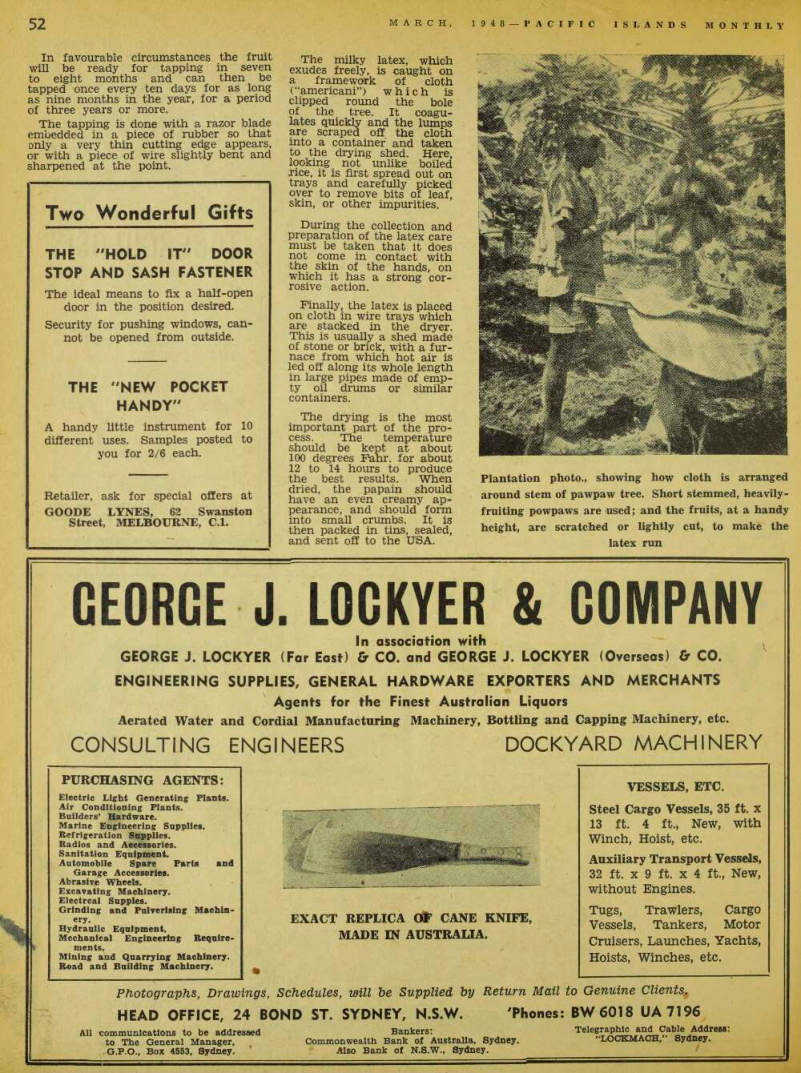
The milky latex, which exudes freely, is caught on a framework of cloth (“americani”) which is clipped round the bole of the tree. It coagu lates quickly and the lumps are scraped off the cloth into a container and taken to the drying shed. Here, looking not unlike boiled xice, it is first spread out on trays and carefully picked over to remove bits of leaf, skin, or other impurities.
During the collection and preparation of the latex care must be taken that it does not come in contact with the skin of the hands, on which it has a strong cor rosive action.
Finally, the latex is placed on cloth in wire trays which are stacked in the dryer.
This is usually a shed made of stone or brick, with a fur nace from which hot air is led off along its whole length in large pipes made of emp ty oil drums or similar containers.
The drying is the most important part of the pro cess. The temperature should be kept at about 100 degrees Fahr. for about 12 to 14 hours to produce the best results. When dried, the papain should have an even creamy ap pearance, and should form into small crumbs. It is then packed in tins, sealed, and sent off to the USA.
Plantation photo., showing how cloth is arranged around stem of pawpaw tree. Short stemmed, heavily fruiting powpaws are used; and the fruits, at a handy height, are scratched or lightly cut, to make the latex run