Tropicalities
pp. 42-43 · Read in the full issue
THIS story (first published in the “Fiji Times”) is currently being told in Fiji;— In the early stages of the war His Majesty’s Ship “Achilles” sent a landing party ashore near Brighton Park, which was defended by the Fiji Military. The rules of the game were that if a hidden party of troops could remain concealed until the invaders were on the beach and then opened fire with a machine gun, the landing party would be judged to be written off by the umpires.
In place of a machine-gun, a kerosene tin was to be loudly rattled with a stick.
Several naval boats crept up to the Cable Hut and some Fijian troops and a Euro pean officer remained quietly hidden. At last the officer gave the signal, but there was no response. Several times he called “fire” but no fire came, and it was the troops who were written off.
Later he inquired what had happened to the machine-gun.
“Oh,” replied the sergeant, “that fellow Viliame take it away to make the yaqona (kava).” * * * “/"VLD TIMER” has sent us the follow- U? ing extract from the Sydney “Sun day Telegraph” with the note that Mr. Angles should be asked to brush up his pidgin before going on the air.
Southerners are apparently very simple souls who are easily amused. It is alleged by the “Telegraph” that hun dreds of listeners have asked for copies of the race description in “Pidgin” broad cast over the 2GB network by a Mr.
Cyril Angles. The finish of the race goes thus;—- Jockey master singin out and catch im fella horse plenty too much whack whack along tail belong im horse, him no like this —he run all same debil debil and all white master now do big sing sing along stand.
Now look im fella horse Bold Beau come along fast first time. Brazier second time by crickey. With Twice Royal third
time horse and last time horse Havoc, jigger up finish. He run all same bull-a ma-cow. *Fella bookie tear im grass be long head.
First time horse Bold Beau, rider be long im Master George Plenty-Pod-Much; second time Brazier ridden by him fella champ discovered Australia, Captain Cook. Number three fella Twice Royal ridden by little fella Blainey Tailor.
Now weight belong im Number one horse him alright. Now me say goodbye all you fella belong New Guinea and cross back along studio to him white master fella grass-along-lip Foster.” * * OCEAN travel is not, as we know, what it was. There is, for example, the “Montoro,” which may have been something of a luxury liner when she was built for Burns Philp & Co., in 1910, but which by 1939 had reached the stage when the firm had decided to sell her for scrap. War kept her in Australian waters as a troopship and for the last couple of years she has been carrying New Guinea residents back and forth between Sydney and Papuan-New Guinea ports.
She is now controlled by the Australian Shipping Control Board and is grubby, uncomfortable, overcrowded, the food is poor and below decks, due to the re moval of the fans which once kept her reasonably cool even in the tropics, it is like a sweat-box.
Before the war “Montoro” was manned by an Australian crew; a year ago she was manned by Indians who all chewed garlic, or curry powder, and blew it down the back of one’s neck while waiting at table and whose allegedly white uniforms had rarely seen a washing tub. This year, according to a recent woman passenger, the crew is Chinese she thinks, from Singapore. The Indians could under stand English: the newer Chinese crew cannot. Thereby hangs this tale.
Our passenger, somewhere out from Moresby and on a choppy sea, one morn ing felt ill. Prudently, she lay quietly in
her bunk and summoned her steward. In English, in Pidgin, then in sign-language she asked him to bring her a “straw berry-box.” The steward smiled blandly and presented her with everything he could lay hands on in the cabin —but never the right article. Desperately she used more sign-language and at last a beam of great enlightenment suffused his face. “Ah!” he> exclaimed dramatically, and backed out of the cabin.
He was gone some time, but at last she could hear him returning, making a great clatter in the narrow passage way.
He struggled through the door and dumped something on the floor. Cauti ously she opened her eyes and raised her head a few inches to look.
He had brought her a deck-chair! * * « VITHEN Fiji’s representative cricket team TT sailed for New Zealand in the Matua on January 31, they were equipped with Suva-made blazers bearing the Colony’s coat-of-arms as a monogram (permission to use the arms was granted by the Government) and sweaters produced in re cord time by Lady Maraia and her Fijian Knitting and Sewing Circle.
The team was farewelled bv a very large crowd, despite the fact that neither the team nor its supporters in Fiji are over optimistic about actual results in the Dominion.
On the previous Sunday, the represent atives were “cleaned-up” by a Suva team.
This was partly due to the fact that a young newcomer to Suva cricket from Lau, Ilekena Bula, sent two sixes from Albert Park over Victoria Parade and into the Grand Pacific Hotel grounds, and a third somewhere down by the Government Buildings. Another six and a four was included in his total.
And the result of this display is that Ilekena Bula has also gone to New Zea land —S. * * *
Ratu Mara Uluilakeba, Now At
Wadham College, Oxford, is probably the most spectacular of the current crop of Fijian students at overseas Universities.
He went to Oxford in 1946. expects to complete his MA degree next year, and then to study for a diploma in anthro pology, and a course in Colonial Admin istration. He will return to Fiji in 1951.
An outstanding athlete in both New Zealand and England, he has been elected a member of the exclusive Achilles Club and has every chance of becoming the first Fijian Oxford “blue.” —J.S. $ THAT jolly Frenchman, Rev. Father Dupeyrat, who has been several weeks in Sydney raising funds for the Yule Island Mission (Papua) has been much entertained by Sydney people, who appreciate his wit, vivacity and culture.
He tells one amusing story against him self.
A Sydney woman insisted that he go to her house for luncheon. “I have a treat for you,” she said.
The missionary, after a couple of decades in the Papuan jungle, is not averse to a well-cooked meal. He went along happily.
His charming hostess produced for his luncheon, as the piece de resistance, a paw-paw and a bunch of nicely-coloured bananas. She was sure that a man from the tropics would greatly relish those tropical fruits.
During the bitter war years, Father
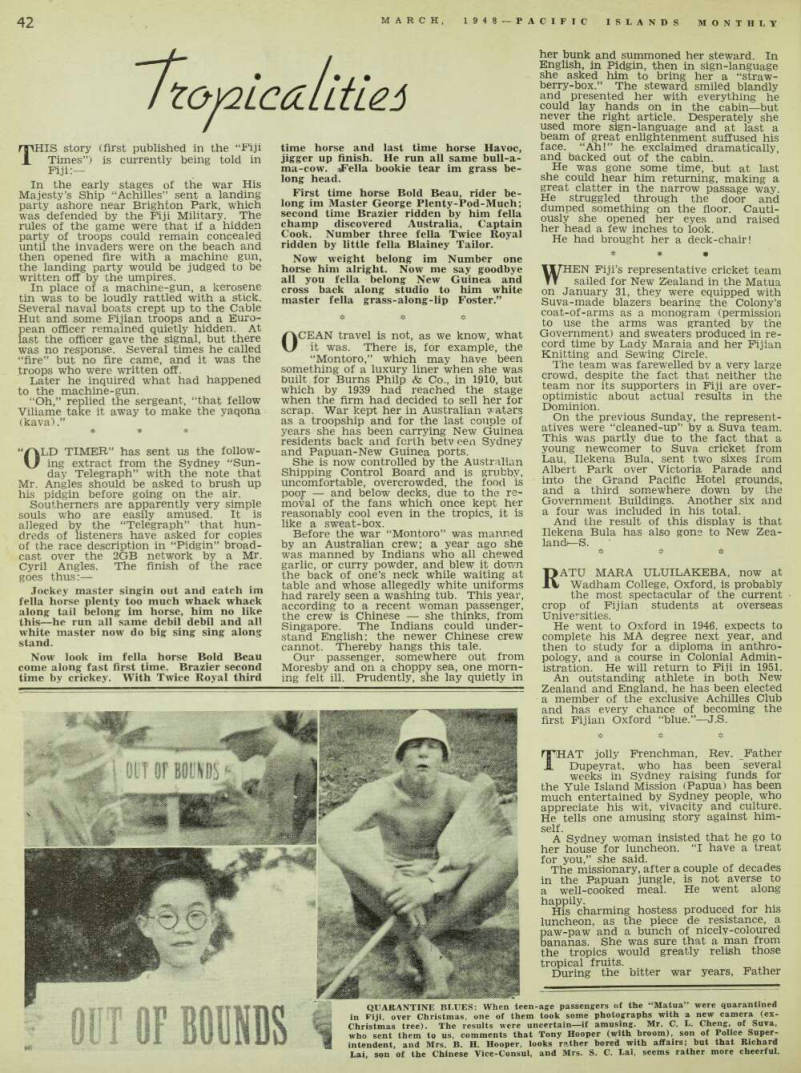
QUARANTINE BLUES: When teen-age passengers of the “Matua” were quarantined in Fiji, over Christmas, one of them took some photographs with a new camera (ex- Christmas tree). The results were uncertain —if amusing. Mr. C. L. of Suva, who sent them to us, comments that Tony Hooper (with broom), son of Police Super intendent, and Mrs. B. H. Hooper, looks rather bored with affairs: but that Richard Lai, son of the Chinese Vice-Consul, and Mrs. S. C. Lai, seems rather more cheerful.
Dupeyrat and his colleagues had been compelled to live on “the produce of the country” until they detested it; and especially does the worthy Father loathe the paw-paw. But, what was a good Frenchman to do? Toujours la politesse!
He toyed with a banana, and he grimly munched a paw-paw, and he secretly gave thanks that his Yule Island confreres could not see him then. * * ON her way back to New Guinea, Mrs.
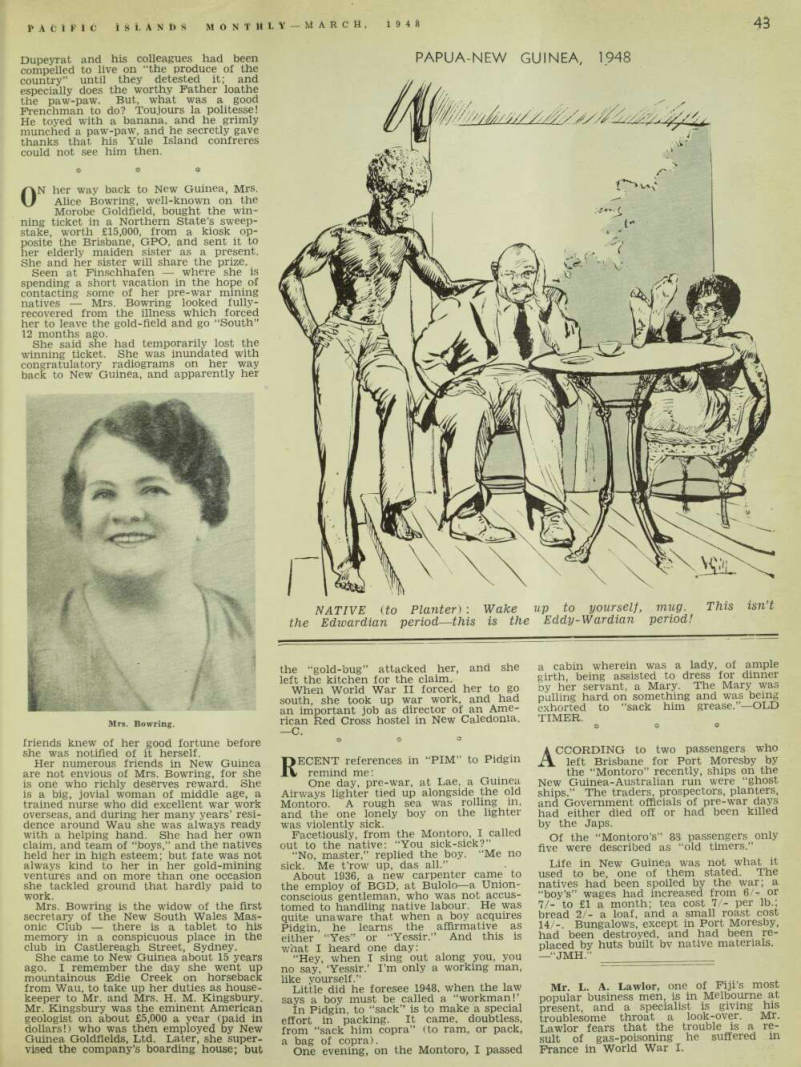
Alice Bowring, well-known on the Morobe Goldfield, bought the win ning ticket in a Northern State’s sweep stake, worth £15,000, from a kiosk op posite the Brisbane, GPO, and sent it to her elderly maiden sister as a present.
She and her sister will share the prize.
Seen at Finschhafen where she is spending a short vacation in the hope of contacting some of her pre-war mining natives Mrs. Bowring looked fully recovered from the illness which forced her to leave the gold-field and go “South” 12 months ago.
She said she had temporarily lost the winning ticket. She was inundated with congratulatory radiograms on her way back to New Guinea, and apparently her
friends knew of her good fortune before she was notified of it herself.
Her numerous friends in New Guinea are not envious of Mrs. Bowring, for she is one who richly deserves reward. She is a big, jovial woman of middle age, a trained nurse who did excellent war work overseas, and during her many years’ resi dence around Wau she was always ready with a helping hand. She had her own claim, and team of “boys,” and the natives held her in high esteem; but fate was not always kind to her in her gold-mining ventures and on more than one occasion she tackled ground that hardly paid to work.
Mrs. Bowring is the widow of the first secretary of the New South Wales Mas onic Club there is a tablet to his memory in a conspicuous place in the club in Castlereagh Street, Sydney.
She came to New Guinea about 15 years ago. I remember the day she went up mountainous Edie Creek on horseback from Wau, to take up her duties as house keeper to Mr. and Mrs. H. M. Kingsbury, Mr. Kingsbury was the eminent American geologist on about £5,000 a year (paid in dollars!) who was then employed by New Guinea Goldfields, Ltd. Later, she super vised the company’s boarding house; but
the “gold-bug” attacked her, and she left the kitchen for the claim.
When World War II forced her to go south, she took up war work, and had an important job as director of an Ame rican Red Cross hostel in New Caledonia. —C.
RECENT references in “PIM” to Pidgin remind me: One day, pre-war, at Lae, a Guinea Airways lighter tied up alongside the old Montoro. A rough sea was rolling in, and the one lonely boy on the lighter was violently sick.
Facetiously, from the Montorp, I called out to the native: “You sick-sick?”
“No, master,” replied the boy. “Me no sick. Me t’row up, das all.”
About 1936, a new carpenter came to the employ of BGD, at Bulolo —a Union conscious gentleman, who was not accus tomed to handling native labour. He was quite unaware that when a boy acquires Pidgin, he learns the affirmative as either “Yes” or “Yessir.” And this is what I heard one day; “Hey, when I sing out along you, you no say, ‘Yessir.’ I’m only a working man, like yourself.”
Little did he foresee 1948. when the law says a boy must be called a “workman!’
In Pidgin, to “sack” is to make a special effort in packing. It came, doubtless, from “sack him copra” (to ram, or pack, a bag of copra).
One evening, on the Montoro, I passed
a cabin wherein was a lady, of ample girth, being assisted to dress for dinner by her servant, a Mary. The Mary was pulling hard on something and was being exhorted to “sack him grease.’’—OLD
Timer.
- * * ACCORDING to two passengers who left Brisbane for Port Moresby by the “Montoro” recently, ships on the New Guinea-Australian run were “ghost ships.” The traders, prospectors, planters, and Government officials of pre-war days had either died off or had been killed by the Japs.
Of the “Montoro’s” 83 passengers only five were described as “old timers.”
Life in New Guinea was not what it used to be, one of them stated. The natives had been spoiled by the war; a “boy’s” wages had increased from or 7/- to £1 a month; tea cost 7/- per lb.; bread 2/- a loaf, and a small roast cost 14/-. Bungalows, except in Port Moresby, had been destroyed, and had been re placed by huts built bv native materials.
—“Jmh.”
Mr. L. A. Lawlor, one of Fiji’s most popular business men, is in Melbourne at present, and a specialist is giving his troublesome throat a look-over. Mr.
Lawlor fears that the trouble is a re sult of gas-poisoning he suffered m Prance in World War I.
Mrs. Bowring.