"Operation screwball"
pp. 40-41 · Read in the full issue
Photographs and Story by Rob Wright
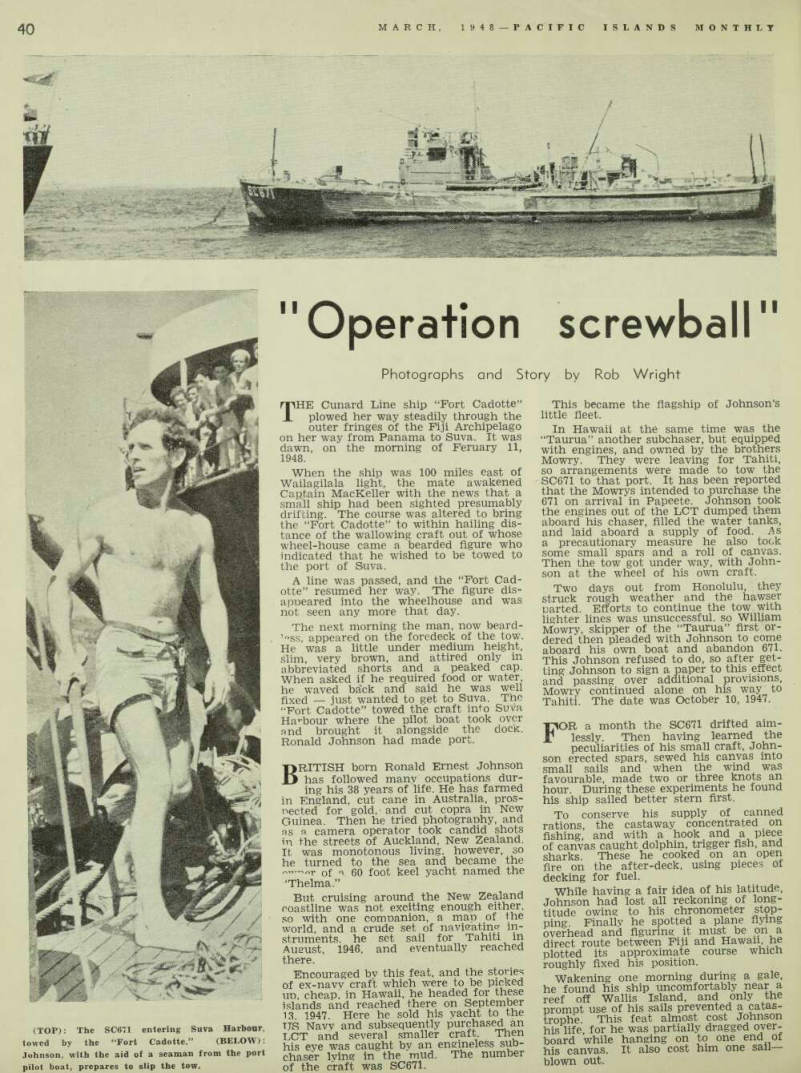
THE Cunard Line ship “Fort Cadotte” plowed her way steadily through the outer fringes of the Fiji Archipelago on her way from Panama to Suva. It was dawn, on the morning of Feruary 11, 1948.
When the ship was 100 miles east of Wailagilala light, the mate awakened Captain Mac Keller with the news that a small ship had been sighted presumably drifting. The course was altered to bring the “Fort Cadotte” to within hailing dis tance of the wallowing craft out of whose wheel-house came a bearded figure who indicated that he wished to be towed to the port of Suva.
A line was passed, and the “Fort Cad otte” resumed her way. The figure dis apneared into the wheelhouse and was not seen any more that day.
The next morning the man, now beard -Iqss, appeared on the foredeck of the tow.
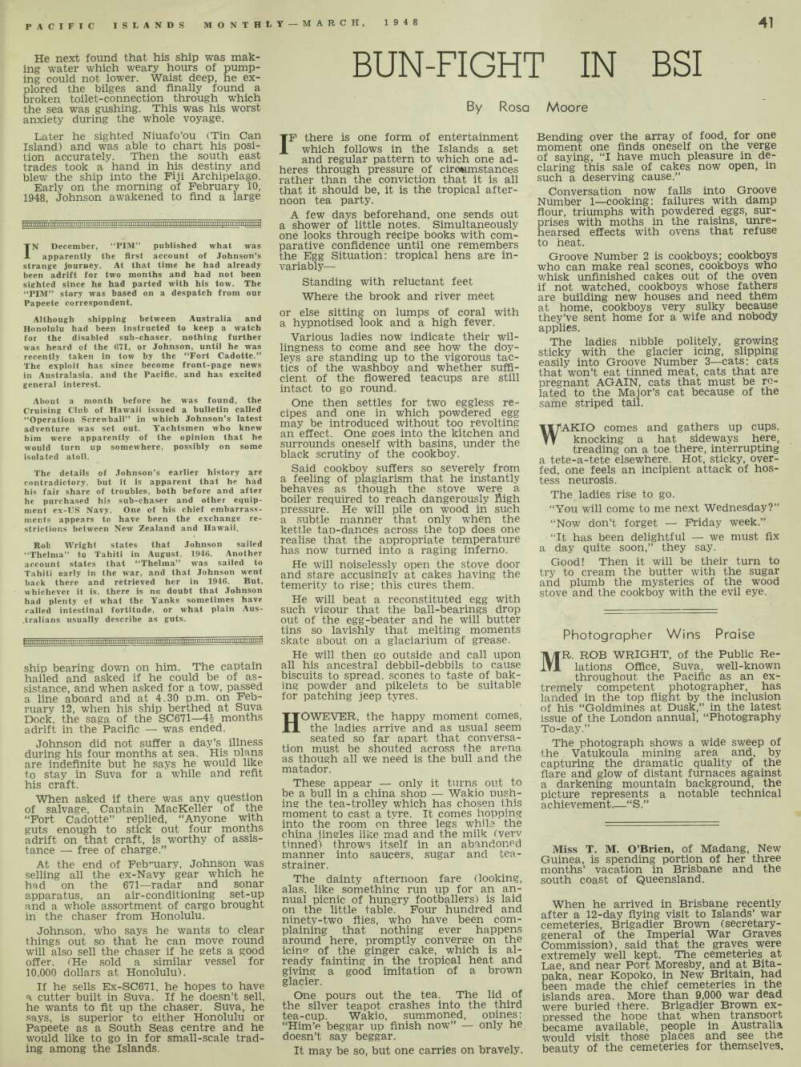
He was a little under medium height, slim, very brown, and attired only in abbreviated shorts and a peaked cap.
When asked if he required food or water, he waved back and said he was well fixed just wanted to get to Suva. The “Fort Cadotte” towed the craft into Suva Harbour where the pilot boat took over and brought it alongside the dock.
Ronald Johnson had made port.
BRITISH born Ronald Ernest Johnson has followed many occupations dur ing his 38 years of life. He has farmed in England, cut cane in Australia, pros pected for gold, and cut copra in New Guinea. Then he tried photography, and as a camera operator took candid shots in the streets of Auckland, New Zealand.
It was monotonous living, however, so he turned to the sea and became the of n, 60 foot keel yacht named the ‘Thelma.”
But cruising around the New Zealand coastline was not exciting enough either, so with one companion, a man of the world, and a crude set of navieratin*? in struments. he set sail for Tahiti in August, 1946, and eventually reached there.
Encouraged bv this feat, and the stories of ex-navv craft which were to be picked un, cheap, in Hawaii, he headed for these islands and reached there on September 13 1947. Here he sold his yacht to the US Navv and subsequently purchased an LCT and several smaller craft. Then his eve was caught by an eneineless sub chaser lying in the mud. The number of the craft was SC67I.
This became the flagship of Johnson’s little fleet.
In Hawaii at the same time was the “Taurua” another subchaser, but equipped with engines, and owned by the brothers Mowry. They were leaving for Tahiti, so arrangements were made to tow the SC67I to that port. It has been reported that the Mowrys intended to purchase the 671 on arrival in Papeete. Johnson took the engines out of the LCT dumped them aboard his chaser, filled the water tanks, and laid aboard a supply of food. x4s a precautionary measure he also took some small spars and a roll of canvas.
Then the tow got under way, with John son at the wheel of his own craft.
Two days out from Honolulu, they struck rough weather and the hawser parted. Efforts to continue the tow with lighter lines was unsuccessful, so William Mowry, skipper of the “Taurua” first or dered then pleaded with Johnson to come aboard his own boat and abandon 671.
This Johnson refused to do, so after get ting Johnson to sign a paper to this effect and passing over additional provisions, Mowry continued alone on his way to Tahiti. The date was October 10, 1947.
FOR a month the SC67I drifted aim lessly. Then having learned the peculiarities of his small craft, John son erected spars, sewed his canvas into small sails and when the wind was favourable, made two or three knots an hour. During these experiments he found his ship sailed better stern first.
To conserve his supply of canned rations, the castaway concentrated on fishing, and with a hook and a piece of canvas caught dolphin, trigger fish, and sharks. These he cooked on an open fire on the after-deck, using pieces of decking for fuel.
While having a fair idea of his latitude, Johnson had lost all reckoning of long titude owing to his chronometer stop ping. Finallv he spotted a plane flying overhead and figuring it must be on a direct route between Fiji and Hawaii he plotted its approximate course which roughly fixed his position.
Wakening one morning during a gale, he found his ship uncomfortably near a reef off Wallis Island, and only the prompt use of his sails prevented a catas trophe This feat almost cost Johnson his life, for he was partially dragged over board while hanging on to one end of his canvas. It also cost him one sail blown out.
(TOP): The SC671 entering Suva Harbour, towed by the “Fort Cadotte.” (BELOW): Johnson, with the aid of a seaman from the port pilot boat, prepares to slip the tow.
He next found that his ship was mak ing water which weary hours of pump ing could not lower. Waist deep, he ex plored the bilges and finally found a broken toilet-connection through which the sea was gushing. This was his worst anxiety during the whole voyage.
Later he sighted Niuafo’ou (Tin Can Island) and was able to chart his posi tion accurately. Then the south east trades took a hand in his destiny and blew the ship into the Fiji Archipelago.
Early on the morning of February IQ, 1948, Johnson awakened to find a large
IN December, “PIM” published what was apparently the first account of Johnson’s strange journey. At that time he had already been adrift for two months and had not been sighted since he had parted with his tow. The “PIM” story was based on a despatch from our Papeete correspondent.
Although shipping between Australia and Honolulu had been instructed to keep a watch for the disabled sub-chaser, nothing further was heard of the 671, or Johnson, until he was recently taken in tow by the “Fort Cadotte.”
The exploit has since become front-page news in Australasia, and the Pacific, and has excited general interest.
About a month before he was found, the Cruising Club of Hawaii issued a bulletin called “Operation Screwball” in which Johnson’s latest adventure was set out. Yachtsmen who knew him were apparently of the opinion that he would turn up somewhere, possibly on some isolated atoll.
The details of Johnson’s earlier history are contradictory, but it is apparent that he had his fair share of troubles, both before and after he purchased his sub-chaser and other equip ment ex-US Navy. One of his chief embarrass ments appears to have been the exchange re strictions between New Zealand and Hawaii.
Rob Wright states that Johnson sailed “Thelma” to Tahiti in August. 1946. Another account states that “Thelma” was sailed to Tahiti early in the war, and that Johnson went back there and retrieved her in 1946. But, whichever it is, there is no doubt that Johnson had plenty of what the Yanks sometimes have railed intestinal fortitude, or what plain Aus tralians usually describe as guts.
ship bearing down on him. The captain hailed and asked if he could be of as sistance, and when asked for a tow, passed a line aboard and at 4.30 p.m. on Feb ruary 12, when his ship berthed at Suva Dock, the saga of the 5C671—41 months adrift in the Pacific was ended.
Johnson did not suffer a day’s illness during his four months at sea. His plans are indefinite but he says he would like to stay in Suva for a while and refit his craft.
When asked if there was any question of salvage, Captain Mac Keller of the “Fort Cadotte” replied, “Anyone with guts enough to stick out four months adrift on that craft, is worthy of assis tance free of charge.”
At the end of February, Johnson was selling all the ex-Navy gear which he had on the 671 —radar and sonar apparatus, an air-conditioning set-up and a whole assortment of cargo brought in the chaser from Honolulu.
Johnson, who says he wants to clear things out so that he can move round will also sell the chaser if he gets a good offer. (He sold a similar vessel for 10,000 dollars at Honolulu).
If he sells Ex-SC67I, he hopes to have a cutter built in Suva. If he doesn’t sell, he wants to fit up the chaser. Suva, he says, is superior to either Honolulu or Papeete as a South Seas centre and he would like to go in for small-scale trad ing among the Islands.