Memories of Wakaya
p. 38 · Read in the full issue
By W. E. Newton
MRS. ALLEN INNES’S photographs,
with description of Wakaya, in De cember issue of “PIM” held more than a passing interest for Mrs. Violet Longdale, now living in Sydney.
In 1866, Mrs. Mary Pflugger, a young Irish-French woman who became noted for her extraordinary beauty and courage (and they were the days when plenty of courage was both needed and shown by pioneers) went out to Fiji with her hus band and was the first white woman to live in Rewa and Ba.
Her daughter, afterwards Mrs. Lang dale, was born there and was a god daughter of the celebrated King Cakabau, who bestowed on her the title of Princess of Ba.
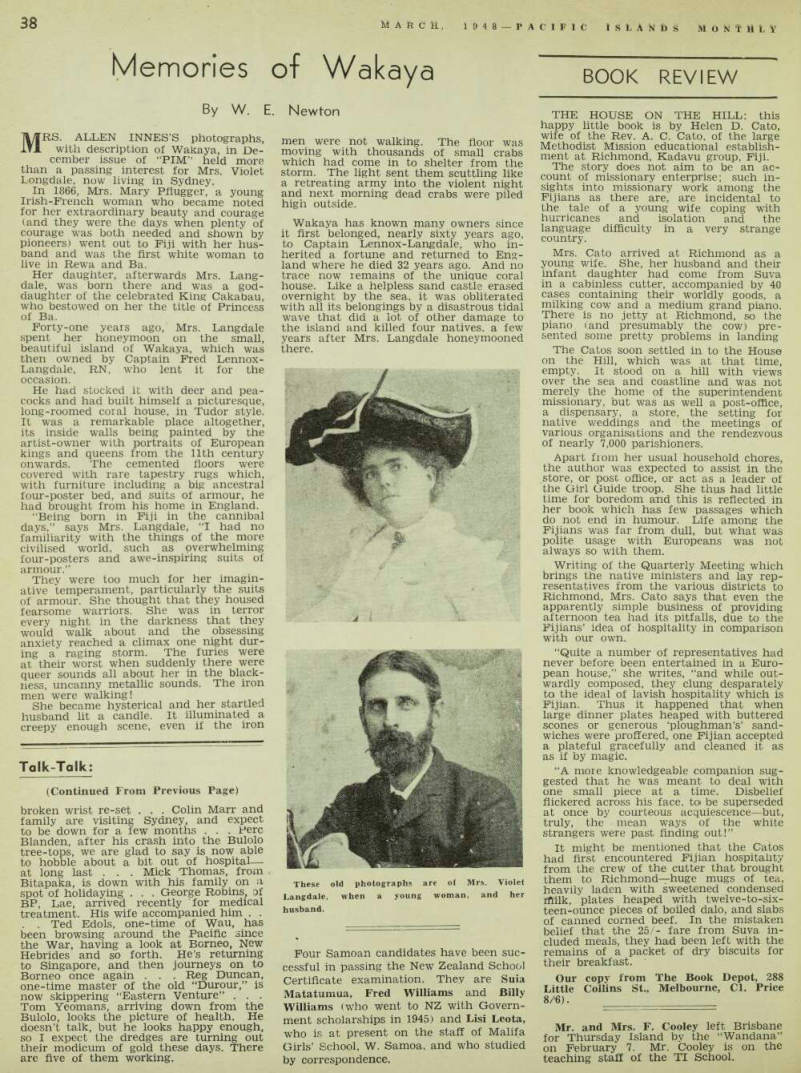
Forty-one years ago, Mrs. Langdale spent her honeymoon on the small, beautiful island of Wakaya, which was then owned by Captain Fred Lennox- Langdale, RN, who lent it for the occasion.
He had stocked it with deer and pea cocks and had built himself a picturesque, long-roomed coral house, in Tudor style.
It was a remarkable place altogether, its inside walls being painted by the artist-owner with portraits of European kings and queens from the 11th century onwards. The cemented floors were covered with rare tapestry rugs which, with furniture including a big ancestral four-poster bed, and suits of armour, he had brought from his home in England.
“Being born in Fiji in the cannibal days,” says Mrs. Langdale, “I had no familiarity with the things of the more civilised world, such as overwhelming four-posters and awe-inspiring suits of armour.”
They were too much for her imagin ative temperament, particularly the suits of armour. She thought that they housed fearsome warriors. She was in terror every night in the darkness that they would walk about and the obsessing anxiety reached a climax one night dur ing a raging storm. The furies were at their worst when suddenly there were queer sounds all about her in the black ness, uncanny metallic sounds. The iron men were walking!
She became hysterical and her startled husband lit a candle. It illuminated a creepy enough scene, even if the iron
men were not walking. The floor was moving with thousands of small crabs which had come in to shelter from the storm. The light sent them scuttling like a retreating army into the violent night and next morning dead crabs were piled high outside.
Wakaya has known many owners since it first belonged, nearly sixty years ago, to Captain Lennox-Langdale, who in herited a fortune and returned to Eng land where he died 32 years ago. And no trace now remains of the unique coral house. Like a helpless sand castle erased overnight by the sea, it was obliterated with all its belongings by a disastrous tidal wave that did a lot of other damage to the island and killed four natives, a few years after Mrs. Langdale honeymooned there.
Four Samoan candidates have been suc cessful in passing the New Zealand School Certificate examination. They are Suia Matatumua, Fred Williams and Billy Williams (who went to NZ with Govern ment scholarships in 1945) and Lisi Leota, who is at present on the staff of Malifa Girls’ School, W. Samoa, and who studied by correspondence.
These old photographs are of Mrs. Violet Langdale, when a young woman, and her husband.