The Pacific
pp. 7-8 · Read in the full issue
THE SOCIALISTS AND THE "BIG FIRMS" IN
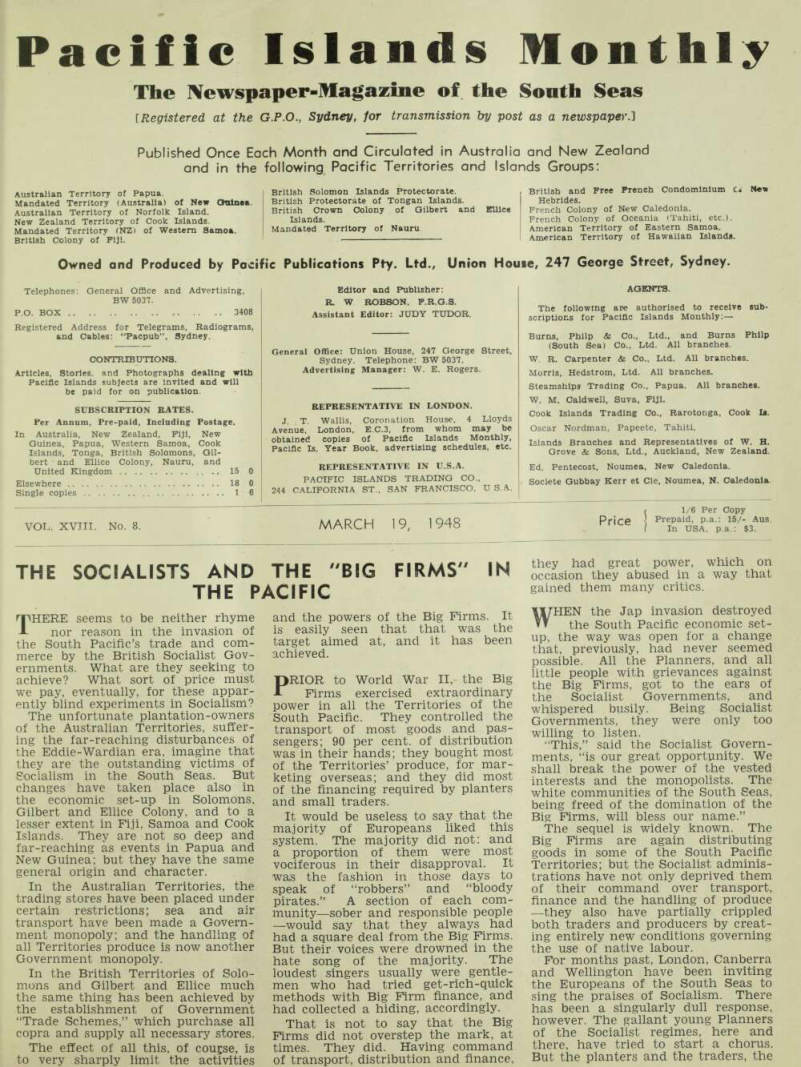
THERE seems to be neither rhyme nor reason in the invasion of the South Pacific’s trade and com merce by the British Socialist Gov ernments. What are they seeking to achieve? What sort of price must we pay, eventually, for these appar ently blind experiments in Socialism?
The unfortunate plantation-owners of the Australian Territories, suffer ing the far-reaching disturbances of the Eddie-Wardian era, imagine that they are the outstanding victims of Socialism in the South Seas. But changes have taken place also in the economic set-up in Solomons, Gilbert and Ellice Colony, and to a lesser extent in Fiji, Samoa and Cook Islands. They are not so deep and far-reaching as events in Papua and New Guinea; but they have the same general origin and character.
In the Australian Territories, the trading stores have been placed under certain restrictions; sea and air transport have been made a Govern ment monopoly; and the handling of all Territories produce is now another Government monopoly.
In the British Territories of Solo mons and Gilbert and Ellice much the same thing has been achieved by the establishment of Government “Trade Schemes,” which purchase all copra and supply all necessary stores.
The effect of all this, of course, is to very sharply limit the activities
and the powers of the Big Firms. It is easily seen that that was the target aimed at, and it has been achieved.
PRIOR to World War 11, the Big Firms exercised extraordinary power in all the Territories of the South Pacific. They controlled the transport of most goods and pas sengers; 90 per cent, of distribution was in their hands; they bought most of the Territories’ produce, for mar keting overseas; and they did most of the financing required by planters and small traders.
It would be useless to say that the majority of Europeans liked this system. The majority did not: and a proportion of them were most vociferous in their disapproval. It was the fashion in those days to speak of “robbers” and “bloody pirates.” A section of each com munity—sober and responsible people —would say that they always had had a square deal from the Big Firms.
But their voices were drowned in the hate song of the majority. The loudest singers usually were gentle men who had tried get-rich-quick methods with Big Firm finance, and had collected a hiding, accordingly.
That is not to say that the Big Firms did not overstep the mark, at times. They did. Having command of transport, distribution and finance,
they had great power, which on occasion they abused in a way that gained them many critics.
WHEN the Jap invasion destroyed the South Pacific economic set up, the way was open for a change that, previously, had never seemed possible. All the Planners, and all little people with grievances against the Big Firms, got to the ears of the Socialist Governments, and whispered busily. Being Socialist Governments, they were only too willing to listen.
“This,” said the Socialist Govern ments, “is our great opportunity. We shall break the power of the vested interests and the monopolists. The white communities of the South S-eas, being freed of the domination of the Big Firms, will bless our name.”
The sequel is widely known. The Big Firms are again distributing goods in some of the South Pacific Territories; but the Socialist adminis trations have not only deprived them of their command over transport, finance and the handling of produce —they also have partially crippled both traders and producers by creat ing entirely new conditions governing the use of native labour.
For months past, London, Canberra and Wellington have been inviting the Europeans of the South Seas to sing the praises of Socialism. There has been a singularly dull response, however. The gallant young Planners of the Socialist regimes, here and there, have tried to start a chorus.
But the planters and the traders, the
missionaries and—yes, let us whisper this! —most of the old-timers among the Administrative officials, are either silent, or condemn the present set up in simple and direct language.
One man has written to the editor: “We thought that conditions under the rule of the Big Firms were pretty foul—they did some blood-thirsty things—but they weren’t half as bad as this. Now, we are tied hand and foot with blasted regulations, we can not get shipment for our supplies in or our produce out, and we are being robbed of a large proportion of our earnings by the Governments and their stabilisation funds. In the old days, Big Firms and all, we did have some life and hope, and we could make some plans. Under this lot, everything is depressed and dead.
I’d ten times rather have the Big Firms again, than this set-up.”
And another: “Under the old re gime, if we got a bad deal from the Companies, we could appeal to the Government, and it would bring the Companies up to scratch. But now we get walked on by woolly-brained bureaucrats, and we have no one to appeal to. Canberra treats us like dirt.”
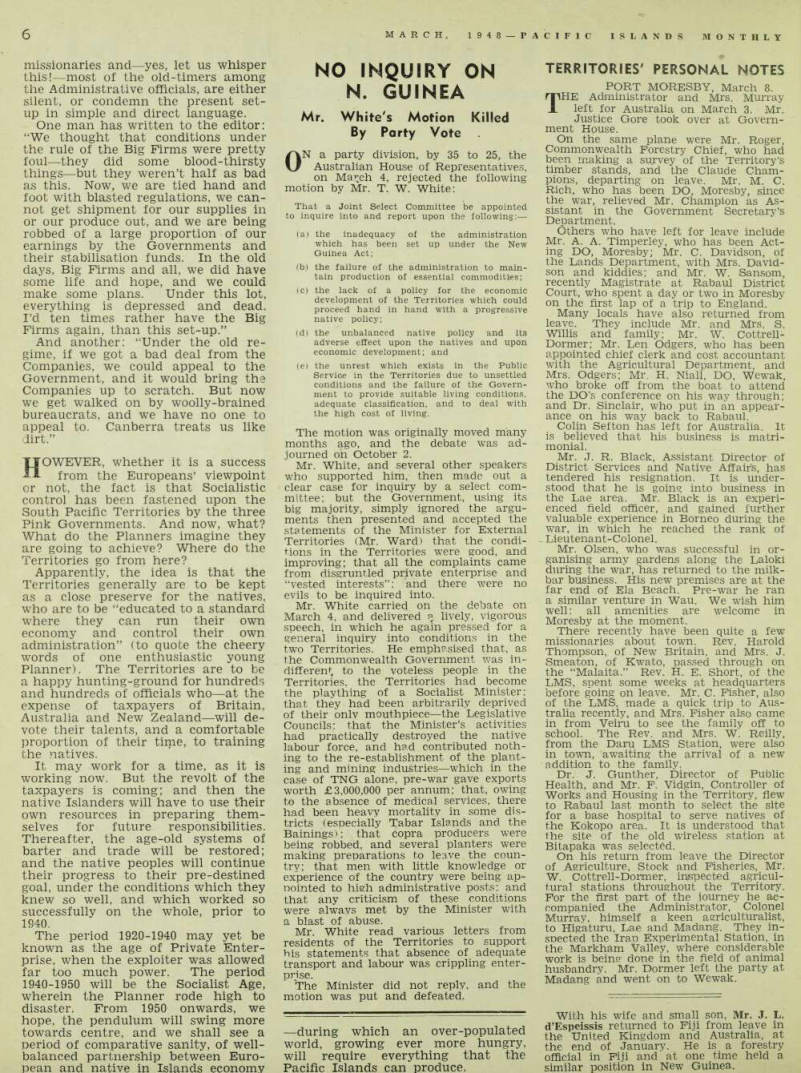
HOWEVER, whether it is a success from the Europeans’ viewpoint or not, the fact is that Socialistic control has been fastened upon the South Pacific Territories by the three Pink Governments. And now, what?
What do the Planners imagine they are going to achieve? Where do the Territories go from here?
Apparently, the idea is that the Territories generally are to be kept as a close preserve for the natives, who are to be “educated to a standard where they can run their own economy and control their own administration” (to quote the cheery words of one enthusiastic young Planner). The Territories are to be a happy hunting-ground for hundreds and hundreds of officials who—at the expense of taxpayers of Britain, Australia and New Zealand—will de vote their talents, and a comfortable proportion of their time, to training the natives.
It may work for a time, as it is working now. But the revolt of the taxpayers is coming; and then the native Islanders will have to use their own resources in preparing them selves for future responsibilities.
Thereafter, the age-old systems of barter and trade will be restored; and the native peoples will continue their progress to their pre-destined goal, under the conditions which they knew so well, and which worked so successfully on the whole, prior to 1940.
The period 1920-1940 may yet be known as the age of Private Enter prise, when the exploiter was allowed far too much power. The period 1940-1950 will be the Socialist Age, wherein the Planner rode high to disaster. From 1950 onwards, we hope, the pendulum will swing more towards centre, and we shall see a period of comparative sanity, of well balanced partnership between Euro pean and native in Islands economy
—during which an over-populated world, growing ever more hungry, will require everything that the Pacific Islands can produce.