The Greigs Of The
p. 44 · Read in the full issue
Line Atolls
Story and Photos By Morwell Hodges
THERE was a reference in December “PIM” to the Greig brothers, who were famous in the Pacific atolls some decades ago. I knew the brothers very well, on Fanning Island, in 1915-16.
The original Greig was a Scotchman, and he once owned Fanning Island and Washington Island, about 66 miles north west of Fanning. He married the sister of the king of Rakahanga (near Manihiki, in the Cook Islands) and they had a family of eight, all of whom received a good education.
The sons, Willie and Hughie, were well known on Fanning Island. Hughie was employed at the cable station, and I re member that he had a sailing-boat, fitted with an outrigger, in Island fashion. It was made, I think, in Sydney, and it was shipped to him in the Pacific Cable Board’s steamer “Iris.”
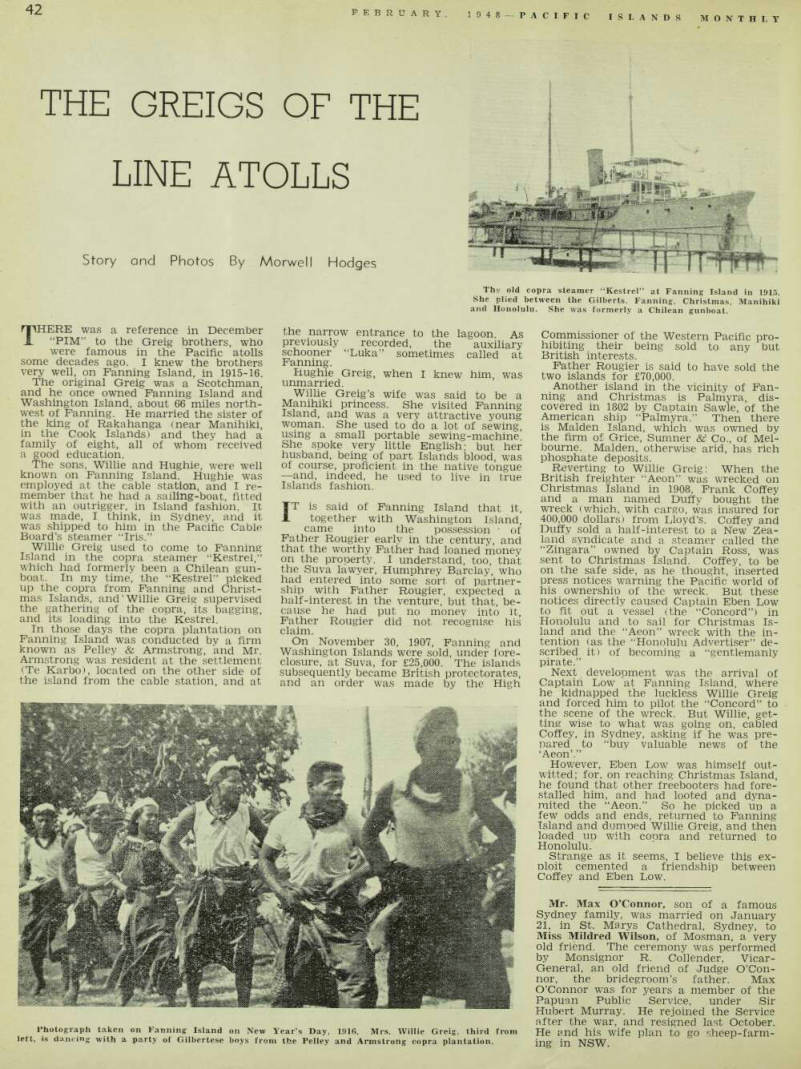
Willie Greig used to come to Fanning Island in the copra steamer “Kestrel,” which had formerly been a Chilean gun boat. In my time, the “Kestrel” picked up the copra from Fanning and Christ mas Islands, and’Willie Greig supervised the gathering of the coora, its bagging, and its loading into the Kestrel.
In those days the copra plantation on Fanning Island was conducted by a firm known as Pelley & Armstrong, and Mr.
Armstrong was resident at the settlement (Te Karbo), located on the other side of the island from the cable station, and at
the narrow entrance to the lagoon As previously recorded, the auxiliary schooner “Luka” sometimes called at Fanning.
Hughie Greig, when I knew him, was unmarried.
Willie Greig’s wife was said to be a Manihiki princess. She visited Fanning Island, and was a very attractive young woman. She used to do a lot of sewing, using a small portable sewing-machine.
She spoke very little English; but her husband, being of part Islands blood, was of course, proficient in the native tongue —and, indeed, he used to live in true Islands fashion.
IT is said of Panning Island that it, together with Washington Island, came into the possession • of Father Rougier early in the century, and that the worthy Father had loaned money on the property. I understand, too, that the Suva lawyer, Humphrey Barclay, who had entered into some sort of partner ship with Father Rougier, expected a half-interest in the venture, but that, be cause he had put no money into it, Father Rougier did not recognise his claim.
On November 30, 1907, Fanning and Washington Islands were sold, under fore closure, at Suva, for £25,000. The islands subsequently became British protectorates, and an order was made by the High
Commissioner of the Western Pacific pro hibiting their being sold to any but British interests.
Father Rougier is said to have sold the two islands for £70,000.
Another island in the vicinity of Pan ning and Christmas is Palmyra, dis covered in 1802 by Cantain Sawle, of the American ship “Palmyra.” Then there is Malden Island, which was owned by the firm of Grice, Sumner &' Co., of Mel bourne. Malden, otherwise arid, has rich phosphate deposits.
Reverting to Willie Greig: When the British freighter “Aeon” was wrecked on Christmas Island in 1908, Frank Coffey and a man named Duffv bought the wreck (which, with cargo, was insured for 400,000 dollars! from Lloyd’s. Coffey and Duffy sold a half-interest to a New Zea land syndicate and a steamer called the “Zingara” owned by Captain Ross, was sent to Christmas Island. Coffey, to be on the safe side, as he thought, inserted press notices warning the Pacific world of his ownership of the wreck. But these notices directly caused Captain Eben Low to fit out a vessel (the “Concord”) in Honolulu and to sail for Christmas Is land and the “Aeon” wreck with the in tention (as the “Honolulu Advertiser” de scribed it) of becoming a “gentlemanly pirate.”
Next development was the arrival of Captain Low at Fanning Island, where he kidnapped the luckless Willie Greig and forced him to pilot the “Concord” to the scene of the wreck. But Willie, get ting wise to what was going on, cabled Coffey, in Sydney, asking if he was pre pared to “buy valuable news of the ‘Aeon’.”
Hov/ever, Eben Low was himself out witted; for. on reaching Christmas Island, he found that other freebooters had fore stalled him, and had looted and dyna mited the “Aeon.” So he picked up a few odds and ends, returned to Fanning Island and dumped Willie Greig, and then loaded up with copra and returned to Honolulu.
Strange as it seems, I believe this ex ploit cemented a friendship between Coffey and Eben Low.
Mr. Max O’Connor, son of a famous Sydney family, was married on January 21, in St. Marys Cathedral, Sydney, to Miss Mildred Wilson, of Mosman, a very old friend. The ceremony was performed by Monsignor R. Collender, Vicar- General, an old friend of Judge O’Con nor, the bridegroom’s father. Max O’Connor was for years a member of the Papuan Public Service, under Sir Hubert Murray. He rejoined the Service after the war, and resigned last October.
He and his wife plan to go sheep-farm ing in NSW.
Photograph taken on Fanning Island on New Year’s Day. 1916. Mrs. Willie Greig, third from left, is dancing with a party of Gilbertese boys from the Pelley and Armstrong copra plantation.
The old copra steamer “Kestrel” at Fanning Island in 1915.
She plied between the Gilberts, Fanning, Christmas, Manibiki and Honolulu. She was formerly a Chilean gunboat.