One-Horse Shay
p. 42 · Read in the full issue
BY what seemed a miracle of Providence, we received a permit to visit the island of Tubuai almost at the same time as the good ship “Terehau” was to depart. We just walked aboard — which is a lot less than one usually does.
Generally, weeks of frustration lie ahead of anyone who wishes to visit in these parts.
At the last moment, 300 lb. Johnny Mervin came puffing to the side to say that he had told the Supercargo to give Eddie Flohr and me a bunk each. A brief argument ensued when the bunk of the first mate and one of the crew were cheerfully given away; but eventually an arrangement was made to the satisfaction I was placed in a cubicle of the extreme dimensions of 8 x 8 x 8 feet. There were three bunks on each of two sides of the cabin, in tiers. The second mate and the bosun had the two topmost bunks. t had one in the second tier, and across the way, a very sick Chinese lady had another. Below, a Tubuai mother and daughter had the bunks, and on the floor were miscellaneous packages, and at times, when it rained, the Tubuai father, his son ana two dogs also. I learned later that my bunk had been given up for me by the Tubuai man; but no amount of argument could induce him to take it back again. , . , , . „ . . .
WO days and nights of fast travel by the ‘Terehau” brought us to Rurutu.
Our clothes, shaving gear, and eating utensils had been securely stored in the bottom of the hold when we weren’t watching, and so we were by now looking very little like orometuas (missionaries).
It will take three good launderings to get my clothes white again. ! ventured ashore on Rurutu immediately. but dear old Eddie couldn t manage it The repast of tinned peas and sardines mixed up in a tin, plus sweet Chinese hi<?r > iiit«; had been too much for his stomach There were absolutely no convpniences on the boat The next day we were able to get our clothes, have a shave and both went ashore. One man showed us the village, and what a village! It was clean and sparkling. Nearly every house was of coral and mortar, freshly whitewashed,
The grassy lawn-like road was bordered by white-washed walls: in the gardens, phlox had gone wild; and here and there clumps of brilliant red valotta or Scar borough lilies were blooming profusely,
Readers will remember how Pastor R. N. Heggie, of the SDA Mission in French Oceania, told the amusing story of his cruise to an outer island.
Now he tells how he visited another island—and used another kind of transportation.
The m f nse coral stone church of the Protestants, complete with great galleries, would be a credit to any large town in Australia.
In most of the neatly enclosed yards were plantations of hat and mat-making pandanus; for the Rurutuans, are in dustrious people. While the men fish or work, the women’s deft fingers fashion Panamas and mats for the Tahiti market, People were almost embarrassing in their goodwill to us. Here one pressed i n to our h ands a mat, an d here another, a h a t. j n these parts such articles are worth about £1 in local currency. We were compelled to eat two huge meals In immediate succession at two different homes. Fortunately, we were almost equal to the occasion as we had had r a ther a lean time on the boat, /f\N the Friday evening we were ready t 0 de p ar t f or Tubuai, but the anchor refused to come up until about 10 0 - clock We ho ve to about midday Satur day, off the jetty at Tubuai. Charles Doom and others were there to welcome and took us home us ana look us nome.
Tubuai just comes within the tropics and some of its sister islands are a num ber of miles within the temperate zone, Consequently, as the wind was then blow ing from the south-east, across unbroken seas from the yery dpors of Antarctica, all Tahitians fairly shivered. Eddie Fiohi wore an overcoat, and I had to borrow a heavy US marine Jacket. I could almost imagine I was in Wellington, New
Zealand—but when I looked up, there were the coconuts!
The land is very fertile and the climate suitable for nearly all temperate and sub tropical products. Charles Doom has done much to educate the people in culti vating the soil for a wide variety of fruit and vegetables, and this has been keenly appreciated by the local French Admin istrator.
We made a circuit of the island in Charles’ spring cart, and we felt that it was fortunate that the local breed of horse is a very dispirited, dejected type of animal. Our reins were merely a rope tied around the horse’s lower jaw. The traces were heavy pieces of insulated, marine cable. The outfit had no saddle, so the shafts were tied directly to the collar and hames. There was no britchen and the cart had no sides. Charles sat with his legs dangling between the shafts and was the driver.
Eddie Flohr (who weighed about 200 lbs.) and I tried to sit on a very small box behind and keep the cart balanced.
This, we found, was rather difficult, prin cipally because we couldn’t brace our feet or hands against anything. When the centre of gravity shifted too far forward the horse’s neck was bowed to the ground, and when it shifted too far to the rear, the shafts brought the collar up with a jerk against the poor animal’s wind pipe and nearly choked it. On one occasion our patient steed need only have pointed its nose to the sky, the collar would have shot right over its head, and we would have been neatly tipped in a pile on the ground behind. But probably only an Australian horse would think of that!
I must admit I was slightly em barrassed with the whole arrangement, but noticing that most of the other horses and carts were similarly tied together, I gathered it was only a fool white man who couldn’t keep the balance, who was to blame.
In this fashion did we circumnavigate the lovely little island in about eight hours, which says much for the patience of ourselves and the horse.
Whatever may be the faults of the Polynesians (and in that respect who are we to judge?), their hospitality, their generosity, and their ready good humour are bevond compare. A week and a half of visiting made Tubuai very dear to us.
THREE days and three nights over a barren ocean returned us to Tahiti, but as we look back to the still un spoilt islands of the south we say, God keep them so!
After serving for three years at the Methodist Mission Hospital at Ba, Fiji, Miss Isobel Chowns recently returned to her home in Brisbane on leave. She will shortly marry Mr. Bruce Newman, of the CSR Co., at Ba.
Miss Betty Gascoigne, formerly of Rabaul, New Guinea, was quietly married to Mr. Peter Muller of Mel bourne on January 2. The bride was given away by the Rev. W. G. Wiede mann.
Lady Hutson, the widow of Sir Eyre Hutson, one-time Governor of Fiji, has this year maintained her custom of many years' by sending New Year greetings to Fiji by way of the “Fiji Times.”
The Rev. C. T. J. Luxton, of the Metho dist Solomon Islands Mission at Buka Passage, returned to New Zealand in the Melanesian Mission ship “Southern Cross” on January 15. He was accom panied by Mrs. Luxton and their child ren. Mr. Luxton went to Buka in 1939 and was evacuated in 1942, He returned with his family in 1946, as soon as the New Guinea Administration had given permission for missionaries to resume work in the area.
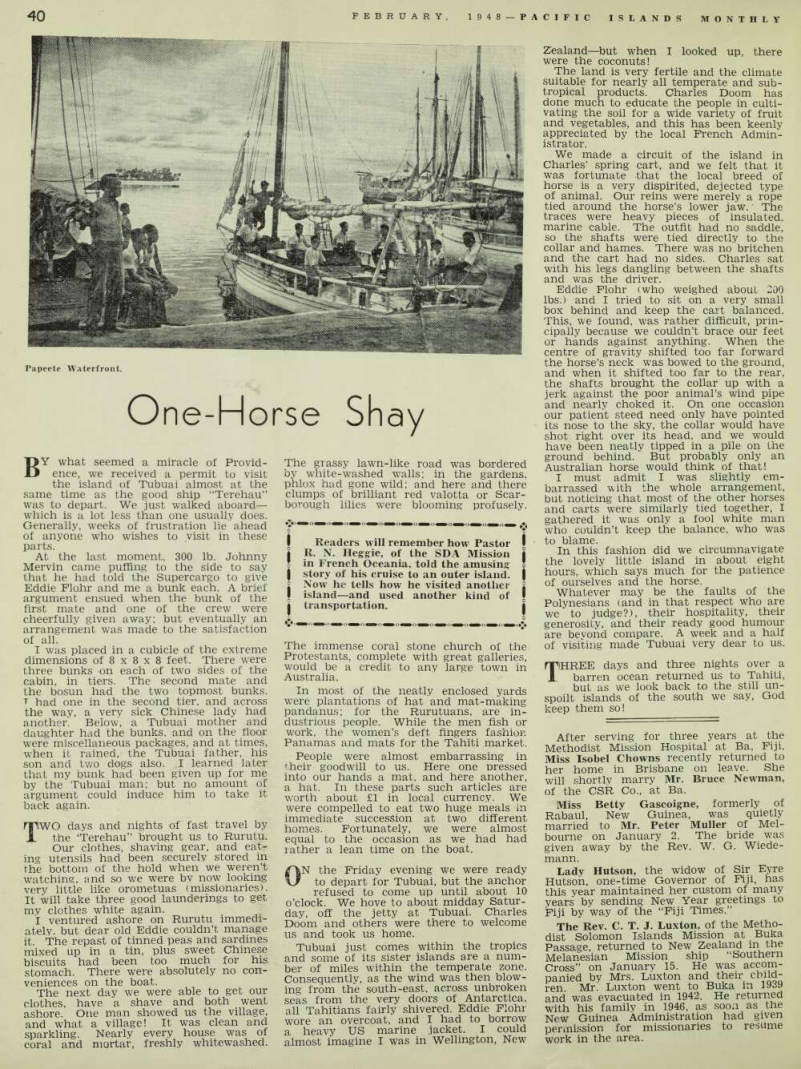
Papeete Waterfront.