Fraud Charges
pp. 12-15 · Read in the full issue
'Jock' Garden Goes To Trial On Forgery and
Fraud Charges Queer Mixture of Politics in N. Guinea Timber Case
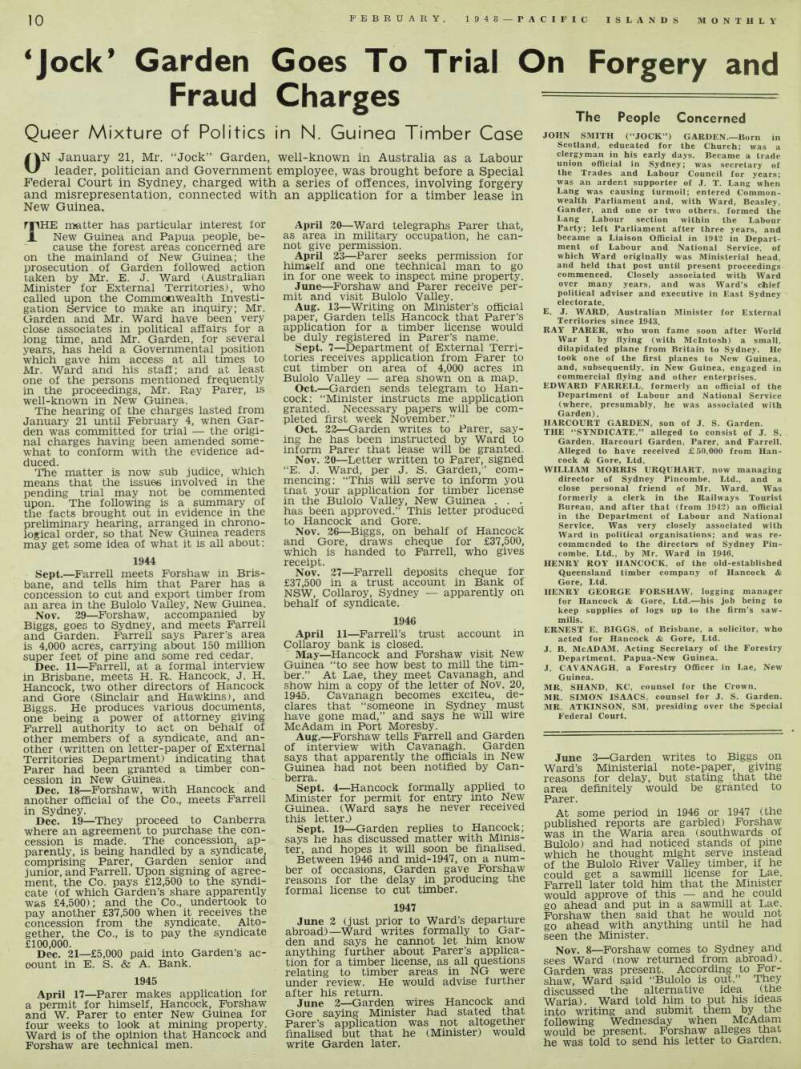
ON January 21, Mr. “Jock” Garden, well-known in Australia as a Labour leader, politician and Government employee, was brought before a Special Federal Court in Sydney, charged with a series of offences, involving forgery and misrepresentation, connected with an application for a timber lease in New Guinea.
THE matter has particular interest for New Guinea and Papua people, be cause the forest areas concerned are on the mainland of New Guinea; the prosecution of Garden followed action taken by Mr. E. J. Ward (Australian Minister for External Territories), who called upon the Commonwealth Investi gation Service to make an inquiry; Mr.
Garden and Mr. Ward have been very close associates in political affairs for a long time, and Mr. Garden, for several years, has held a Governmental position which gave him access at all times to Mr. Ward and his staff; and at least one of the persons mentioned frequently in the proceedings, Mr. Ray Parer, is well-known in New Guinea.
The hearing of the charges lasted from January 21 until February 4, when Gar den was committed for trial the origi nal charges having been amended some what to conform with the evidence ad duced.
The matter is now sub judice, which means that the issues involved in the pending trial may not be commented upon. The following is a summary of the facts brought out in evidence in the preliminary hearing, arranged in chrono logical order, so that New Guinea readers may get some idea of what it is all about: 1944 Sept.—Farrell meets Forshaw in Bris bane, and tells him that Parer has a concession to cut and export timber from an area in the Bulolo Valley, New Guinea.
Nov. 29—Forshaw, accompanied by Biggs, goes to Sydney, and meets Farrell and Garden. Farrell says Parer’s area is 4,000 acres, carrying about 150 million super feet of pine and some red cedar, Dec. 11— Farrell, at a formal interview in Brisbane, meets H. R. Hancock, J. H.
Hancock, two other directors of Hancock and Gore (Sinclair and Hawkins), and Biggs. He produces various documents, one being a power of attorney giving Farrell authority to act on behalf of other members of a syndicate, and an other (written on letter-paper of External Territories Department) indicating that Parer had been granted a timber con cession in New Guinea.
Dec. 18 —Forshaw, with Hancock and another official of the Co., meets Farrell in Sydney.
Dec. 19 —They proceed to Canberra where an agreement to purchase the con cession is made. The concession, ap parently, is being handled by a syndicate, comprising Parer, Garden senior and junior, and Farrell. Upon signing of agree ment, the Co. pays £12,500 to the syndi cate (of which Garden’s share apparently was £4,500); and the Co., undertook to pay another £37,500 when it receives the concession from the syndicate. Alto gether, the Co., is to pay the syndicate
£Loo,Ooo.
Dec. 21—£5,000 paid into Garden’s ac count in E. S. & A. Bank. 1945 April 17 —Parer makes application for a permit for himself, Hancock, Forshaw and W. Parer to enter New Guinea for four weeks to look at mining property.
Ward is of the opinion that Hancock and Forshaw are technical men.
April 20 —Ward telegraphs Parer that, as area in military occupation, he can not give permission.
April 23 —Parer seeks permission for himself and one technical man to go in for one week to inspect mine property.
June —Forshaw and Parer receive per mit and visit Bulolo Valley.
Aug. 13 —Writing on Minister’s official paper, Garden tells Hancock that Parer’s application for a timber license would be duly registered in Parer’s name.
Sept. 7—Department of External Terri tories receives application from Parer to cut timber on area of 4,000 acres in Bulolo Valley area shown on a map, Oct. —Garden sends telegram to Han cock: “Minister instructs me application granted. Necessary papers will be com pleted first week November.”
Oct. 22—Garden writes to Parer, say ing he has been instructed by Ward to inform Parer that lease will be granted.
Nov. 20—Letter written to Parer, signed “E. J. Ward, per J. S. Garden,” com mencing: “This will serve to inform you that your application for timber license in the Bulolo Valley, New Guinea . . . has been approved.” This letter produced to Hancock and Gore.
Nov. 26 —Biggs, on behalf of Hancock and Gore, draws cheque for £37,500, which is handed to Farrell, who gives receipt.
Nov. 27 —Farrell deposits cheque for £37,500 in a trust account in Bank of NSW, Collaroy, Sydney apparently on behalf of syndicate. 1946 April 11 —Farrell’s trust account in Collaroy bank is closed.
May—Hancock and Forshaw visit New Guinea “to see how best to mill the tim ber.” At Lae, they meet Cavanagh, and show him a copy of the letter of Nov. 20, 1945. Cavanagn becomes exciteu, de clares that “someone in Sydney must have gone mad,” and says he will wire McAdam in Port Moresby.
Aug. —Forshaw tells Farrell and Garden of interview with Cavanagh. Garden says that apparently the officials in New Guinea had not been notified by Can bcrra Sept. 4— Hancock formally applied to Minister for permit for entry into New Guinea. (Ward says he never received this letter.) Sept. 19 —Garden replies to Hancock; says he has discussed matter with Minis ter, and hopes it will soon be finalised.
Between 1946 and mid-1947, on a num ber of occasions, Garden gave Forshaw reasons for the delay in producing the formal license to cut timber. 1947 June 2 (just prior to Ward’s departure abroad) —Ward writes formally to Gar den and says he cannot let him know anything further about Parer’s applica tion for a timber license, as all questions relating to timber areas in NG were under review. He would advise further after his return.
June 2—Garden wires Hancock and Gore saying Minister had stated that Parer’s apnlication was not altogether finalised blit that he (Minister) would write Garden later.
June 3 —Garden writes to Biggs on Ward’s Ministerial note-paper, giving reasons for delay, but stating that the area definitely would be granted to Parer.
At some period in 1946 or 1947 (the published reports are garbled) Forshaw was in the Waria area (southwards of Bulolo) and had noticed stands of pine which he thought might serve instead of the Bulolo River Valley timber, if he could get a sawmill license for Lae.
Farrell later told him that the Minister would approve of this and he could go ahead and put in a sawmill at Lae.
Forshaw then said that he would not go ahead with anything until he had seen the Minister.
Nov. B—Forshaw comes to Sydney and sees Ward (now returned from abroad).
Garden was present. According to For shaw, Ward said “Bulolo is out.” They discussed the alternative idea (the Waria). Ward told him to put his ideas into writing and submit them by the following Wednesday when McAdam would be present, Forshaw alleges that he was told to send his letter to Garden.
Later, this day, Forshaw asked Garden if everything was in order. Garden as sured him that it was.
Nov. 10—Back in Brisbane, Forshaw drafts a letter to Ward, complaining strongly about delay and frustration.
This is typed by Briggs’s typist, and sent to Garden. (When the letter is produced in evidence, it is shown that the last page has been re-typed, on different paper, and Forshaw’s signature forged.
One of Ward’s Departmental typists gave evidence that she re-typed that page on Garden’s instructions, before it went to the Minister. The page, as re-typed, omitted all references to Parer’s conces sion and the payment of money to the syndicate.) Dec. 6—Forshaw has another interview in Sydney with Ward. Garden and Mc- Adam are present. McAdam told For shaw that Parer had no license to cut timber in New Guinea. Forshaw, now suspicious and alarmed, reports back to Brisbane.
Dec. 15 —Forshaw again sees Ward taking with him a copy of the letter of Nov. 20, 1945. Ward says he has not known anything of this. He calls in Garden, who admits having signed the letter. - Ward says Garden had no authority to do this and then consults Commonwealth Solicitor, and places matter in hands of Commonwealth Inves tigation Service. 1948 Jan. 2—Garden is summoned to appear before Special Federal Court, on charges involving forgery and fraud.
Mr. Ward’S Evidence
ACCORDING to Mr, Ward’s evidence, Garden on many occasions in 1945, 1946 and 1947 discussed with him the application for a timber license made by Parer; but he had never approved the issue of a license. He had, on the contrary, repeatedly indicated to Garden that the grant of a concession to cut timber in New Guinea was subject to im portant Government policy, which had not been finalised. He denied that he had ever met Ray Parer, Garden had an office close to his office in the Com monwealth Bank Chambers, Sydney; but he had never given Garden permission to use his note-paper or autnority to sign his name. Garden acted for him in many electorate matters. Garden had no staff —when he wanted staff help, he made use of the Minister’s staff.
Ward, under cross-examination, denied that he saw Parer in his office in May, 1944; that Parer said he wanted a tim ber concession; that he had said he would do anything he could for Parer, because he recognised what the Parers had done for New Guinea, but that they would have to move cautiously, because there were others in the field, among them Brett and E. G. Theodore. He also denied that he was to receive £20,000 as his share from the sale of timber con cessions in New Guinea; that he had le ceived £5,000 in £lO notes, in his office, as part of the deal; that he had directed all monies for him to his friend Urquhart; that his wife had told friends that she had won £ll,OOO by backing a horse called Precise. He made his safety deposit box in the Bank of NSW avail able. and it was duly examined, and dis closed nothing that would throw light upon the inquiry.
During this cross-examination of Ward by Isaacs, there were some very angry scenes, in which Ward showed great re sentment of the questions.
No Witnesses For Defence
MR. ISAACS called no evidence for the defence he relied upon his cross examination of the various wit nesses for the Crown to prove his con tention that all that had been done had been done with the knowledge, if not the consent, of the Minister. There were
some bitter clashes between Mr. Isaacs and Mr, Ward when the latter was in the box.
Isaacs brought out the fact that Urquhart, Ward’s closest friend, had risen from the position of railway clerk to the managing directorship of a Sydney company, at some £2,000 per annum, via Mr. Ward’s former Department, in recent years; that large sums of money had
SS*to'wded b too4h OU iS- :
Ward amdlcatlons° for nermits totoDOTt mods- and that Mr Wkrd and Mr Urquhart .were together in 1947. (Urquhart in evidence said he got most of his money on the racecourse, especially in backing a horse called Precise; and Ward said that the meeting of himself and Urouhart in London was quite accidental.) The Crown, in this case, apparently made no attempt to trace the fate of the £37,500 paid by Hancock and Gore on November 26, 1945. Altogether, this Co. Paid out £50,000. £12,500 seems to have been divided up in some way between members of the syndicate (Garden, Garden junior, Parer and Farrell); but the balance of £37,500 is lost to sight after it was paid into Farrell’s Trust Account on November 27, 1945. .
A Full Inquiry Needed leadin.r artiole- g ’ as ,ts I ieaa ng article.
N 'due course a jury will determine whether Mr. J. S. Garden is innocent or guilty of the charges on which he has been committed from the Special Court.
But evidence given at the preliminary hearing has raised other questions touch ing public administration which call for the strictest inquiry, whatever the out come of the Garden case. Public opinion has been deeply disturbed by some of the disclosures made and their implications.
These clearly call for a thorough inves tigation by a Royal Commission with wide terms of reference.
The Government should need no prompting in this regard. If there has been administrative laxity, the facts should be fully explored and revealed.
It must seem extraordinary that though Mr. Garden, as a “liaison officer,” had nothing to do with Mr. Ward’s de partment, he should have had such ready access to the Ministerial suite, and should have been able, as late as November last, according to evidence given, to employ the services of a typist in the External Territories Department.
Another matter requiring further eluci dation is the relationship between Mr.
Ward and the former national service officer whose appointment as managing director of a typewriter agency he was in strumental in procuring. When this company sought a licence to import type writers from Sweden, Mr. Ward became, as he admitted, the intermediary between the firm and the Department of Import Procurement.
Is it customary for a Minister to give this kind of assistance? Does the favoured applicant thereby obtain an ad vantage not available to other business concerns?
Mr. Urquhart seems to have been most fortunate in his Ministerial friend.
(Continued on page 13)
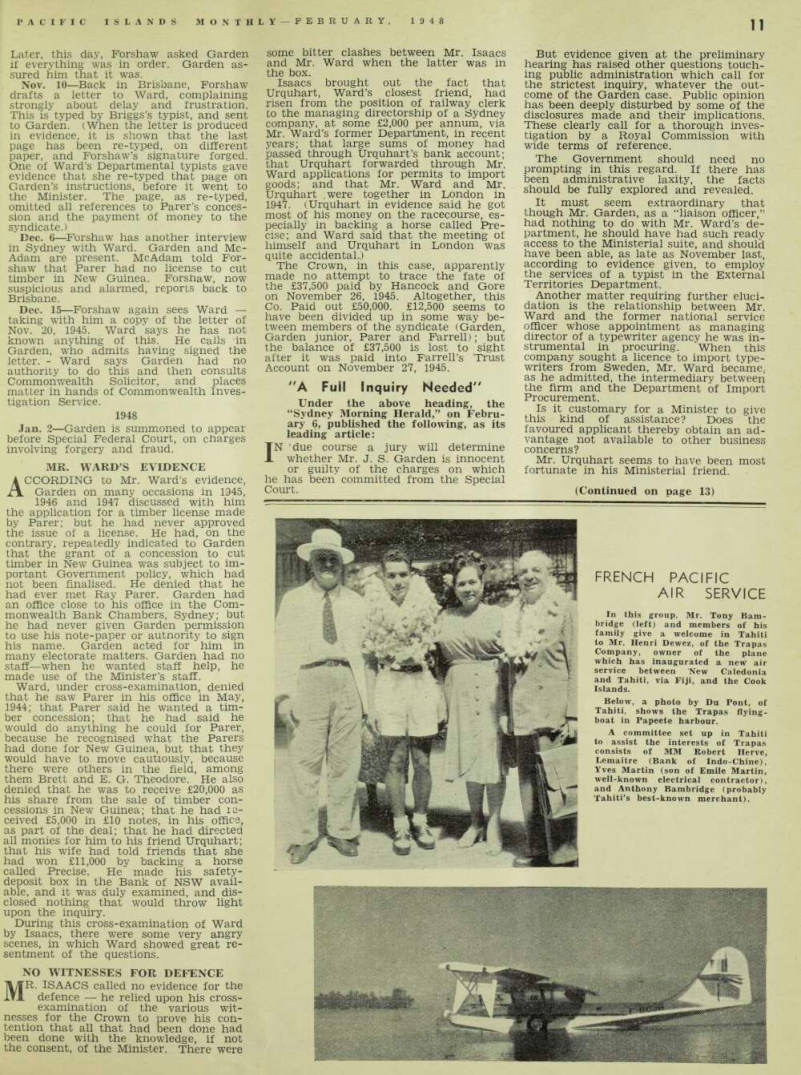
French Pacific
Air Service
In this group. Mr. Tony Bam bridge (left) and members of his family give a welcome in Tahiti to Mr. Henri Dewez, of the Trapas Company, owner of the plane which has inaugurated a new air service between New Caledonia and Tahiti, via Fiji, and the Cook Islands.
Below, a photo by Du Pont, of Tahiti, shows the Trapas flying boat in Papeete harbour.
A committee set up in Tahiti to assist the interests of Trapas consists of MM Robert Herve, Lemaitre (Bank of Indo-Chine), Yves Martin (son of Emile Martin, well-known electrical contractor), and Anthony Bambridge (probably Tahiti’s best-known merchant).
Apart from these matters, there is ob vious need for an investigation into both policy and administration where the dis posal of New Guinea timber lands is concerned. Rightly or wrongly, grave misgivings as to the present state of affairs have been aroused by some of the evidence given in the Special Court.
For this reason also the Government has a duty to assure the public that it will appoint a Royal Commission as soon as the Garden case Is disposed of.
Possible Attack On Ward
IT was reported in the “Sunday Tele graph” of February 8, that, when Parliament assembles this month, the Opposition will move for the sus pension of Mr. Ward from Ministerial office until the “Jock” Garden trial is disposed of.
When the renort was referred to Mr.
Ward on February 9, he ridiculed it. He said: “There is nothing original in the idea. Anti-Labour forces have been de siring my resignation ever since I became Cabinet Minister. The ‘Sunday Tele graph’ had the report in the wrong sec tion of the paper. It should have been on the comic page.”