"Tagua"
p. 63 · Read in the full issue
Story Of The
Forgotten Incident of World War I
By Oscar Nordman
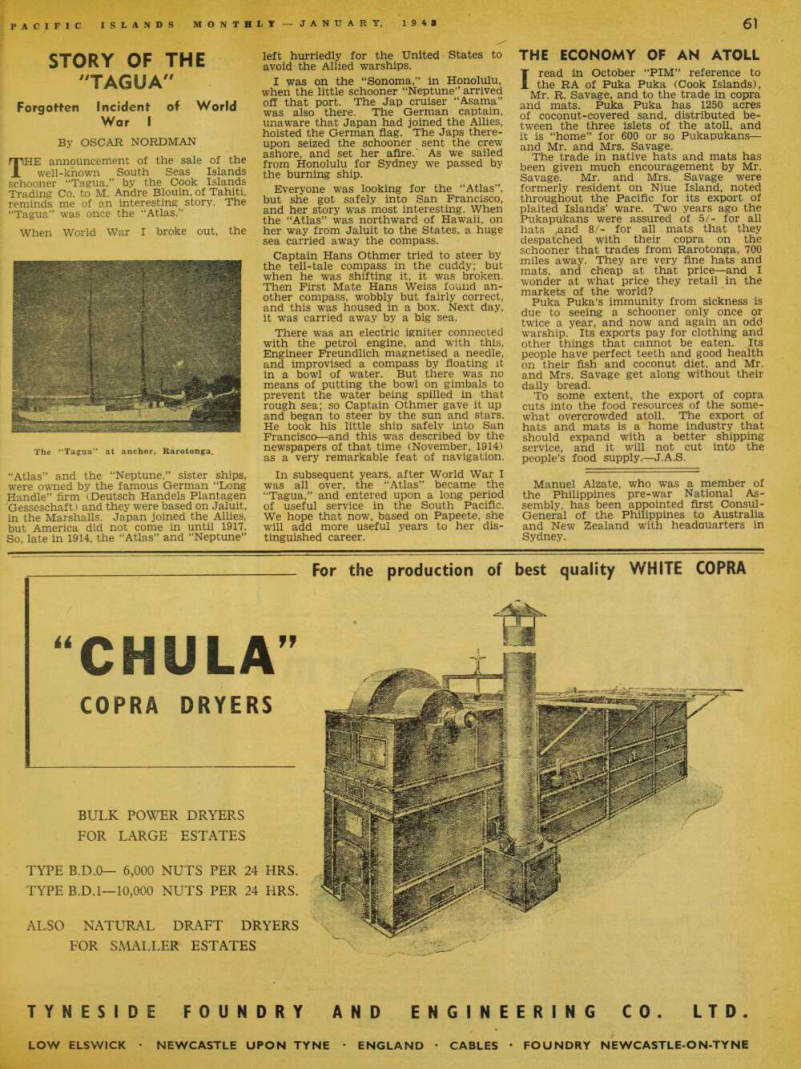
THE announcement of the sale of the well-known South Seas Islands schooner “Tagua,” by the Cook Islands Trading Co. to M. Andre Blouin, of Tahiti, reminds me of an interesting story. The “Tagua” was once the “Atlas.”
When World War I broke out, the
“Atlas” and the “Neptune,” sister ships, were owned by the famous German “Long Handle” firm (Deutsch Handels Plantagen Gesseschaft) and they were based on Jaluit, in the Marshalls. Japan joined the Allies, but America did not come in until 1917.
So, late in 1914, the “Atlas” and “Neptune”
left hurriedly for the United States to avoid the Allied warships.
I was on the “Sonoma,” in Honolulu, when the little schooner “Neptune” arrived off that port. The Jap cruiser “Asama” was also there. The German captain, unaware that Japan had joined the Allies, hoisted the German flag. The Japs there upon seized the schooner sent the crew ashore, and set her afire.' As we sailed from Honolulu for Sydney we passed by the burning ship.
Everyone was looking for the “Atlas”, but she got safely into San Francisco, and her story was most interesting. When the “Atlas” was northward of Hawaii, on her way from Jaluit to the States, a huge sea carried away the compass.
Captain Hans Othmer tried to steer by the tell-tale compass in the cuddy; but when he was shifting it, it was broken.
Then First Mate Hans Weiss found an other compass, wobbly but fairly correct, and this was housed in a box. Next day, it was carried away by a big sea.
There was an electric igniter connected with the petrol engine, and with this, Engineer Freundlich magnetised a needle, and improvised a compass by floating it in a bowl of water. But there was no means of putting the bowl on gimbals to prevent the water being spilled in that rough sea; so Captain Othmer gave it up and began to steer by the sun and stars.
He took his little ship safely into San Francisco —and this was described by the newspapers of that time (November. 1914) as a very remarkable feat of navigation.
In subsequent years, after World War I was all over, the “Atlas” became the “Tagua,” and entered upon a long period of useful service in the South Pacific, We hope that now, based on Papeete, she will add more useful years to her dis tinguished career.
The “Tagua” at anchor, Rarotonga.