Man Overboard!
p. 62 · Read in the full issue
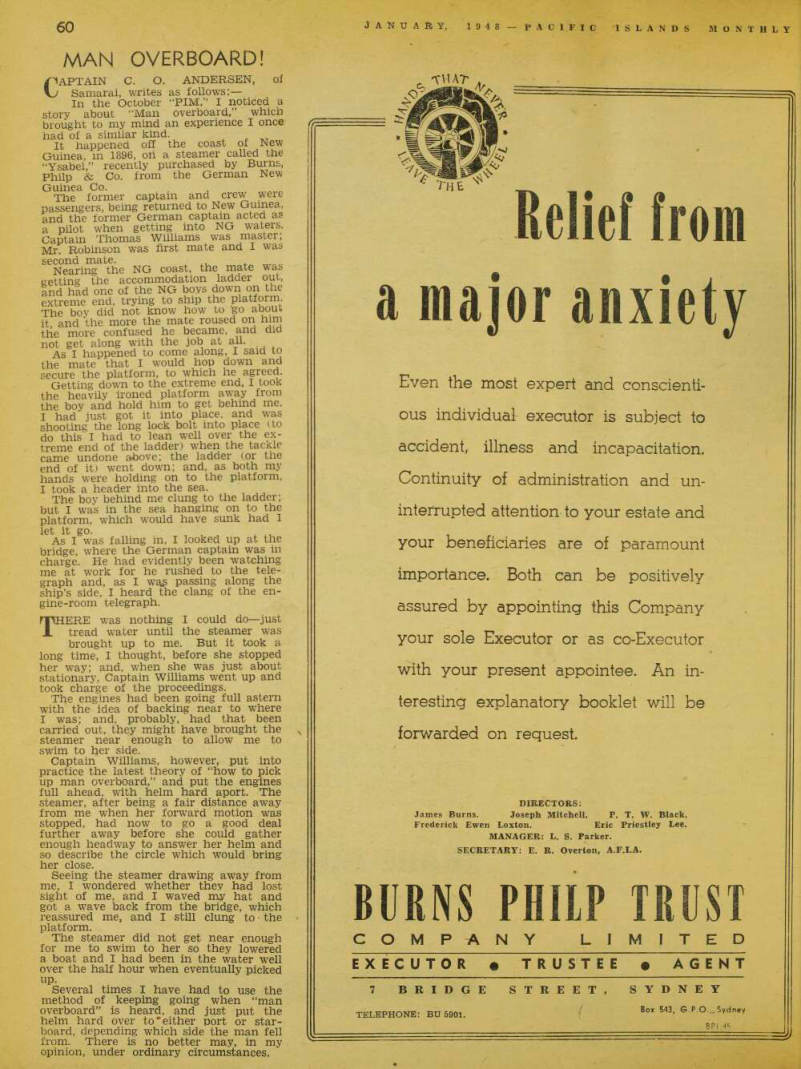
Captain C. O. Andersen, Of
Samarai, writes as follows; In the October “PIM,” I noticed a story about “Man overboard,” which brought to my mind an experience I once had of a similar kind. , It happened off the coast of New Guinea, in 1896, on a steamer called the “Ysatael,” recently purchased by Burns, Philp & Co. from the German New Guinea Co.
The former captain and crew were passengers, being returned to New Guinea, and the former German captain acted as a pilot when getting into NG waters.
Captain Thomas Williams was master; Mr. Robinson was first mate and I was second mate. , Nearing the NG coast, the mate was setting the accommodation ladder out, Ind hid one of the NG boys down on the extreme end, trying to ship the platform.
The boy did not know how to 'go about it and the more the mate roused on him the more confused he became, and did not get along with the job at all.
As I happened to come along, I said to the mate that I would hop down and secure the platform, to which he agreed.
Getting down to the extreme end, I took the heavily ironed platform away from the boy and hold him to get behind me.
I had just got it into place, and was shooting the long lock bolt into place (to do this I had to lean well over the ex treme end of the ladder) when the tackle came undone above; the ladder (or the end of it) went down; and, as both my hands were holding on to the platform, I took a header into the sea.
The boy behind me clung to the ladder; but I was in the sea hanging on to the platform, which would have sunk had 1 let it go. , , , As I was falling in, I looked up at the bridge, where the German captain was in charge. He had evidently been watching me at work for he rushed to the tele graph and, as I passing along the ship’s side, I heard the clang of the en gine-room telegraph. mHERE was nothing I could do—just ± tread water until the steamer was brought up to me. But it took a long time, I thought, before she stopped her way; and, when she was just about stationary, Captain Williams went up and took charge of the proceedings.
The engines had been going full astern with the idea of backing near to where I was; and, probably, had that been carried out, they might have brought the steamer near enough to allow me to swim to her side.
Captain Williams, however, put into practice the latest theory of “how to pick up man overboard,” and put the engines full ahead, with helm hard aport. The steamer, after being a fair distance away from me when her forward motion was stopped, had now to go a good deal further away before she could gather enough headway to answer her helm and so describe the circle which would bring her close.
Seeing the steamer drawing away from me, I wondered whether they had lost sight of me, and I waved my hat and got a wave back from the bridge, which reassured me, and I still clung to the platform.
The steamer did not get near enough for me to swim to her so they lowered a boat and I had been in the water well over the half hour when eventually picked up.
Several times I have had to use the method of keeping going when “man overboard” is heard, and just put the helm hard over to'either port or star board, depending which side the man fell from. There is no better may, in my opinion, under ordinary circumstances.