Ladies Don’T
pp. 46-47 · Read in the full issue
Like It!
By Basil Hall
THEY don’t, either—in Fiji. Discover the totem word, if you can—and then utter the same, if you dare!
The result will surprise the most enter prising carpet knight, for he will dis cover that those lustrous eyes can become a pair of snapping fire-crackers.
In all probability, he would be soundly slapped. He would most certainly be tumbled over and walked upon by large bare feet (they call it “turkey tramp ling”) ; and, as finale to a regrettable lapse, the poor boob would be tossed into the nearest waterhole.
All this can happen in Fiji; and it was a crowd of Fijians we were facing at the moment.
Perhaps the District Commissioner —or Roko Tui, in the local tongue—was not in the most serious frame of mind. To gether, we were in the remoter parts of the district of Tholo East, among the hills of Viti Levu, where, for the past fortnight, my host had been inspecting everything from village sanitation to the seating accommodation in schools. He had settled all sorts of difficulties, in cluding such diverse matters as divorce petitions and navigational problems in cidental to rafting bananas down the Wainamala River to market; and, be fore long, he might expect to be back in the comfort of his own bungalow.
IT had been a good trip—something to remember with the keenest pleasure —and, at various times, we had dis cussed the oddities of native custom, up on due regard for which is based British administration the world over.
With this last night of our patrol had come relaxation and a fine feeling, that, bone-weary after the day’s march, we should not again have to plug uo the in evitable greasy path to the village in which we meant to spend the night, or sit drenched by thunderstorms upon a bamboo raft careering down a swollen river. Jove nods at times, and this was one of them.
Yet. there was nothing remarkable about that evening’s entertainment. The exchange of gifts and the ceremonial kava-drinking had already taken place.
Beds were set up in the principal “M’buri,” or guest house, and the scent of a prawn curry was in the air.
The sight of the Roko Tui at dinner was always an irresistible lure; and, with the innate good manners of this charm ing race, the men were filing quietly in to sit in strict order of precedence upon the finely woven mats before us. Among the shadows were the women, their chatter subdued in deference to what was
really a male reception. A radio which we carried for experimental purposes was tuned in to a Suva station broadcasting in the Fijian language. Giggles outside meant that the “meke” maidens were decorating themselves with hibiscus blos som and croton leaves, in preparation for their own share of the night’s proceed ings.
NATIVE dancing, no matter where per formed, finds its urge in the funda mental causes of love and hate. A full moon, a harvest festival, or plain buck fever will produce the first-named on the most slender provocation. But, while the full moon does its stuff each month, a DC rarely finds time to make patrols more than twice a year; and, as the King’s representative, a visit of the kind means something to people who still take pride in the fact that they were treated as’ equals when King Thakombau handed his war club to Queen Victoria in 1874. Failure to understand this point misses the whole basis of present day relations, which are as happy as the spontaneous “meke” dance now about to begin.
Imagine these husky but gentle-look ing maidens, shy and timid (or so it seemed), now seated cross-legged beneath the hurricane lamps. One strikes a note that sends them into the lilting cadence of a contralto chant, in which recognis able hymn tunes mingle strangely with
comment that is frank to a degree. Gain ing confidence, the refrain is helped by well-timed movements of both arms and body, which gives to the whole an effect of wind-blown leaves upon a forest pool, Hard-boiled or not, the sight is unfor gettable. 11THEN the evening was more advanced »» v, O fHo S h,S SIIOWOQ thclt tllo IcLQIOS of th.o ITIOKO team were indulging themselves with re pt hut pyhphqp r phic fnn ntpo 1 normal Thl‘ Roko Tufwasl friend of years’ standing. He knew most things good and bad about the present company—and, he also knew their totem word The DC thought the chance was too good to be missed. As a new chum, I should have the opportunity of learning about native customs at first hand, Writing down the Fijian word for “maize,” he withdrew, a dignified figure, to the seclusion of his mosquito net, with the intention of watching the out come through half-closed eyes. He hoped that, in revenge on the meke ladies. I "it did not work outlhai “~‘ y lor me - 11 Qlcl not worK out tnat Although that whole episode was in lighter vein, the subject of totems and tabus are as serious to the native mind as anything can be. They represent a
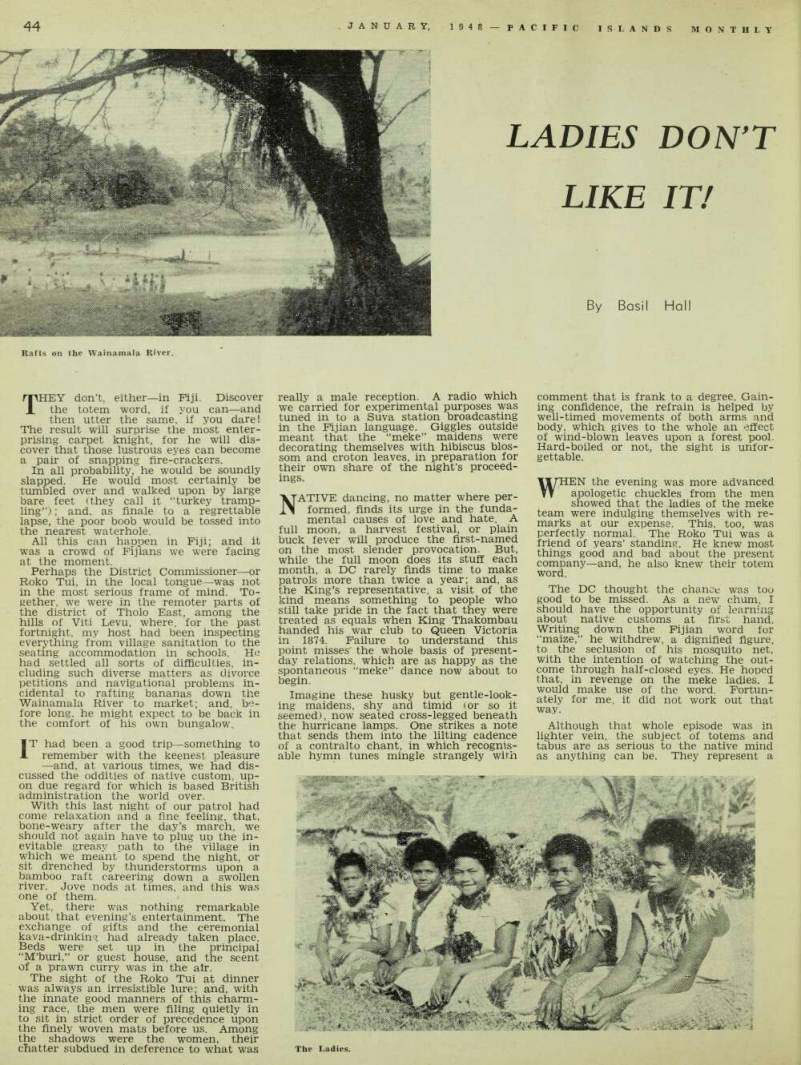
Rafts on the Wainamala River.
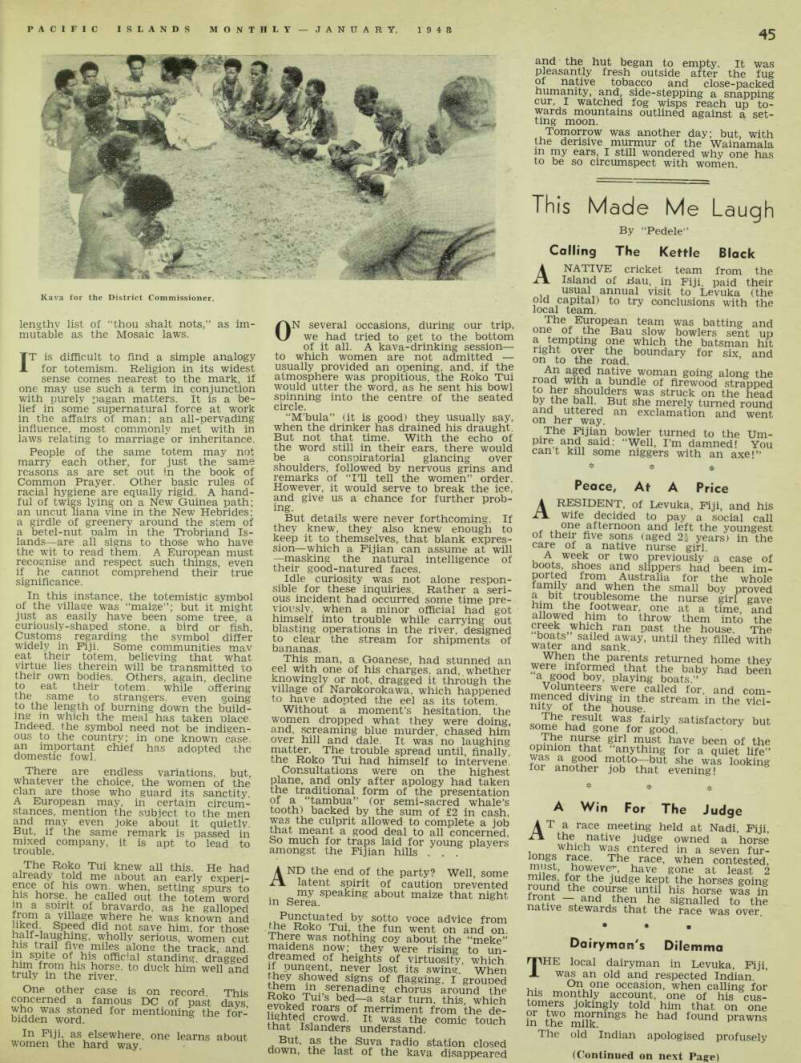
The Ladies.
lengthy list of “thou shalt nots,” as im mutable as the Mosaic laws.
IT is difficult to find a simple analogy for totemism. Religion in its widest sense comes nearest to the mark, if one may use such a term in conjunction with purely pagan matters. It is a be lief in some supernatural force at work in the affairs of man; an all-pervading influence, most commonly met with in laws relating to marriage or inheritance.
People of the same totem may not marry each other, for just the same reasons as are set out in the book of Common Prayer. Other basic rules of racial hygiene are equally rigid. A hand ful of twigs lying on a New Guinea path; an uncut liana vine in the New Hebrides: a girdle of greenery around the stem of a betel-nut oalm in the Trobriand Is lands —are all signs to those who have the wit to read them. A European must recognise and respect such things, even if he cannot comprehend their true significance.
In this instance, the totemistic symbol of the village was “maize”; but it might just as easily have been some tree, a curiously-shaped stone, a bird or fish.
Customs regarding the symbol differ widely in Fiji. Some communities mav eat their totem, believing that what virtue lies therein will be transmitted to their own bodies. Others, again, decline to eat their totem, while offering the same to strangers, even going to the length of burning down the build ing in which the meal has taken place.
Indeed, the symbol need not be indigen ous to the country; in one known case, an important chief has adopted the domestic fowl.
There are endless variations, but, whatever the choice, the women of the clan are those who guard its sanctity.
A European may, in certain circum stances, mention the subject to the men and may even joke about it quietly.
But, if the same remark is passed in mixed company, it is apt to lead to trouble.
The Roko Tui knew all this. He had already told me about an early experi ence of his own. when, setting spurs to his horse, he called out the totem word m a spirit of bravardo, as he galloped from a village where he was known and liked Speed did not save him, for those half-laughing, wholly serious, women cut his trail five miles alone the track, and. m spite of his official standing, dragged him from his horse, to duck him well and truly in the river.
One other case is on record This concerned a famous DC of past da vs who was stoned for mentioning the for bidden word. „J n Fiji, as elsewhere, one learns about women the hard way.
ON several occasions, during our trip, we had tried to get to the bottom of it all. A kava-drinking session— to which women are not admitted usually provided an opening, and, if the atmosphere was propitious, the Roko Tui would utter the word, as he sent his bowl spinning into the centre of the seated circle.
“M’bula” (it is good) they usually say, when the drinker has drained his draught.
But not that time. With the echo of the word still in their ears, there would be a conspiratorial glancing over shoulders, followed by nervous grins and remarks of “I’ll tell the women” order.
However, it would serve to break the ice, and give us a chance for further prob ing.
But details were never forthcoming. If they knew, they also knew enough to keep it to themselves, that blank expres sion—which a Fijian can assume at will —masking the natural intelligence of their good-natured faces.
Idle curiosity was not alone respon sible for these inquiries. Rather a seri ous incident had occurred some time pre viously, when a minor official had got himself into trouble while carrying out blasting operations in the river, designed to clear the stream for shipments of bananas.
This man, a Goanese, had stunned an eel with one of his charges, and, whether knowingly or not, dragged it through the village of Narokorokawa, which happened to have adopted the eel as its totem.
Without a moment’s hesitation, the women dropped what they were doing, and, screaming blue murder, chased him over hill and dale. It was no laughing matter. The trouble spread until, finally, the Roko Tui had himself to intervene.
Consultations were on the highest plane, and only after apology had taken the traditional form of the presentation of a “tambua” (or semi-sacred whale’s tooth) backed by the sum of £2 in cash, was the culprit allowed to complete a job that meant a good deal to all concerned, So much for traps laid for young players amongst the Fijian hills ...
AND the end of the party? Well, some latent spirit of caution prevented my speaking about maize that night in Serea. hy sotto voce advice from the Roko Tui the fun went on and on.
There was nothing coy about the “meke” maidens now; they were rising to un dreamed of heights of virtuosity, which, if pungent, never lost its swing. When they showed signs of flagging. I grouped 2 16 !? 1 4, n -,serenading chorus around the Roko Tui s bed—a star turn, this, which evoked roars of merriment from the de lighted crowd. It was the comic touch that Islanders understand.
But, as the Suva radio station closed down, the last of the kava disappeared
and the hut began to empty. It was pleasantly fresh outside after the fug of native tobacco and close-packed humanity, and, side-stepping a snapping cur, I watched fog wisps reach up to wards mountains outlined against a set ting moon.
Tomorrow was another day; but, with the derisive murmur of the Wainamala m my ears, I still wondered why one has to be so circumspect with women.
Kava for the District Commissioner.