Tropicalities
p. 45 · Read in the full issue
Mr. and Mrs. Allen Innes, both well known in Fiji, Papua and New Guinea,
spent some months re-visiting Fiji to
wards the end of 1946. They spent Christmas on Norfolk Island, how ever, and from there Mrs. Innes writes : STRANGE how few tourist offices could tell us anything definite about Nor folk Island under post-war condi tions. I knew some of the Old New Guineaites and a few ex-Papuans were there and that others had been there, in Administration —and gone. We got a pleasant surprise, therefore, to find old friends Mr. and Mrs. Bill Mitchell, late of Wau and Salamaua still on the Island, as well as Mr. and Mrs. Norman Davies, of Port Moresby, and Mr. Fred Bunting and others. We all met at a tea party Mrs. Mitchell arranged for us last week!
The hospitality is overwhelming! Not only at the “hen parties” were the lusci ous cakes and sandwiches brought forth, either! We had a very big gathering of men folk to welcome Canon Robinson and Mr. Paynter from the Anglican Home Missions and Welfare Department. This Sunday afternoon there was a reception
and high-tea given to the distinguished visitors followed by service at the uniquely lovely little Church of Saint Barnabas.
To every visitor Norfolk would have some outstanding appeal; there is so much to admire here apart from the mild and even climate. I found the well-spaced homes and farmlets one of its greatest charms.
Every home, even every shop building, was set away in a quiet retreat and garden area—neighbourly without congestion, as it were. There is something whimsical in a shopping tour that takes one down leafy lanes, across lawn-like paddocks of vivid green, over a carpet of mauve blossoms, where the Norfolk Oaks have shed their petals. Then we come to “The Gift Store” —a wee cabin with a wee window and a very surprising variety of delightful things to buy.
Off again to find, up the end of a dignified avenue, if not exactly the Manor house, at least, the most historical home of a pioneer family . . . and here, also, we do a spot of shopping . . , even to climb ing the orange tree to “pick our pur chases” off an old veteran of the citrus world. * * EX-RAAF Wing Commander R. H. (“Bobby”) Gibbes, landed in Bris bane recently en route to New Guinea, where he is now selling lap laps, knives, and other goods to the natives.
Previously he was a pilot with one of the air companies there.
Mr. Gibbes, whose brilliant war record included winning the DSO and DFC and Bar, uses his own Auster, 3-seater plane to carry goods to his trading posts at Yamil and other villages in the Sepik District. He said he went to New Guinea because he believed there were good opportunities there. Eventually, he hopes to establish a dozen trading posts in the district.
The natives, he said, who bought at the stores generally had obtained money by working at Lae, Moresby, or Madang.
Some had piled it up during the war. but a native he thought, would be exception ally wealthy if he had £lO. They were keen to buy rice and bully beef, but sup plies were hard to get.
Mr. Gibbes said his wife was living with him at Wewak. They made daily trips to their stores in which natives were
employed
J.M.H.
IWAS greatly takeh, the other day, with the play, on the lines of “let’s pretend,” of two little village kiddies.
They were, by turns, Captain Blank, of the schooner; Mr. Whoosis, of the Ad ministration, or Rev. Gabbletosh, of the Mission.
After half an hour of imaginative im personations of this nature, the wee laddie was stuck for an idea.
“Let’s play we’re married,” suggested the little girl. He agreed.
And thereupon he gave her a thumping
clip across the ear!
“Eti.”
NEW ZEALAND’S Minister for Finance, Mr. Walter Nash, gets plenty of verbal kicks as well as halfpence from irate taxpayers, but he had a pleasant surprise recently when repre sentatives of the Methodist Missionary
Society of NZ called on him and pre sented him with a stick.
It was no ordinary shillelagh but a carved ebony stick, inlaid with mother-of pearl—an exceptionally fine specimen of Solomon Island native craftsmanship.
This was a gift from some of the mission’s native adherents in acknow ledgment of the action of Mr. Nash in remitting £12,450 of succession duty in the estate of the late Samuel Gorman, who left a substantial sum for rehabilita tion of hospitals and medical services of the Methodist mission in the Solomon Islands. * ♦ « MANY will remember that clever Danish writer and artist, Hakon Mielche, who came into the Pacific, via Panama, in 1934, on the yacht “Mon sunen,” and who was ship-wrecked on Vanikora (Southern Solomons). His book, “Monsunens Sidste Rejse,” published 1935, contained some
very bright car toons of people we know well. Well, here is a typical letter from our friend: “Hello, Mr. Rob son I have not sent you many letters in the last seven years. But I hope you will ex cuse me when I tell you that we have had a few Germans visiting us and hanging around! They ar rived soon after I got your last letter, dated October 4,
1939, and they would not allow me to answer you. But —as you may have read —we got rid of them again. . . .
“Tell my old friends in the Pacific that I am still going strong. My third book in English has just been published in London by Hodge. War stopped the con tinued publication of my first two in Eng lish—“ Let's See If the World Is Round,” and “Journey to the World’s End.” The title of the new one is “Land of the Con dor’ ’and it deals with Chile. . .
“After war came, I went to Prance and Germany as a war correspondent.
Then I went out again to Brazil, and I sailed up the Amazon River and down the Rio Madeira, and then I published two books about the trip—making my fifteenth book in Danish. ‘ I should like to pay another visit to the Islands, and I think I may turn up in Australia one day.” • • • TENNIS is booming at Finschhafen, and every week racquets go to northern Australian ports for re stringing with tropically-seasoned nylon “gut,” and come back by Qantas air freight. The well-made concrete court, built by the Americans, is in a beautiful setting immediately overlooking the sea.
It is intended to flood-light the court.
The Assistant Harbour Master at pre sent is the undisputed champion of the
large sub-District.-
“F.”
Queensland Soccer players may get a flying trip to New Caledonia during 1948 season to play five or six games there.
Subject to satisfactory arrangements be ing made between New Caledonia and Queensland, the Australian Soccer Asso ciation officials have given approval for the tour. New Caledonians will pay air fares from Brisbane back to Brisbane, hotel accommodation and travel expenses in New Caledonia.
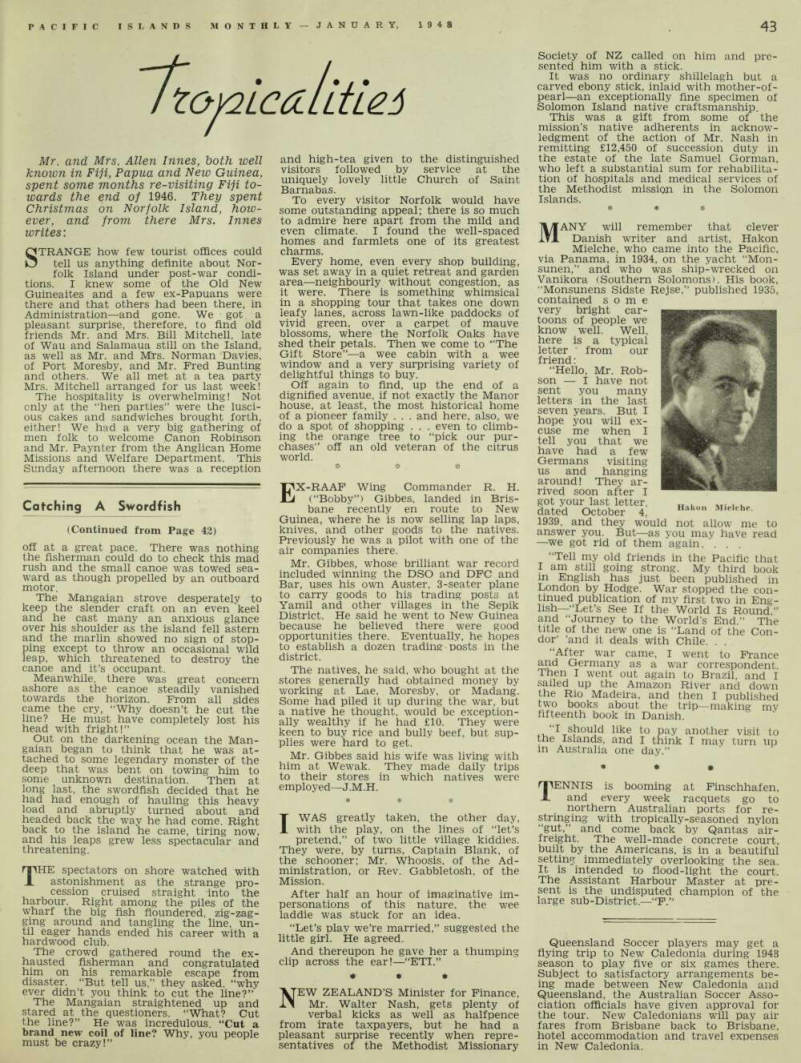
Hakon Mielche.