The Dream
pp. 81-82 · Read in the full issue
Short Story:
By Kim Sutherland
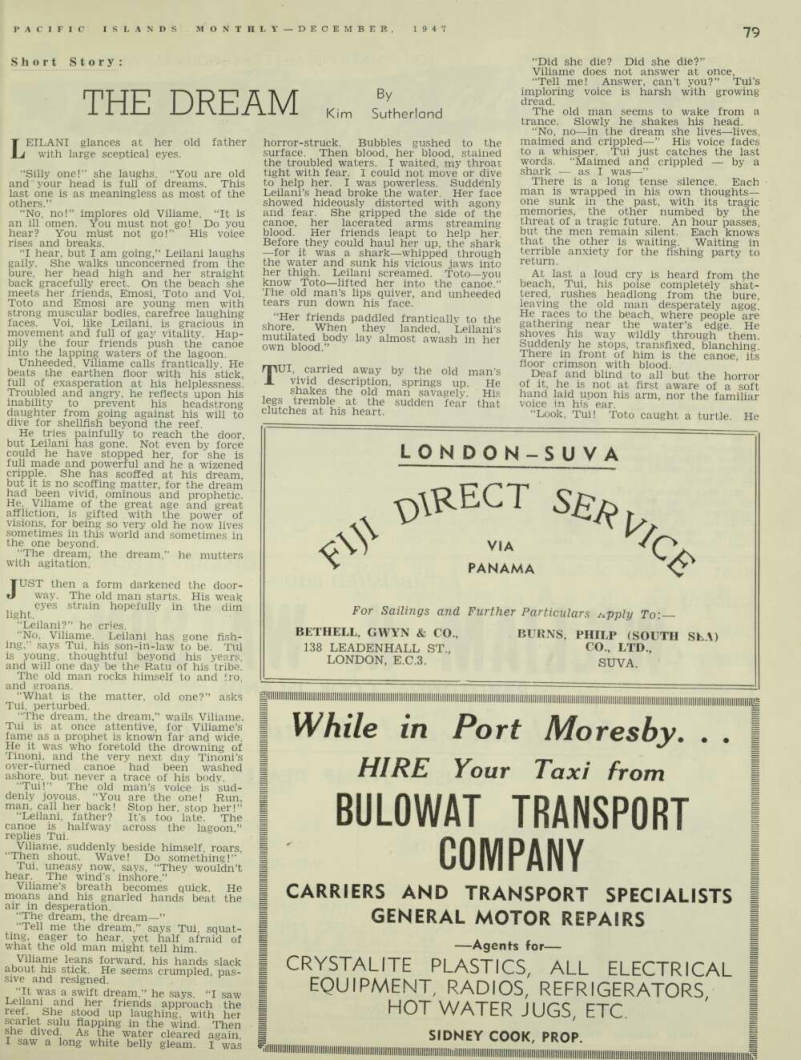
LEILANI glances at her old father with large sceptical eyes.
“Silly one!” she laughs. “You are old and your head is full of dreams. This last one is as meaningless as most of the others.”
“No. no!” implores old Viliame. “It is an ill omen. You must not go! Do you hear? You must not go!” His voice rises and breaks.
“I hear, but I am going,” Leilani laughs gaily. She walks unconcerned from the bure. her head high and her straight back gracefully erect. On the beach she meets her friends, Emosi, Toto and Voi.
Toto and Emosi are young men with strong muscular bodies, carefree laughing faces. Voi, like Leilani, is gracious in movement and full of gay vitality. Hap pily the four friends push the canoe into the lapping waters of the lagoon.
Unheeded, Viliame calls frantically. He beats the earthen floor with his stick, full of exasperation at his helplessness.
Troubled and angry, he reflects upon his inability to prevent his headstrong daughter from going against his will to dive for shellfish beyond the reef.
He tries painfully to reach the door, but Leilani has gone. Not even by force could he have stopped her, for she is full made and powerful and he a wizened cripple. She has scoffed at his dream, but it is no scpffing matter, for the dream had been vivid, ominous and prophetic.
He, Viliame of the great age and great affliction, is gifted with the power of visions, for being so very old he now lives sometimes in this world and sometimes in the one beyond.
“The dream, the dream,” he mutters with agitation.
JUST then a form darkened the door way. The old man starts. His weak eyes strain hopefully in the dim light.
“Leilani?” he cries.
“No, Viliame. Leilani has gone fish ing,” says Tui, his son-in-law to be. Tui is young, thoughtful beyond his years, and will one day be the Ratu of his tribe.
The old man rocks himself to and Iro, and groans.
“What is the matter, old one?” asks Tui, perturbed.
“The dream, the dream,” wails Viliame.
Tui is at once attentive, for Viliame’s fame as a prophet is known far and wide.
He it was who foretold the drowning of Tinoni, and the very next day Tinoni’s over-turned canoe had been washed ashore, but never a trace of his bodv.
“Tui!” The old man’s voice is sud denly joyous. “You are the one! Run, man, call her back! Stop her, stop her!”
“Leilani, father? It’s too late. The canoe is halfway across the lagoon,” replies Tui.
Viliame, suddenly beside himself, roars, “Then shout. Wave! Do something!”
Tui, uneasy now, savs, “They wouldn’t hear. The wind’s inshore.”
Viliame’s breath becomes quick. He moans and his gnarled hands beat the air in desperation.
“The dream, the dream—”
“Tell me the dream,” says Tui, squat ting, eager to hear, yet half afraid of what the old man might tell him.
Viliame leans forward, his hands slack about his stick. He seems crumpled, pas sive and resigned.
“It was a swift dream,” he says. “I saw Leilani and her friends approach the reef She stood up laughing, with her scarlet sulu flapping in the wind. Then she dived. As the water cleared again I saw a long white belly gleam. I was
horror-struck. Bubbles gushed to the surface. Then blood, her blood, stained the troubled waters. I waited, my throat tight with fear. I could not move or dive to help her. I was powerless. Suddenly Leilani’s head broke the v/ater. Her face showed hideously distorted with agony and fear. She gripped the side of the canoe, her lacerated arms streaming blood. Her friends leapt to help her.
Before they could haul her up, the shark —for it was a shark —whipped through the water and sunk his vicious jaws into her thigh. Leilani screamed. Toto—you know Toto—lifted her into the canoe.”
The old man’s lips quiver, and unheeded tears run down his face.
“Her friends paddled frantically to the shore. When they landed, Leilani’s mutilated body lay almost awash in her own blood.”
TUI, carried away by the old man’s vivid description, springs up. He shakes the old man savagely. His legs tremble at the sudden fear that clutches at his heart.
“Did she die? Did she die?”
Viliame does not answer at once, “Tell me! Answer, can’t you?” Tui’s imploring voice is harsh with growing dread.
The old man seems to wake from a trance. Slowly he shakes his head.
“No, no—in the dream she lives —lives, maimed and crippled—” His voice fades to a whisper. Tui just catches the last words. “Maimed and crippled by a shark as I was—”
There is a long tense silence. Each man is wrapped in his own thoughts— one sunk in the past, with its tragic memories, the other numbed by the threat of a tragic future. An hour passes, but the men remain silent. Each knows that the other is waiting. Waiting in terrible anxiety for the fishing party to return.
At last a loud cry is heard from the beach, Tui, his poise completely shat tered, rushes headlong from the bure, leaving the old man desperately agog He races to the beach, where people are gathering near the water’s edge. He shoves his way wildly through them.
Suddenly he stops, transfixed, blanching There in front of him is the canoe, its floor crimson with blood.
Deaf and blind to all but the horror of it, he is not at first aware of a soft hand laid upon his arm, nor the familiar voice in his ear.
“Look, Tui! Toto caught a turtle. He
cut it up on the way back. It was a huge one. Look, the shell is big enough for a cradle. It is mine—for our first-born!”
Tui turns, and looks into the shy laugh ing face of Leilani.