Filariasis
p. 76 · Read in the full issue
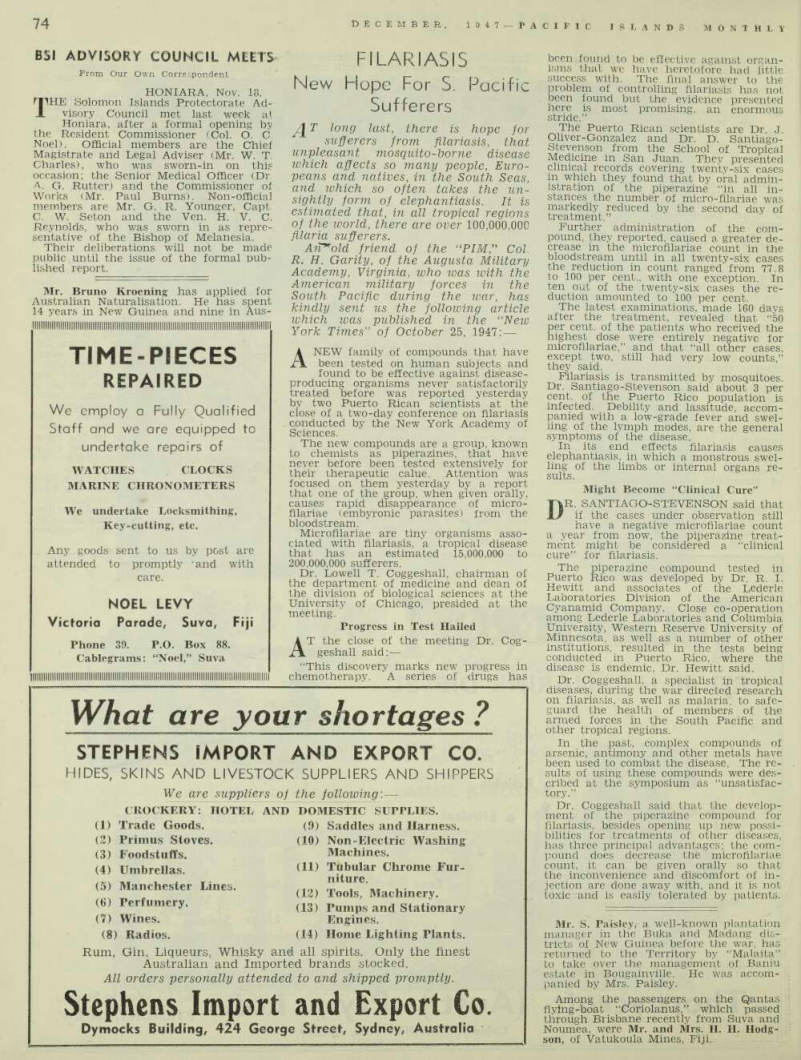
New Hope For S. Pacific Sufferers
T long last, there is hope for
sufferers from filariasis, that
unpleasant mosquito-borne disease which affects so many people, Euro peans and natives, in the South Seas, and which so often takes the un
sightly form of elephantiasis. It is
estimated that, in all tropical regions of the world, there o.re over 100,000,000
fflaria sufferers.
friend of the “PIMP Col R. H. Garity, of the Augusta Military Academy, Virginia, who was with the American military forces in the South Pacific during the war, has kindly sent us the following article which was published in the “New York Times” of October 25, 1947: ANEW family of compounds that have been tested on human subjects and found to be effective against disease producing organisms never satisfactorily treated before was reported yesterday by two Puerto Rican scientists at the close of a two-day conference on filariasis conducted by the New York Academy of Sciences.
The new compounds are a group, known to chemists as piperazines, that have never before been tested extensively for their therapeutic calue. Attention was focused on them yesterday by a report that one of the group, when given orally, causes rapid disappearance of micro filariae (embyronic parasites) from the bloodstream.
Microfilariae are tiny organisms asso ciated with filariasis, a tropical disease that has an estimated 15,000,000 to 200,000,000 sufferers.
Dr. Lowell T. Coggeshall, chairman of the department of medicine and dean of the division of biological sciences at the University of Chicago, presided at the meeting.
Progress in Test Hailed AT the close of the meeting Dr. Cog geshall said: — “This discovery marks new progress in chemotherapy. A series of drugs has
been found to be effective against organ isms that; we have heretofore had little success with. The final answer to the problem of controlling filariasis has not been found but the evidence presented here is most promising, an enormous stride.”
The Puerto Rican scientists are Dr. J.
Oliver-Gonzalez and Dr. D. Santiago- Stevenson from the School of Tropical Medicine in San Juan. They presented clinical records covering twenty-six cases in which they found that by oral admin istration of the piperazine ‘‘in all in stances the number of micro-filariae was markedly reduced by the second day of treatment.”
Further administration of the com pound, they reported, caused a greater de crease in the microfilariae count in the bloodstream until in all twenty-six cases the reduction in count ranged from 77.8 to 100 per cent., with one exception. In ten out of the twenty-six cases the re duction amounted to 100 per cent.
The latest examinations, made 160 days after the treatment, revealed that “50 per cent, of the patients who received the highest dose were entirely negative for microfilariae,” and that “all other cases, except two, still had very low counts,” they said.
Filariasis is transmitted by mosquitoes.
Dr. Santiago-Stevenson said about 3 per cent, of the Puerto Rico population is infected. Debility and lassitude, accom panied with a low-grade fever and swel ling of the Ivmph modes, are the general symptoms of the disease.
In its end effects filariasis causes elephantiasis, in which a monstrous swel ling of the limbs or internal organs re sults.
Might Become “Clinical Cure”
Dr. Santiago-Stevenson Said That
if the cases under observation still have a negative microfilariae count a year from now, the piperazine treat ment might be considered a “clinical cure” for filariasis.
The piperazine compound tested in Puerto Rico was developed by Dr. R. I.
Hewitt and associates of the Lederle Laboratories Division of the American Cyanamid Company. Close co-operation among Lederle Laboratories and Columbia University, Western Reserve University of Minnesota, as well as a number of other institutions, resulted in the tests being conducted in Puerto Rico, where the disease is endemic, Dr. Hewitt said.
Dr. Coggeshall, a specialist in tropical diseases, during the war directed research on filariasis, as well as malaria, to safe guard the health of members of the armed forces in the South Pacific and other tropical regions.
In the past, complex compounds of arsenic, antimony and other metals have been used to combat the disease. The re sults of using these compounds were des cribed at the symposium as “unsatisfac tory.”
Dr. Coggeshall said that the develop ment of the piperazine compound for filariasis, besides opening up new possi bilities for treatments of other diseases, has three principal advantages; the com pound does decrease the microfilariae count, it can be given orally so that the inconvenience and discomfort of in jection are done away with, and it is not toxic and is easily tolerated by patients.
Mr, S. Paisley, a well-known plantation manager in the Buka and Madang dis tricts of New Guinea before the war. has returned to the Territory by “Malaita” to take over the management of Baniu estate in Bougainville. He was accom panied by Mrs. Paisley.
Among the passengers on the Qantas flying-boat “Coriolanus,” which passed through Brisbane recently from Suva and Noumea, were Mr. and Mrs. H. H. Hodg son, of Vatukoula Mines, Fiji.