It’s Flame-Tree Time in Merauke
p. 47 · Read in the full issue
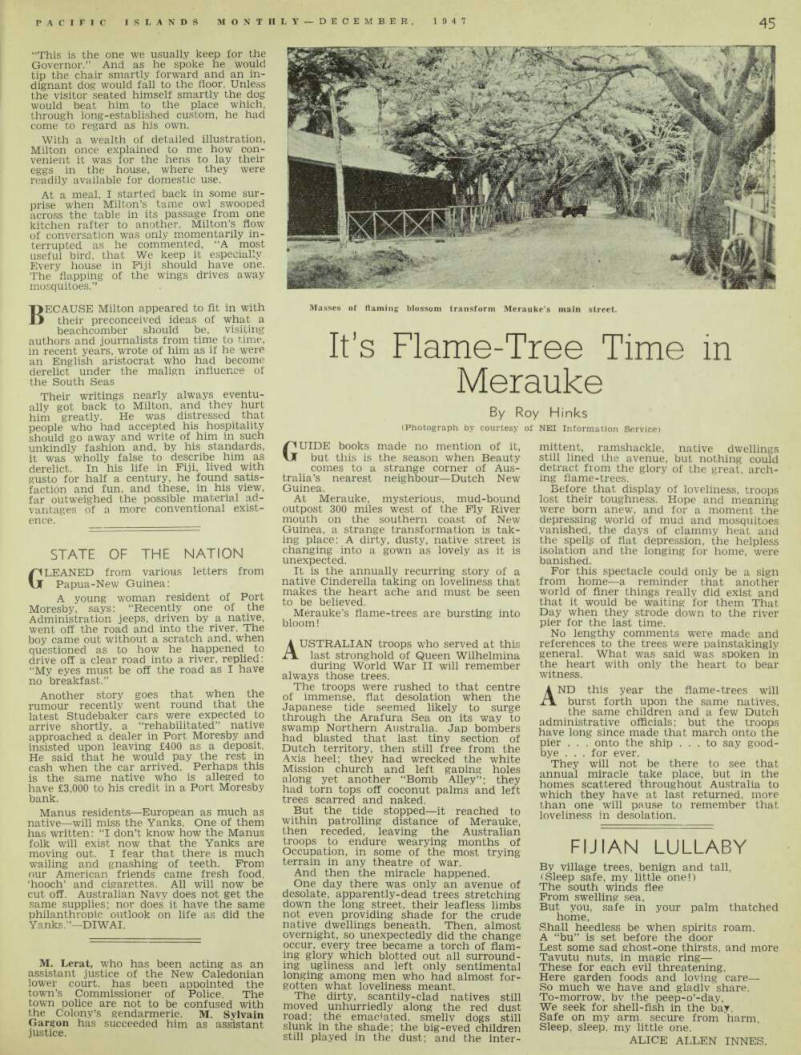
Merauke
By Roy Hinks
(Photograph by courtesy of NEI Information Service)
UIDE books made no mention of it, X but this is the season when Beauty comes to a strange corner of Aus tralia’s nearest neighbour—Dutch New Guinea.
At Merauke, mysterious, mud-bound outpost 300 miles west of the Fly River mouth on the southern coast of New Guinea, a strange transformation is tak ing place: A dirty, dusty, native street is changing into a gown as lovely as it is unexpected.
It is the annually recurring story of a native Cinderella taking on loveliness that makes the heart ache and must be seen to be believed.
Merauke’s flame-trees are bursting into bloom!
AUSTRALIAN troops who served at this last stronghold of Queen Wilhelmina during World War II will remember always those trees.
The troops were rushed to that centre of immense, flat desolation when the Japanese tide seemed likely to surge through the Arafura Sea on its way to swamp Northern Australia. Jap bombers had blasted that last tiny section of Dutch territory, then still free from the Axis heel; they had wrecked the white Mission church and left ganing holes along yet another “Bomb Alley”; they had torn tops off coconut palms and left trees scarred and naked.
But the tide stopped—it reached to within patrolling distance of Merauke, then receded, leaving the Australian troops to endure wearying months of Occupation, in some of the most trying terrain in any theatre of war.
And then the miracle happened.
One day there was only an avenue of desolate, apparently-dead trees stretching down the long street, their leafless limbs not even providing shade for the crude native dwellings beneath. Then, almost overnight, so unexpectedly did the change occur, every tree became a torch of flam ing glory which blotted out all surround ing ugliness and left only sentimental longing among men who had almost for gotten what loveliness meant.
The dirty, scantily-clad natives still moved unhurriedly along the red dust road; the emaciated, smelly dogs still slunk in the shade; the big-eyed children still played in the dust; and the inter -
mittent, ramshackle, native dwellings still lined the avenue, but nothing could detract from the glory of the great, arch ing flame-trees.
Before that display of loveliness, troops lost their toughness. Hope and meaning were born anew, and for a moment the depressing world of mud and mosquitoes vanished, the days of clammy heat and the spells of flat depression, the helpless isolation and the longing for home, were banished.
For this spectacle could only be a sign from home—a reminder that another world of finer things really did exist and that it would be waiting for them That Day when they strode down to the river pier for the last time.
No lengthy comments were made and references to the trees were painstakingly general. What was said was spoken in the heart with only the heart to bear witness.
AND this year the flame-trees will burst forth upon the same natives, the same children and a few Dutch administrative officials; but the troops have long since made that march onto the pier . . . onto the ship ... to say good bye . . . for ever.
They will not be there to see that annual miracle take place, but in the homes scattered throughout Australia to which they have at last returned, more than one will pause to remember that loveliness in desolation.