Eyes Turn Northwards As Native Independence
p. 37 · Read in the full issue
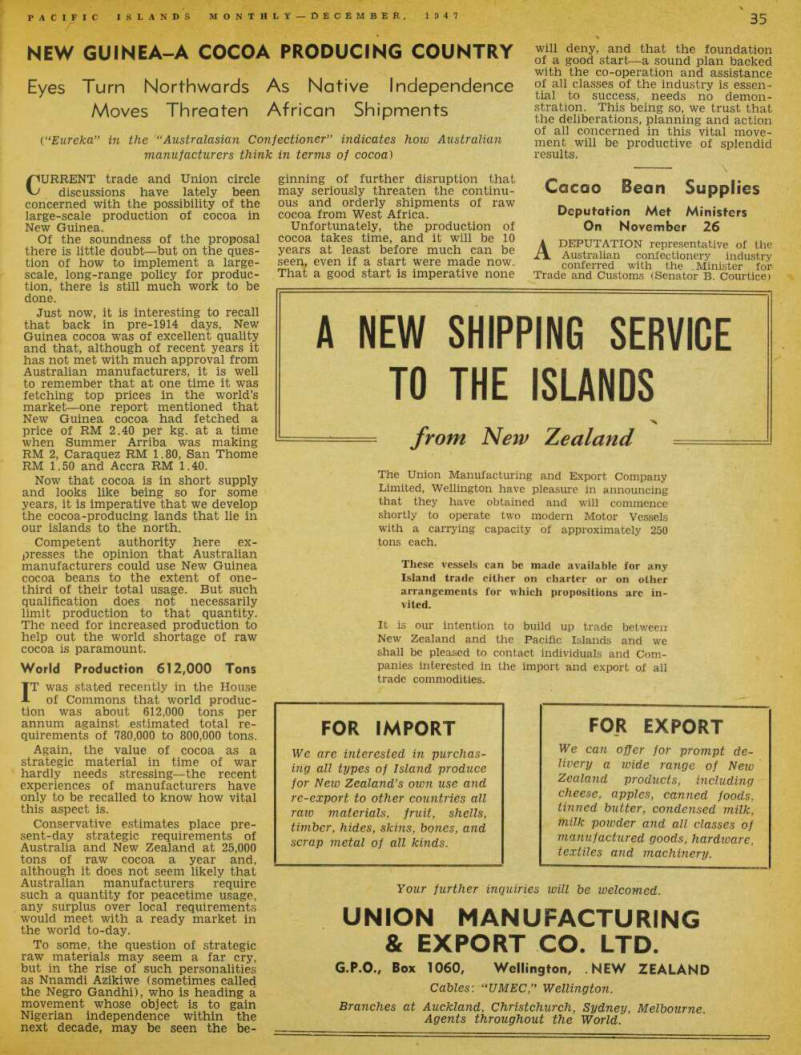
New Guinea-A Cocoa Producing Country
Eyes Turn Northwards As Native Independence Moves Threaten African Shipments
(“ Eureka” in the “Australasian Confectioner” indicates how Australian manufacturers think in terms of cocoa )
CURRENT trade and Union circle discussions have lately been concerned with the possibility of the large-scale production of cocoa in New Guinea.
Of the soundness of the proposal there is little doubt—but on the ques tion of how to implement a large scale, long-range policy for produc tion, there is still much work to be done.
Just now, it is interesting to recall that back in pre-1914 days, New Guinea cocoa was of excellent quality and that, although of recent years it has not met with much approval from Australian manufacturers, it is well to remember that at one time it was fetching top prices in the world’s market—one report mentioned that New Guinea cocoa had fetched a price of RM 2.40 per kg. at a time when Summer Arriba was making RM 2, Caraquez RM 1.80, San Thome RM 1.50 and Accra RM 1.40.
Now that cocoa is in short supply and looks like being so for some years, it is imperative that we develop the cocoa-producing lands that lie in our islands to the north.
Competent authority here ex presses the opinion that Australian manufacturers could use New Guinea cocoa beans to the extent of one third of their total usage. But such qualification does not necessarily limit production to that quantity.
The need for increased production to help out the world shortage of raw cocoa is paramount.
World Production 612,000 Tons IT was stated recently in the House of Commons that world produc tion was about 612,000 tons per annum against .estimated total re quirements of 780,000 to 800,000 tons.
Again, the value of cocoa as a strategic material in time of war hardly needs stressing—the recent experiences of manufacturers have only to be recalled to know how vital this aspect is.
Conservative estimates place pre sent-day strategic requirements of Australia and New Zealand at 25,000 tons of raw cocoa a year and, although it does not seem likely that Australian manufacturers require such a quantity for peacetime usage, any surplus over local requirements would meet with a ready market in the world to-day.
To some, the question of strategic raw materials may seem a far cry, but in the rise of such personalities as Nnamdi Azikiwe (sometimes called the Negro Gandhi), who is heading a movement whose object is to gain Nigerian independence within the next decade, may be seen the be
ginning of further disruption that may seriously threaten the continu ous and orderly shipments of raw cocoa from West Africa.
Unfortunately, the production of cocoa takes time, and it will be 10 years at least before much can be seen, even if a start were made now.
That a good start is imperative none
wdl den y’ and that the foundation of a good start—a sound plan backed with the co-operation and assistance of au classes of the industry is essen tial to success, needs no demon- This being so, we trust that the deliberations, planning and action of all concerned in this vital move ment will be productive of splendid results.