'Fijianisation' Now Would
pp. 7-8 · Read in the full issue
Be Only 'Indianisation'
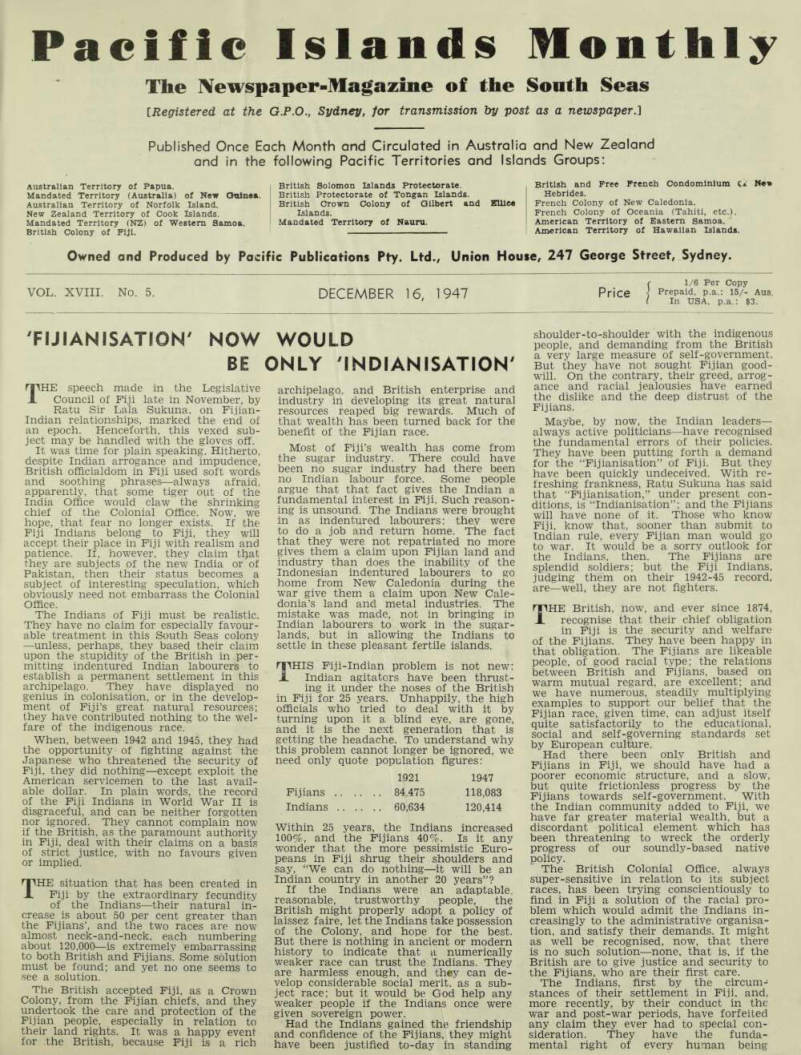
THE speech made in the Legislative Council of Fiji late in November, by Ratu Sir Lala Sukuna, on Fijian- Indian relationships, marked the end of an epoch. Henceforth, this vexed sub ject may be handled with the gloves off.
It was time for plain speaking. Hitherto, despite Indian arrogance and impudence, British officialdom in Fiji used soft words and soothing phrases—always afraid, apparently, that some tiger out of the India Office would claw the shrinking chief of the Colonial Office. Now, we hope, that fear no longer exists. If the Fiji Indians belong to Fiji, they will accept their place in Fiji with realism and patience. If, however, they claim tl>at they are subjects of the new India or of Pakistan, then their status becomes a subject of interesting speculation, which obviously need not embarrass the Colonial Office.
The Indians of Fiji must be realistic.
They have no claim for especially favour able treatment in this South Seas colony —unless, perhaps, they based their claim upon the stupidity of the British in per mitting indentured Indian labourers to establish a permanent settlement in this archipelago. They have displayed no genius in colonisation, or in the develop ment of Fiji’s great natural resources; they have contributed nothing to the wel fare of the indigenous race.
When, between 1942 and 1945, they had the opportunity of fighting against the Japanese who threatened the security of Fiji, they did nothing—except exploit the American servicemen to the last avail able dollar. In plain words, the record of the Fiji Indians in World War II is disgraceful, and can be neither forgotten nor ignored. They cannot complain now if the British, as the paramount authority in Fiji, deal with their claims on a basis of strict justice, with no favours given or implied.
THE situation that has been created in Fiji by the extraordinary fecundity of the Indians —their natural in crease is about 50 per cent greater than the Fijians’, and the two races are now almost neck-and-neck, each numbering about 120,000 —is extremely embarrassing to both British and Fijians. Some solution must be found; and yet no one seems to see a solution.
The British accepted Fiji, as a Crown Colony, from the Fijian chiefs, and they undertook the care and protection of the Fijian people, especially in relation to their land rights. It was a happy event for .the British, because Fiji is a rich
archipelago, and British enterprise and industry in developing its great natural resources reaped big rewards. Much of that wealth has been turned back for the benefit of the Fijian race.
Most of Fiji’s wealth has come from the sugar industry. There could have been no sugar industry had there been no Indian labour force. Some people argue that that fact gives the Indian a fundamental interest in Fiji. Such reason ing is unsound. The Indians were brought in as indentured labourers: they were to do a job and return home. The fact that they were not repatriated no more gives them a claim upon Fijian land and industry than does the inability of the Indonesian indentured labourers to go home from New Caledonia during the war give them a claim upon New Cale donia’s land and metal industries. The mistake was made, not in bringing in Indian labourers to work in the sugar lands, but in allowing the Indians to settle in these pleasant fertile islands. rriHIS Fiji-Indian problem is not new: J. Indian agitators have been thrust ing it under the noses of the British in Fiji for 25 years. Unhappily, the high officials who tried to deal with it by turning upon it a blind eye, are gone, and it is the next generation that is getting the headache. To understand why this problem cannot longer be ignored, we need only quote population figures:
Within 25 years, the Indians increased 100%, and the Fijians 40%. Is it any wonder that the more pessimistic Euro peans in Fiji shrug their shoulders and say, “We can do nothing—it will be an Indian country in another 20 years”?
If the Indians were an adaptable, reasonable, trustworthy people, the British might properly adopt a policy of laissez faire, let the Indians take possession of the Colony, and hope for the best.
But there is nothing in ancient or modern history to indicate that a numerically weaker race can trust the Indians. They are harmless enough, and they can de velop considerable social merit, as a sub ject race; but it would be God help any weaker people if the Indians once were given sovereign power.
Had the Indians gained the friendship and confidence of the Fijians, they might have been justified to-day in standing
shoulder-to-shoulder with the indigenous people, and demanding from the British a very large measure of self-government.
But they have not sought Fijian good will. On the contrary, their greed, arrog ance and racial jealousies have earned the dislike and the deep distrust of the Fijians.
Maybe, by now, the Indian leaders — always active politicians—have recognised the fundamental errors of their policies.
They have been putting forth a demand for the “Fijianisation” of Fiji. But they have been quickly undeceived. With re freshing frankness, Ratu Sukuna has said that “Fijianisation,” under present con ditions, is “Indianisation”; and the Fijians will have none of it. Those who know Fiji, know that, sooner than submit to Indian rule, every Fijian man would go to war. It would be a sorry outlook for the Indians, then. The Fijians are splendid soldiers; but the Fiji Indians, judging them on their 1942-45 record, are—well, they are not fighters.
THE British, now, and ever since 1874, recognise that their chief obligation in Fiji is the security and welfare of the Fijians. They have been happy in that obligation. The Fijians are likeable people, of good racial type; the relations between British and Fijians, based on warm mutual regard, are excellent; and we have numerous, steadily multiplying examples to support our belief that the Fijian race, given time, can adjust itself quite satisfactorily to the educational, social and self-governing standards set by European culture.
Had there been only British and Fijians in Fiji, we should have had a poorer economic structure, and a slow, but quite frictionless progress by the Fijians towards self-government. With the Indian community added to Fiji, we have far greater material wealth, but a discordant political element which has been threatening to wreck the orderly progress of our soundly-based native policy.
The British Colonial Office, always super-sensitive in relation to its subject races, has been trying conscientiously to find in Fiji a solution of the racial pro blem which would admit the Indians in creasingly to the administrative organisa tion, and satisfy their demands. It might as well be recognised, now, that there is no such solution—none, that is, if the British are to give justice and security to the Fijians, who are their first care.
The Indians, first by the circum stances of their settlement in Fiji, and, more recently, by their conduct in the war and post-war periods, have forfeited any claim they ever had to special con sideration. They have the funda mental right of every human being
sdsdsdsdsd 1921 1947 Fijians .. .. . .. 84,475 118,083 Indians .. . . .. 60,634 120,414
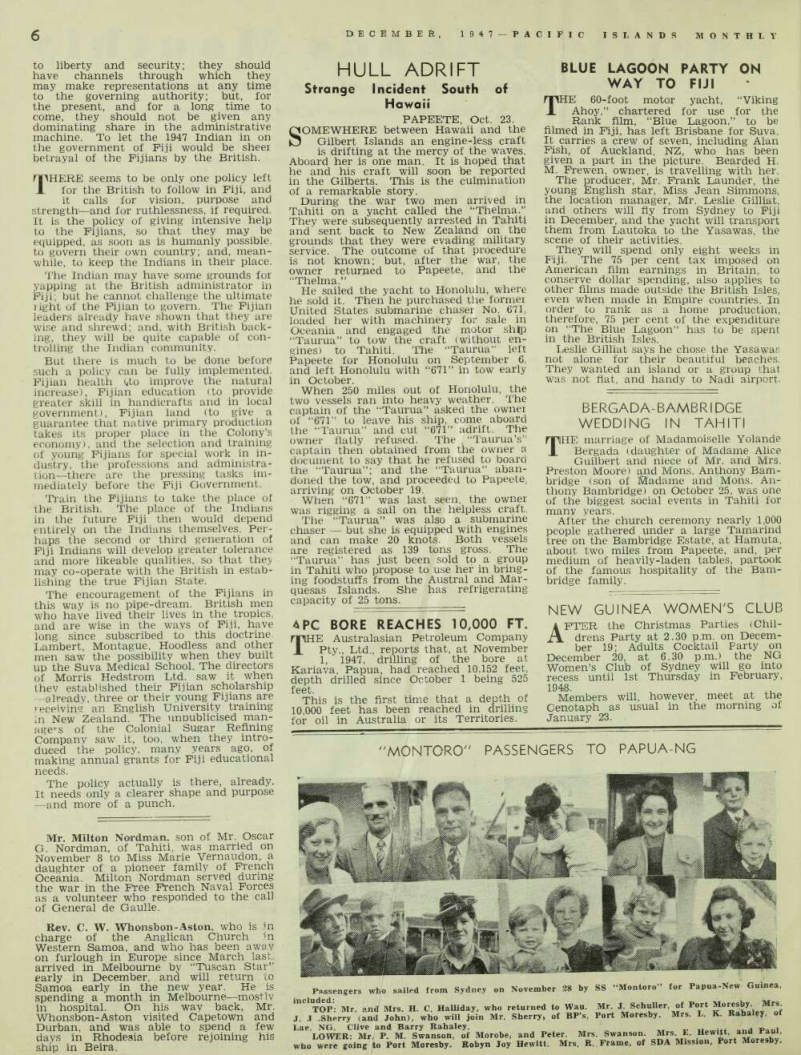
to liberty and security; they should have channels through which they may make representations at any time to the governing authority; but, for the present, and for a long time to come, they should not be given any dominating share in the administrative machine. To let the 1947 Indian in on the government of Fiji would be sheer betrayal of the Fijians by the British. rpHERE seems to be only one policy left Jl for the British to follow in Fiji, and it calls for vision, purpose and strength—and for ruthlessness, if required.
It is the policy of giving intensive help to the Fijians, so that they may be equipped, as soon as is humanly possible, to govern their own country; and, mean while, to keep the Indians in their place.
The Indian may have some grounds for yapping at the British administrator in Fiji; but he cannot challenge the ultimate right of the Fijian to govern. The Fijian leaders already have shown that they are wise and shrewd; and, with British back ing, they will be quite capable of con trolling the Indian community.
But there is much to be done before such a policy can be fully implemented.
Fijian health qto improve the natural increase), Fijian education (to provide greater skill in handicrafts and in local government), Fijian land (to give a guarantee that native primary production takes its proper place in the Colony’s economy), and the selection and training of young Fijians for special work in in dustry, the professions and administra tion—there are the pressing tasks im mediately before the Fiji Government.
Train the Fijians to take the place of the British. The place of the Indians in the future Fiji then would depend entirely on the Indians themselves. Per haps the second or third generation of Fiji Indians will develop greater tolerance and more likeable qualities, so that they may co-operate with the British in estab lishing the true Fijian State.
The encouragement of the Fijians in this way is no pipe-dream. British men who have lived their lives in the tropics, and are wise in the ways of Fiji, have long since subscribed to this doctrine Lambert, Montague, Hoodless and other men saw the possibility when they built up the Suva Medical School, The directors of Morris Hedstrom Ltd. saw it when thev established their Fijian scholarship —alreadv, three or their young Fijians are receiving an English University training in New Zealand. The unpublicised man agers of the Colonial Sugar Refining Company saw it, too, when they intro duced the policy, many years ago, of making annual grants for Fiji educational needs.
The policy actually is there, already.
It needs only a clearer shape and purpose —and more of a punch.
Mr. Milton Nordman. son of Mr. Oscar G. Nordman, of Tahiti, was married on November 8 to Miss Marie Vernaudon, a daughter of a pioneer family of French Oceania. Milton Nordman served during the war in the Free French Naval Forces as a volunteer who responded to the call of General de Gaulle.
Rev. C. W. Whonsbon-Aston, who is in charge of the Anglican Church in Western Samoa, and who has been away on furlough in Europe since March last, arrived in Melbourne by “Tuscan Star” early in December, and will return to Samoa early in the new year. He is spending a month in Melbourne —most I v in hospital. On his way back, Mr.
Whonsbon-Aston visited Capetown and Durban, and was able to spend a few days in Rhodesia before rejoining his ship in Beira.