Settling Down
p. 97 · Read in the full issue
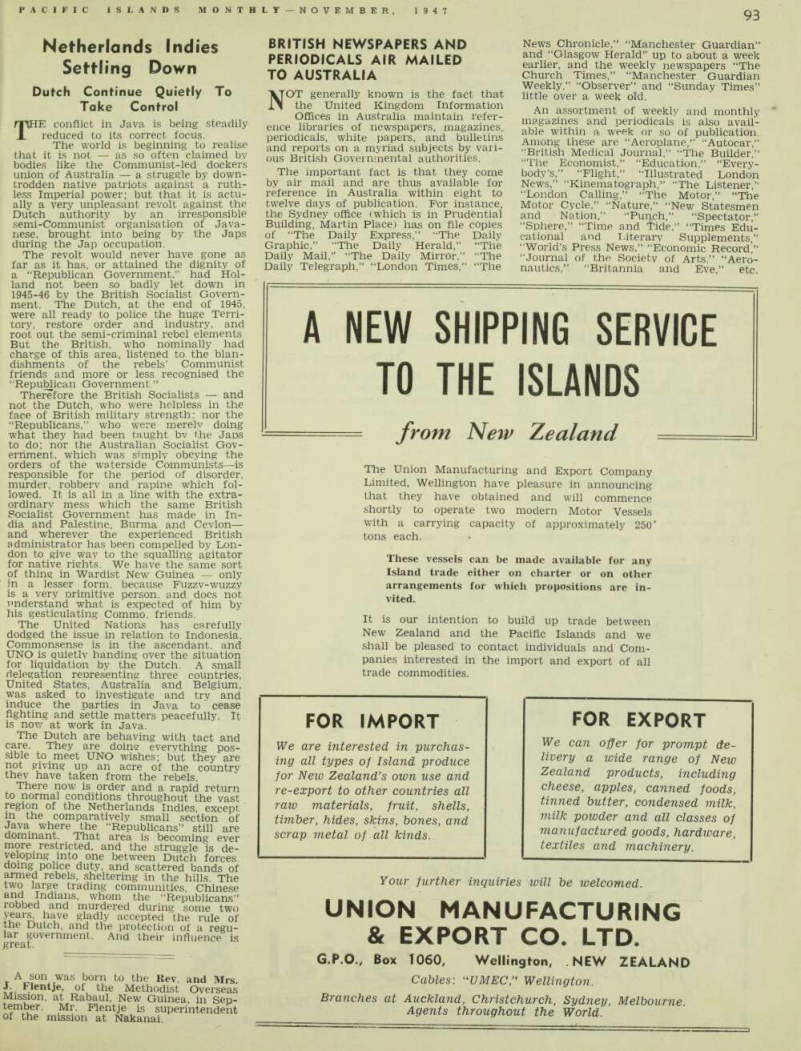
Netherlands Indies Settling Down Dutch Continue Quietly To Take Control
rE conflict in Java is being steadily reduced to its correct focus.
The world is beginning to realise that it is not as so often claimed bv bodies like the Communist-led dockers union of Australia a struggle by down trodden native patriots against a ruth less Imperial power; but that it is actu ally a very unpleasant revolt against the Dutch authority by an irresponsible semi-Communist organisation of Java nese, brought into being by the Japs during the Jap occupation.
The revolt would never have gone as far as it has, or attained the dignity of a “Republican Government.” had Hol land not been so badly let down in 1945-46 by the British Socialist Govern ment. The Dutch, at the end of 1945, were all ready to police the huge Terri tory, restore order and industry, and root out the semi-criminal rebel elements But the British, who nominally had charge of this area, listened to the blan dishments of the rebels’ Communist friends and more or less recognised the “Republican Government.”
Therefore the British Socialists and not the Dutch, who were helpless in the face of British military strength: nor the “Republicans.” who were merelv doing what they had been taught bv the Japs to do; nor the Australian Socialist Gov ernment. which was simplv obeying the orders of the waterside Communists —is responsible for the period of disorder, murder, robberv and rapine which fol lowed. It is all in a line with the extra ordinary mess which the same British Socialist Government has made in In dia and Palestine, Burma and Cevlon — and wherever the experienced British administrator has been compelled by Lon don to give wav to the squalling agitator for native rierhts. We have the same sort of thing in Wardist New Guinea only in a lesser form, because Fuzzv-wuzzy is a very nrimitive person, and does not understand what is expected of him by his gesticulating Commo. friends.
The United Nations has carefully dodged the issue in relation to Indonesia.
Commonsense is in the ascendant, and UNO is quietlv handing over the situation for liquidation by the Dutch. A small delegation renresenting three countries, United States, Australia and Belgium, was asked to investigate and try and induce the parties in Java to cease fighting and settle matters peacefully. It is now at work in Java.
The Dutch are behaving with tact and care. They are doin? everything pos sible to meet UNO wishes; but they are not giving up an acre of the country they have taken from the rebels.
There now is order and a rapid return to normal conditions throughout the vast region of the Netherlands Indies, except m the comparatively small section of Java where the “Republicans” still are dommant. That area is becoming ever more restricted, and the struggle is de veloping into one between Dutch forces doing police duty, and scattered bands of armed rebels, sheltering in the hills. The two large trading communities, Chinese and i ndlans - whom the “Republicans” robbed and murdered during some two ye ar s. have gladly accepted the rule of the Dutch, and the protection of a regu lar government. And their influence is great.
A son was born to the Rev. and Mrs.
J. Flentje, of the Methodist Overseas Mission, at Rabaul, New Guinea, in Sep tember. Mr. Flentje is superintendent of the mission at Nakanai,