The Kuper Family An Influence For Good in BSI
pp. 69-70 · Read in the full issue
Under The Union Jack
THE over-colourful newspaper reports of the visit of units of the Royal and Royal Australian Navies to the Solomons several weeks ago, contained some items which were of interest to those who know the Solomons.
It is stated that when the submarine Amplion entered Santa Ana harbour, Santa Cruz islands, two groups were drawn up on the beach. .The larger stood around the yellow and black “flag of freedom” of the new “Marching Law”
(or “Martin Lo” or “Marxian Law”) cult. (“Marching Law” is supposed to be a hang-over from the days of the Ameri can occupation. .Its leaders were recently arrested by the BSI Administration.) The other group, much smaller, consisted of Henry Kuper, a German planter of British nationality, and his two sons, who stood beneath a Union Jack.
The gathering of Marching Rule ad herents on the beach at Santa Ana was apparently a variation of the old Cargo Cult theme, well known in the South- West Pacific. The natives were, it is stated, waiting for “The Day” which was to be heralded by an American cargo ship which would bring them each a mosquito-proof house and a refrigerator (a peculairly Yankee twist). They had mistaken the Navy ships cruising in the vicinity for this harbinger of luxury.
An official statement on the whole situation by the High Commissioner of the Western Pacific, was published last month; but the following story of the Kuper family, which was written by Eric Ramsden and published recently in New Zealand, is of interest.
ANYONE who knows anything about the Solomons has heard of the Kuper family (writes Mr. Rams den). Henry, the father, married the chieftainess of Santa Ana, and for many years has traded there. Geoffrey, the elder son, was educated at the Cathedral
School in Christchurch, and served with such gallantry during the tense days in <he Solomons when the Japanese were in control that he was awarded the British Empire Medal.
Prior to that he had graduated as a native medical practitioner from the Suva Medical School. Before the war, and since, he has travelled extensively through the Solomons performing valu able service among a people often sorely in need of medical aid.
When the Pacific Islands Society was formed in Sydney it was decided to pre sent an annual prize to the Suva school.
Geoffrey, the first winner of the award,
a useful medical book, subsequently passed through Sydney on his way back to the Solomons. Keen, intelligent, im bued with a desire to help less fortunate islanders, he was a most likeable young fellow.
I was not surprised, therefore, to learn that, during the war, he remained at his post, and, indeed, gave help at a time when it was sorely needed by organising
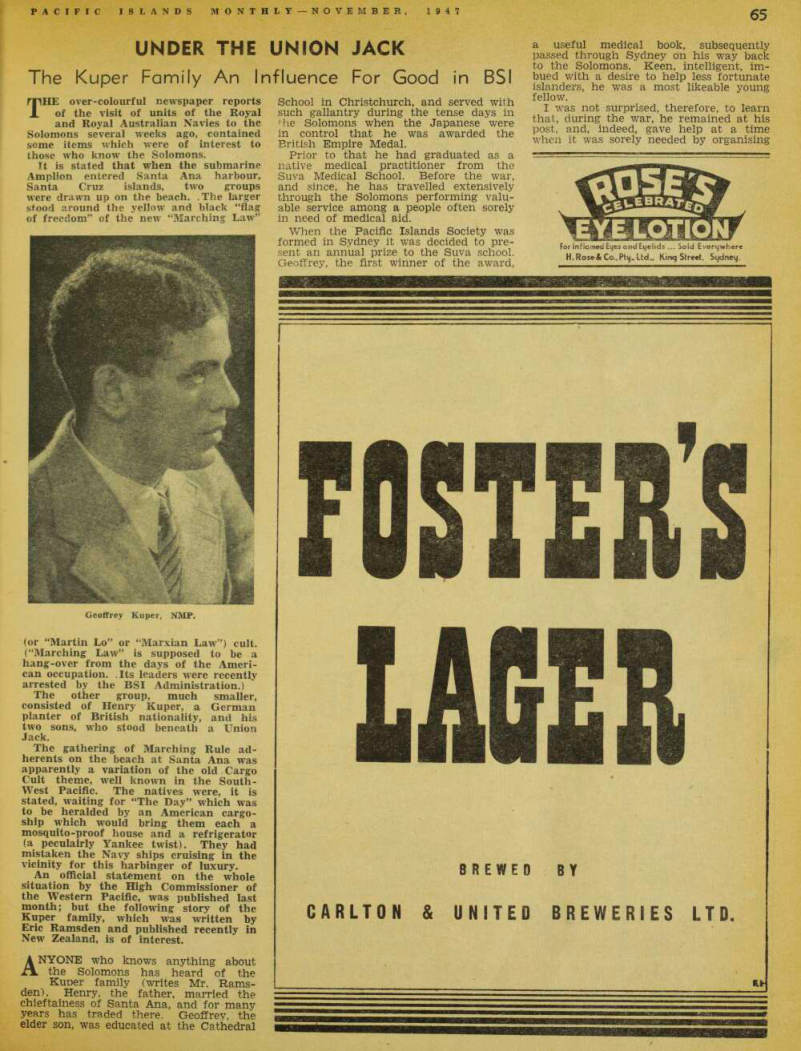
Geoffrey Kuper, NMP.
an intelligence movement. If the Japanese could have laid hands on Geoffrey Kuper, his fate would have been decided instantly. Therefore, it was good to learn that Geoffrey was assisting his father and brother to keep the British flag flying in Santa Ana the other day.
One of the best books on the Pacific written in recent years is Dr. S. M. Lambert’s “A Doctor in Paradise.” Thousands of native folk owe their lives to Dr. Lambert. Perhaps his most fitting memorial, and certainly a very useful one, is the Medical School he established at Suva, where Geoffrey and others were prepared for work in the field.
In the book he makes several references to the Kuper family. When he first met them, Geoffrey and his brother were running wild, absolutely naked, he says, on the beach. Their mother, who posed for the visitor’s camera, was “bare from the top of her head to the waistband of her lavalava, and around her neck were shark’s teeth, and a long pen-
cil of polished shell ran through the septum of her nose.” “Tenderly,” he wrote, “she picked up the children and told me they were nice boys, but not strong.”
Dr. Lambert found them suffering from hookworm, and dosed them with chenopoium. Both grew into “fine” husky lads,” and it was at the sugges tion of the American that Henry Kuper eventually decided to send his elder son to the medical training school, “I have another picture,” said the author. “It is of a good-looking boy, very collegiate in a tweed suit and striped necktie. He would be hard to recognise as the naked child in the first picture.”
Such was the background of Geoffrey Kuper.
The boy who was destined to win a coveted medical prize went through the usual tribal initiation among his mother’s people. For six months he stayed in the ceremonial house, among the ancestral canoes and skulls. Priests came to his
pagan retreat to instruct him in ritual, which included house building, fishing, and the preparation of a yam and taro garden.
But when he became a graduate prac titioner, he had been away so long from his mother’s people that he had for gotten their language, the roots of which are definitely Polynesian, Geoffrey spoke the English of a public school boy.
“His father, a very progressive Euro pean,” says Dr. Lambert, “wanted his son to have the best of our civilisation.
He was right, I think, for Geoffrey is doing fine work in the Solomons.”