'Marching Rule'
p. 13 · Read in the full issue
First-Hand Notes On Strange Social Phenomenon In Solomons
“rriHE difficult situation created in the X Solomon Islands by the ‘Marching Rule’ (Marxian Law) movement has been handled by the British Adminis tration with characteristic patience and tolerance: and, as a result, the trouble is not likely to be serious. They allowed time to lake care of an awkward thing that had developed out of wartime con ditions, and their patience has been com pletely justified.”
That was the summary of the BSI situation given by Major H. S. Robinson, secretary of the Melanesian Mission, who returned to Sydney recently after a two months’ visit to the Group, during which he visited all the main Islands and out lying archipelagoes.
“No one seemed able to explain the origin of the Movement. It appears to have a Communist flavour—yet there was no trace of anyone having visited the Solomons to spread Communism among the natives. The Movement apparently began as the result of careless talk by some sections of United States troops,” said Major Robinson. ‘‘One must not re gard natives as fools. They may have difficulty in expressing themselves to white people bul they can follow con versations between white people with considerable intelligence and draw con clusions accordingly. There is no doubt that the spectacle of United States soldiers with large amounts of money had a profoundly disturbing effect on the majority of natives, who had been accustomed to thinking only in terms of their wages—namely, 20/- per month. The Marching Rule Movement started origin ally among some villages in Malaita, but during the past two years spread steadily over all Malaita, and on Ysabel, and to some extent on Guadalcanal and the other Islands.
“When we steamed in the ‘Southern Cross’ along the north-west coast of Malaita,” said Major Robinson, “we were much interested to see a line of forty three native houses (we counted them) all sited and completed with military pre cision—a very neat and workmanlike job —and all empty. They had been erected by followers of the Marching Rule Cult in the belief that cargoes of goods were coming to them from across the sea, and these were to be the store-houses for the goods. They are still there and still empty—a very remarkable picture.”
Major Robinson said that as a result of the measures taken against the leaders of the Movement much life had gone out of the organisation and little more trouble was expected.
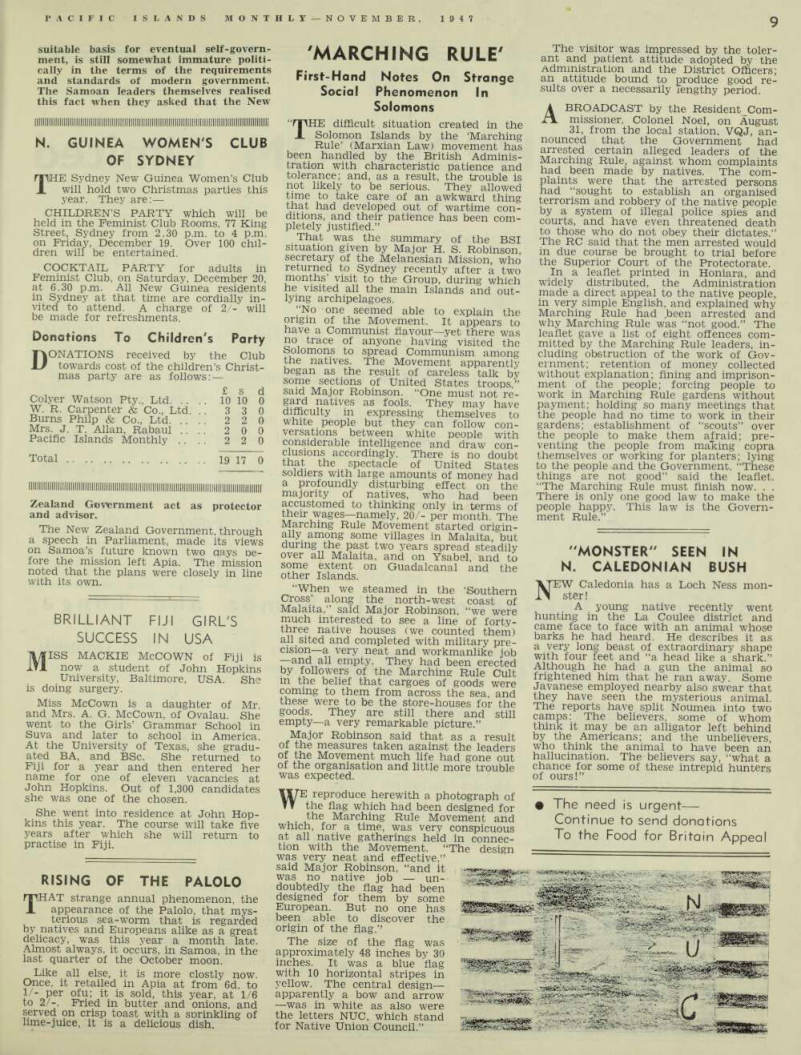
WE reproduce herewith a photograph of the flag which had been designed for the Marching Rule Movement and which, for a time, was very conspicuous at all native gatherings held in connec tion with the Movement. “The design was very neat and effective,”
said Major Robinson, “and it was no native job un doubtedly the flag had been designed for them by some European. But no one has been able to discover the origin of the flag.”
The size of the flag was approximately 48 inches by 30 inches. It was a blue flag with 10 horizontal stripes in yellow. The central design— apparently a bow and arrow —was in white as also were the letters NUC, which stand for Native Union Council.”
The visitor was impressed by the toler ant and patient attitude adopted by the Administration and the District Officers; an attitude bound to produce good re sults over a necessarily lengthy period.
A BROADCAST by the Resident_Com missioner, Colonel Noel, on August 31, from the local station, VQJ, an nounced that the Government had arrested certain alleged leaders of the Marching Rule, against whom complaints had been made by natives. The com plaints were that the arrested persons had “sought to establish an organised terrorism and robbery of the native people by a system of illegal police spies and courts, and have even threatened death to those who do not obey their dictates.”
The RC said that the men arrested would in due course be brought to trial before the Superior Court of the Protectorate.
In a leaflet printed in Honiara, and widely distributed, the Administration made a direct appeal to the native people, in very simple English, and explained why Marching Rule had .been arrested and why Marching Rule was “not good.” The leaflet gave a list of eight offences com mitted by the Marching Rule leaders, in cluding obstruction of the work of Gov ernment; retention of money collected without explanation; fining and imprison ment of the people: forcing people to work in Marching Rule gardens without payment; holding so many meetings that the people had no time to work in their gardens: establishment of “scouts” over the people to make them afraid; pre venting the people from making copra themselves or working for planters; lying to the people and the Government. “These things are not good” said the leaflet.
“The Marching Rule must finish now. . .
There is only one good law to make the people happy. This law is the Govern ment Rule.”