Another Plan For Samoa
pp. 12-13 · Read in the full issue
Mission's Recommendations Similar To NZ
Proposals
(See Also Article on Page 22)
AN examination of the report of the Trusteeship Council mission on its investigation in Samoa, made available to the press on October 12, shows that the plan favoured by the mission is very similar to the plan put forward recently by the New Zealand Governmen t The mission made its inquiry in Western Samoa in July and August last; and the members of the mission were Mr.
F. B. Sayre (United States), M. Pierre Ryckmans (Belgium) and Dr. Eduardo Cruz Coke (Chile).
The following are the chief recommendations:— (1) At the head of the Government of Western Samoa should be a representative of New Zealand and a representative or representatives of the inhabitants of Samoa sitting together as a Council of State or High Council. Until the Samoans decide otherwise, the Samoan representative should be the Fautua acting as a body. The New Zealand representative should preside over the council and should have a new title, perhaps High Commissioner. (2) The Samoan members of the Council of State should have the right to initiate legislation on all matters except those reserved to the New Zealand Government and to advise the High Commissioner in all matters relating to the territory’s government and welfare, including the appointment of the heads of executive departments. (3) The New Zealand representative should have the fullest possible authority
from the New Zealand Government, should preside over the Government of Samoa, should have the exclusive right to initiate financial bills, and should have a right of disallowance over all measures passed by the local Legislature, It may be advisable for him to have special emergency powers of legislation. (4) The present Legislative Council should be replaced by a Legislative Assembly, with all powers of legislation, in which Samoans should have an absolute majority. (5) The New Zealand Government, continuing as the administering auth ority under the trusteeship system, should have reserved to it powers con cerning the adoption of amendments to the Constitution, external relations, de fence, currency, loans, control of foreign exchange, audits of public accounts and the discharge of the responsibilities con ferred on New Zealand by the United Nations Charter and the trusteeship agreement. The High Commissioner should have the right of vetoing all measures passed by the Legislative As sembly, but that right should be ex ercised sparingly and all instances of its use should be reported to the Trus teeship Council. mHE mission also recommends that the X Fono should be retained in its present form as an advisory body, that until a tradition of public service has been developed the executive de partments should remain under New Zealand authority, and that boards of health, education and others, all having
Samoan representation, should be est ablished.
“The development and constitutional recognition of an adequate system of popular local government, which should be brought into appropriate relation ship with the central authority, is essen tial to progress in self-government,” the report says. “Village councils should have the right to make local by-laws, subject to approval by the central auth ority. In the criminal field they should be confined to minor offences.
“The possibility of development of a city or town government for Apia should be carefully studied. The responsibilities of Samoan associate judges in cases affecting Samoans should be increased.
Constitutional recognition should be given to acknowledge Samoan custom and tradition.
THE present distinction between Samoans and Europeans seems un necessary and should be gradually abolished in favour of a distinction be tween permanent and non-permanent residents. The foreign population would need special protection, though not special privileges.
“The most deep-seated grievances is the privileged situation accorded to Europeans. This is aggravated by the arbitrary distinction made in the law It clearly cannot be remedied by Gov ernment alone, but the Government can, at least, eliminate from legislation and from administrative practice all discrim ination based exclusively on colour. ‘The mission encountered strong criti cisms of the existing personnel situation.
Salaries and other conditions of appoint ment were said to involve discrimination against local people and to provide them with little opportunity, training or ad vancement. A public service authority should be established for the territory.
Preference in appointment should be given to residents of the territory as far as possible.
EVERY effort should be made through research and development to extend the export products beyond their present limited range. The research facilities of the South Pacific Commis sion will help. An efficient Department of Agriculture should be set up.
“The request that New Zealand act as protector and adviser represents the general desire of the resident popula tion, but changes in the present system of administration are desired. New Zea land has done much for Samoa, in spite of the fact that there have been only ten years where fruitful activity was possible.”
THE mission reports that it could not deal with the request in the Samoan petition for considering the ending of the “unnatural division” of the Samoan islands into two groups because Eastern Samoa was not a trust territory and did not come within the Trustee ship Council’s competence.
It has drawn two main inferences from its observations and hearings, the mission states. They are: — (1) It is the Samoans’ natural desire to see their own leaders at the head of their Government and they will not be satisfied with any piecemeal improve ments in the existing system, but only with dramatic and fundamental changes which would give them the feeling that the Government they live under is their own. (2) In its present stage the develop ment of the traditional Samoan politi cal organisation, although providing a
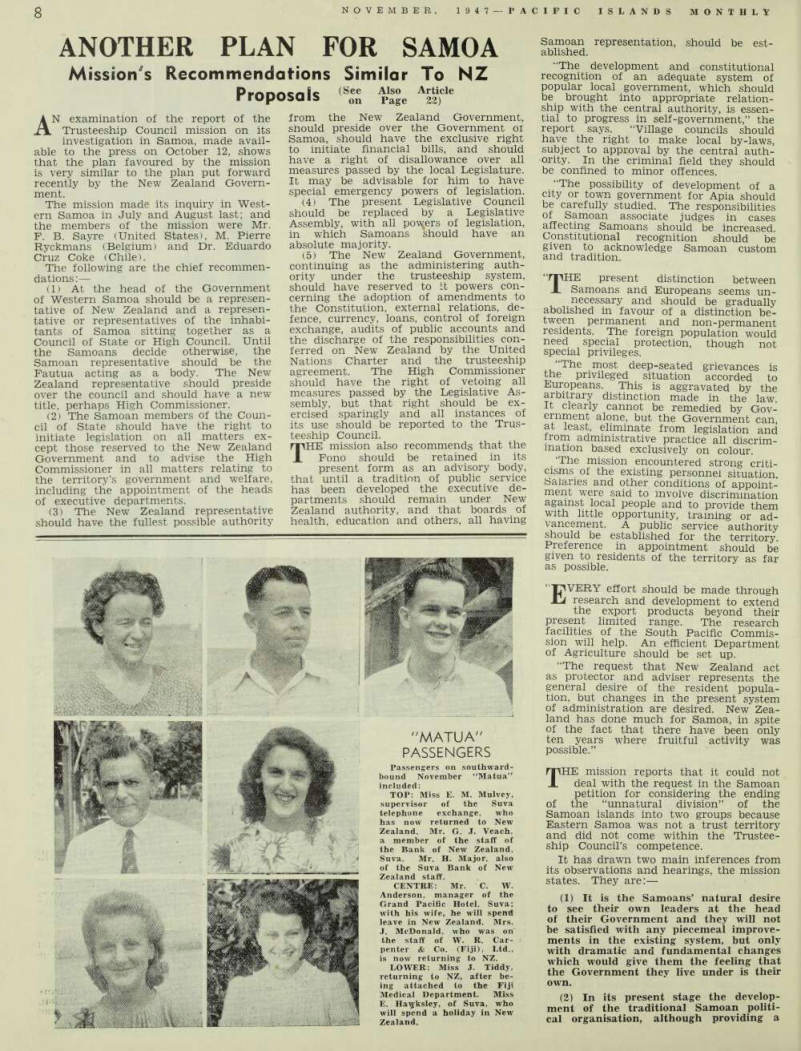
"Matua"
Passengers
Passengers on southward bound November “Matua” included: TOP: Miss E. M. Mulvey, supervisor of the Suva telephone exchange, who has now returned to New Zealand. Mr. G. J. Veach. a member of the staff of the Bank of New Zealand, Suva. Mr. H. Major, also of the Suva Bank of New Zealand staff.
Centre: Mr. C. W.
Anderson, manager of the Grand Pacific Hotel, Suva; with his wife, he will spend leave in New Zealand. Mrs.
J. McDonald, who was on the staff of W. R. Car penter & Co. (Fiji), Ltd., is now returning to NZ.
LOWER: Miss J. Tiddy, returning to NZ, after be ing attached to the Fiji Medical Department. Miss E. of Suva, who will spend a holiday in New Zealand.
suitable basis for eventual self-govern ment, is still somewhat immature politi cally in the terms of the requirements and standards of modern government.
The Samoan leaders themselves realised this fact when they asked that the New