Sweeping The Seas
Nearly 200 Vessels Damaged, in Vast Mine Cleaning-up Job
LITTLE has been said about it; but intensive mine-sweeping opera tions have been proceeding off the North Queensland coast for over two years; and the seas there are now comparatively safe for Australian- New Guinea shipping.
As soon as the Japanese threat to Australia developed, in 1942, Austra lian mine-layers laid many mine fields across the tracks likely to be used by enemy vessels, and these traps were carefully maintained for three years. Then the Australian Navy had the heartbreaking task of sweeping up thousands of mines, and rendering them harmless. Much re mains to be done: but the worst of the task is over. The cost of the mine-sweeping, in human life, has been heavy.
A LARGE and complicated mine sweeping operation, making European waters safe for the unre stricted movement of shipping, is nearing completion.
For two years the fleets of 13 nations have been co-operating in tjiis work, with the largest share fall ihg to the lot of Britain’s Royal Navy.
When the war ended, Europe’s coastal waters were sown with at least 600,000 mines of varying types.
Now after two years patient labour, always under the threat of sudden danger, 140,000 square miles of sea are entirely clear.
In May, 1945, an international Mine Clearance Board was formed with headquarters at the Admiralty in London, and progress reports of the work controlled and planned from this point have been passed to an international routing authority, also situated in London. There, in structions are issued for the safety and guidance of all shipping. 2,000 vessels have made up the international mine sweeping fleet which has operated in four main zones, the East Atlantic, the Mediterranean and Black Sea. the Baltic and the Kattegat and Bal tic approaches. British ships have worked in each zone and the whole task has been supervised from Lon don.
The fleet always operates in flot-
illas of eight ships each, which, in reasonable weather conditions, clear 25 square miles a day, working at an effective sweeping speed of 8 to 9 knots.
The difficulty of the task is vividly illustrated by just one example.
Magnetic mines equipped with de layed firing devices must be swept over no fewer than 15 times before they detonate.
Nearly 200 vessels have been either sunk or damaged while engaged on
this work of making the seas safe for other ships, but since the work began two years ago there has not been a single human casualty.
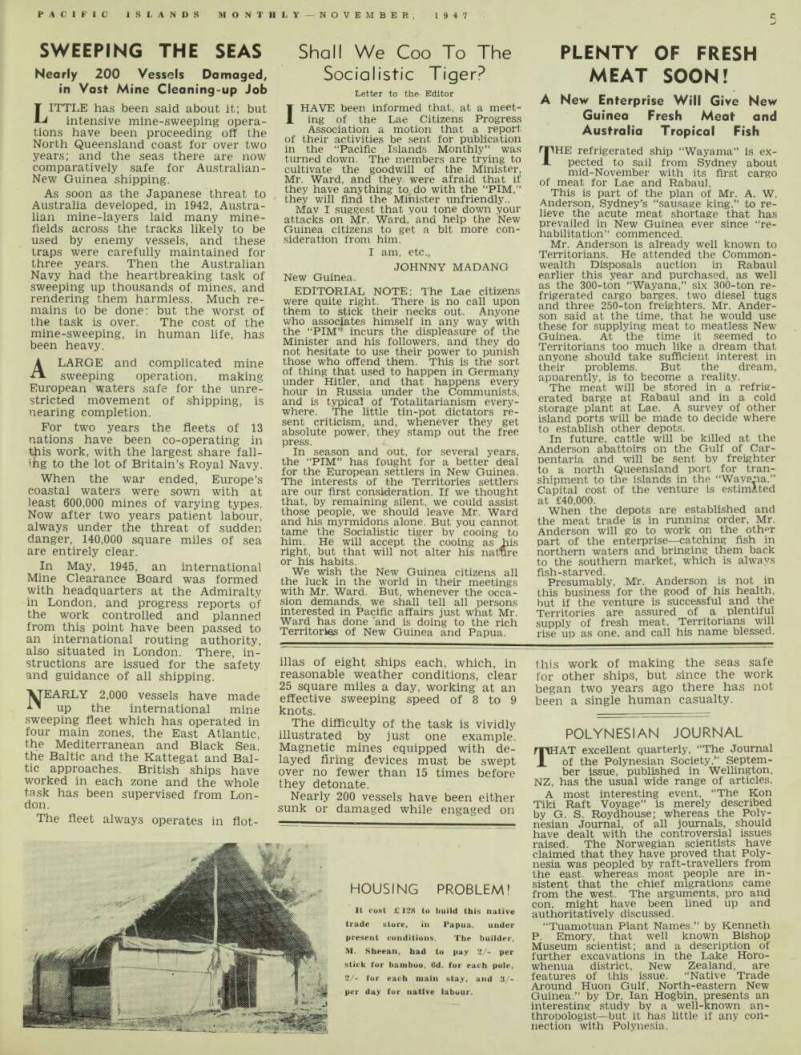
Housing Problem!
It cost £128 to build this native trade store, in Papua. under present conditions. The builder, M. Sheean, had to pay 2/- per stick for bamboo, 6d. for each pole, 2/- for each main stay, and 3/per day for native labour.