Sing-Sing At Scarlet Beach
p. 77 · Read in the full issue
Commemorating AIF Landing in 1943
pOUR years ago, on September 22, the 20 th Australian Brigade landed at what was to become known as Scarlet Beach, near Finsch hafen, New Guinea, in the face of strong Japanese opposition. The Japanese were driven back but the name, Scarlet Beach, stuck—not be cause it was an out of the ordinary bloody battle, but because that was the system of beach marking in use at that time by the United States Navy.
On September 22, 1947, celebrations were held in Finschhafen in com memoration of this landing. Pre dominantly it was a native show, centring around a well organised “ sing-sing ” Our correspondent has sent us the following notes about it: Highlights of the big “sing-sing” commemorating the successful AIF landing here four years ago, were the excellent show by the band of the Royal Papuan Constabulary, specially brought over from Moresby for the occasion; the arrival, that day, of HMAS
“Kanimbla” with occupational troops from Japan; and the presence of the Administrator of Papua-New Guinea (Col.
J. K. Murray), smart in pith helmet and official, white, tropical uniform. Post war, unique native head-dresses were also a feature of the festivities. * * * We did not know before that the Ad ministrator was a “Digger” in the old 18th Battalion Ist AIF. His dignity and bearing at the Finschhafen show coupled with those two rows of . war ribbons, gave him added prestige, and had a psychological affect, especially on the natives.
ADO Jack Keenan, of Finschhafen, to whom fell the brunt of the work, is to be congratulated on his organising ability and general enthusiasm. He received support from HMAS “Tarangau” and the US War Graves Unit. * ♦ ♦ The area was flood-lit at night—neces sary, as it was the moonless part of the month. There were considerably fewer natives present than last year. In any case, the Finschhafen folk do not put the same zest into their “sing-sings” as those from other districts. Perhaps mission in fluence has something to do with it; or perhaps, as the result of the war, they think “sing-sings” are now below their dignity.
There was no betel-nut, and only one night’s revelry. For this, some of the natives trudged for as much as a week, bringing their foodstuffs with them.
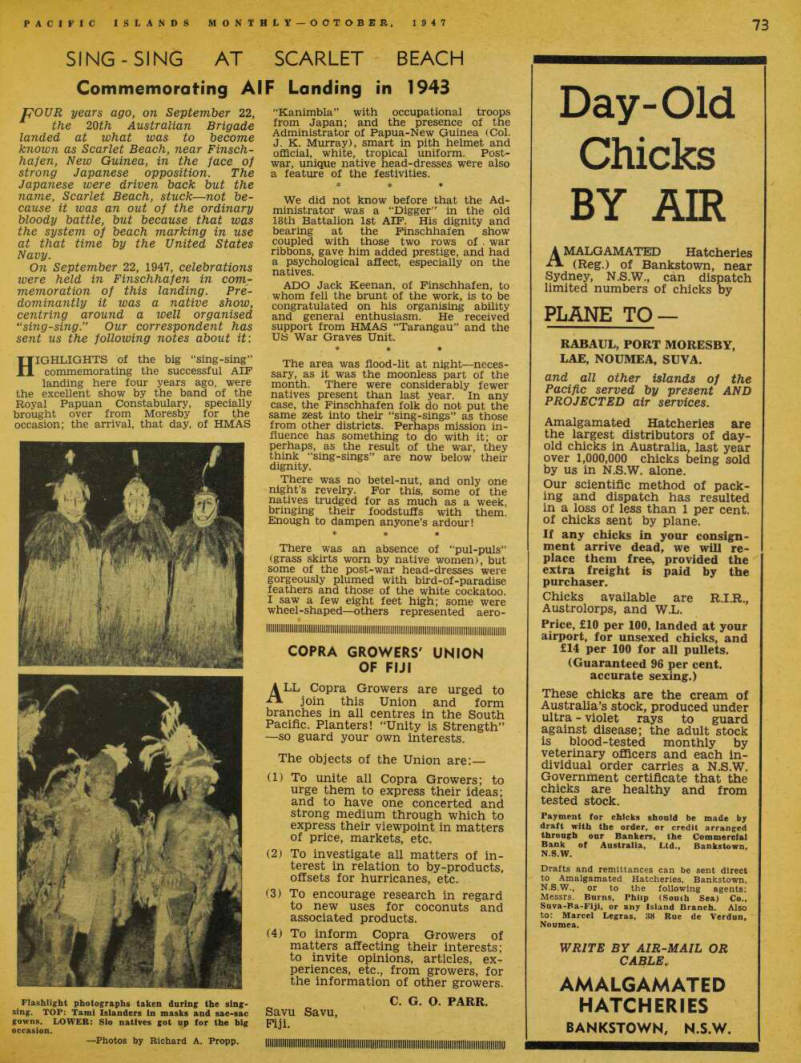
Enough to dampen anyone’s ardour! * • * There was an absence of “pul-puls” (grass skirts worn by native women), but some of the post-war head-dresses were gorgeously plumed with bird-of-paradise feathers and those of the white cockatoo.
I saw a few eight feet high; some were wheel-shaped—others represented aero-
Flashlight photographs taken during the sing sing. TOP: Tami Islanders in masks and sac-sac gowns. LOWER: Sio natives got up for the big occasion. —Photos by Richard A. Propp.