Fiji Population
p. 40 · Read in the full issue
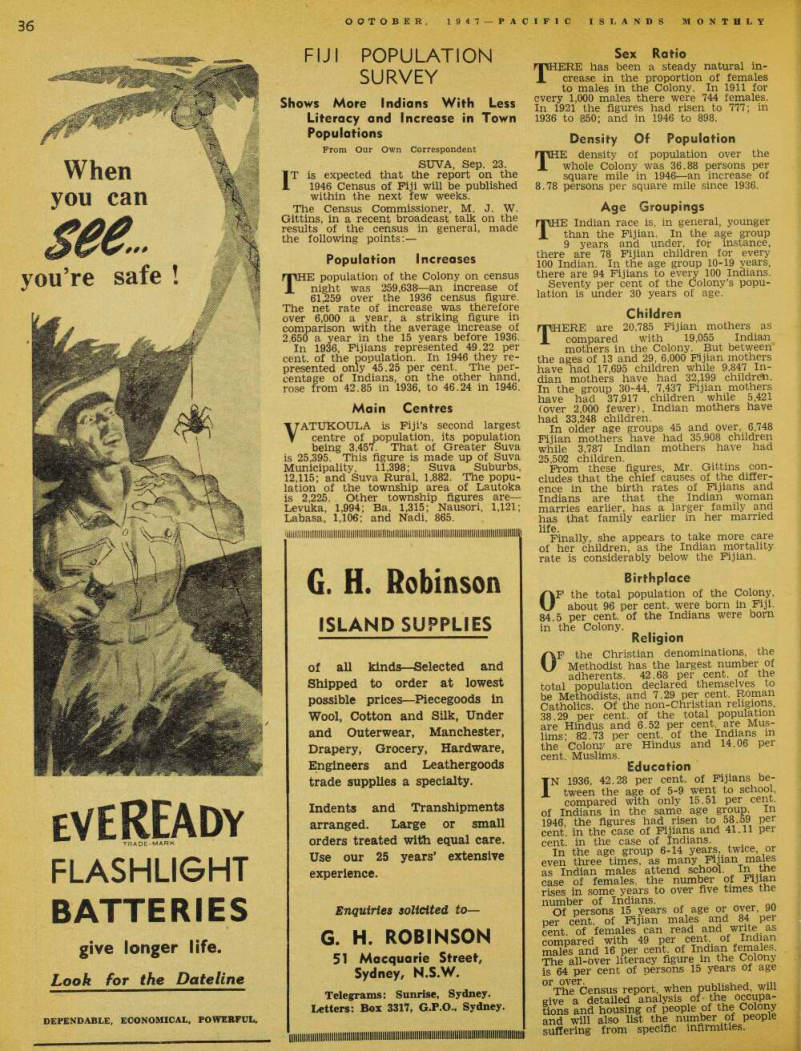
Survey
Shows More Indians With Less Literacy and Increase in Town Populations
From Our Own Correspondent
Suva, Sep. 23.
IT is expected that the report on the 1946 Census of Fiji will be published within the next few weeks.
The Census Commissioner, M. J. W.
Gittins, in a recent broadcast talk on the results of the census in general, made the following points;—
Population Increases
rE population of the Colony on census night was 259,638 —an increase of 61,259 over the 1936 census figure.
The net rate of increase was therefore over 6,000 a year, a striking figure in comparison with the average increase of 2,650 a year in the 15 years before 1936.
In 1936, Fijians represented 49.22 per cent, of the population. In 1946 they re presented only 45.25 per cent. The per centage of Indians, on the other hand, rose from 42.85 in 1936, to 46.24 in 1946.
Main Centres
YATUKOULA is Fiji’s second largest centre of population, its population being 3,457. That of Greater Suva is 25,395. This figure is made up of Suva Municipality, 11,398; Suva Suburbs, 12,115; and Suva Rural, 1,882. The popu lation of the township area of Lautoka is 2,225. Other township figures are— Levuka, 1,994; Ba. 1,315; Nausori, 1,121; Labasa, 1,106; and Nadi, 865.
Sex Ratio
rERE has been a steady natural in crease in the proportion of females to males in the Colony. In 1911 for every 1,000 males there were 744 females.
In 1921 the figures had risen to 777; in 1936 to 850; and in 1946 to 898.
Density Of Population
rpHE density of population over the X whole Colony was 36.88 persons per square mile in 1946—an increase of 8.78 persons per square mile since 1936.
Age Groupings
rE Indian race is, in general, younger than the Fijian. In the age group 9 years and under, for instance, there are 78 Fijian children for every 100 Indian. In the age group 10-19 years, there are 94 Fijians to every 100 Indians.
Seventy per cent of the Colony’s popu lation is under 30 years of age.
Children
rERE are 20,785 Fijian mothers as compared with 19,055 Indian mothers in the Colony. But between the ages of 13 and 29, 6,000 Fijian mothers have had 17,695 children while 9,847 In dian mothers have had 32,199 children.
In the group 30-44, 7,437 Fijian mothers have had 37,917 children while 5,421 (over 2,000 fewer), Indian mothers have had 33,248 children.
In older age groups 45 and over, 6,748 Fijian mothers have had 35,908 children while 3,787 Indian mothers have had 25,502 children.
From these figures, Mr. Gittins con cludes that the chief causes of the differ ence in the birth rates of Fijians and Indians are that the Indian woman marries earlier, has a larger family and has that family earlier in her married life.
Finally, she appears to take more care of her children, as the Indian mortality rate is considerably below the Fijian.
Birthplace
OF the total population of the Colony, about 96 per cent, were born in Fiji. 84.5 per cent, of the Indians were born in the Colony.
Religion
OF the Christian denominations, the Methodist has the largest number of adherents. 42.68 per cent, of the total peculation declared themselves to be Methodists, and 7.29 per cent. Roman Catholics. Of the non-Christian religions, 38.29 per cent, of the total population are Hindus and 6.52 per cent are Mus lims- 82.73 per cent, of the Indians m the Colon;/ are Hindus and 14.06 per cent. Muslims.
Education
IN 1936, 42.28 per cent, of Fijians be tween the age of 5-9 went to school, compared with only 15.51 per cent, of Indians in the same age group. In 1946, the figures had risen to 58 59 per cent, in the case of Fijians and 41.11 per cent, in the case of Indians.
In the age group 6-14 years, twice, or even three times, as many Fijian males as Indian males attend school. In the case of females, the number of Fijian rises in some years to over five times tne number of Indians.
Of persons 15 years of age or over, 90 ner cent, of Fijian males and 84 per cent, of females can read and write as compared with 49 per cent of Indian males and 16 per cent of Indian females The all-over literacy figure in the Colony is 64 per cent of persons 15 years of age ° r The Census report, when published, will give a detailed analysis of the occupa tions and housing of people of the Colony and will also list the number of people suffering from specific infirmities.