More Troubles for Employers and Less Freedom
p. 38 · Read in the full issue
for Natives
(From a Special Correspondent in New Britain)
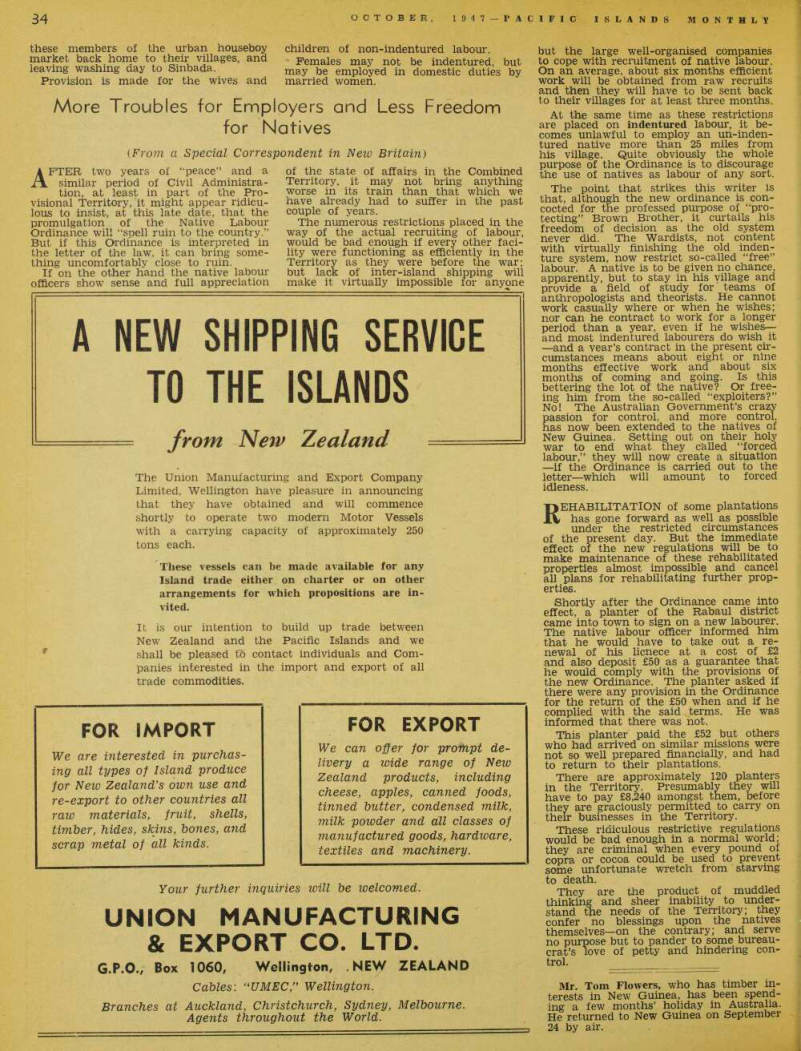
AFTER two years of “peace” and a similar period of Civil Administra tion, at least in part of the Pro visional Territory, it might appear ridicu lous to insist, at this late date, that the promulgation of the Native Labour Ordinance will “soell ruin to the country.”
But if this Ordinance is interpreted in the letter of the law, it can bring some thing uncomfortably close to ruin.
If on the other hand the native labour officers show sense and full appreciation
of the state of affairs in the Combined Territory, it may not bring anything worse in its train than that which we have already had to suffer in the past couple of years.
The numerous restrictions placed in the way of the actual recruiting of labour, would be bad enough if every other faci lity were functioning as efficiently in the Territory as they were before the war; but lack of inter-island shipping will make it virtually impossible for anyone
but the large well-organised companies to cope with recruitment of native labour.
On an average, about six months efficient work will be obtained from raw recruits and then they will have to be sent back to their villages for at least three months.
At the same time as these restrictions are placed on indentured labour, it be comes unlawful to employ an un-inden tured native more than 25 miles from his village. Quite obviously the whole purpose of the Ordinance is to discourage the use of natives as labour of any sort.
The point that strikes this writer is that, although the new ordinance is con cocted for the professed purpose of “pro tecting” Brown Brother, it curtails his freedom of decision as the old system never did. The Wardists, not content with virtually finishing the old inden ture system, now restrict so-called “free” labour. A native is to be given no chance, apparently, but to stay in his village and provide a field of study for teams of anthropologists and theorists. He cannot work casually where or when he wishes; nor can he contract to work for a longer period than a year, even if he wishes— and most indentured labourers do wish it —and a year’s contract in the present cir cumstances means about eight or nine months effective work and about six months of coming and going. Is this bettering the lot of the native? Or free ing him from the so-called “exploiters?”
No! The Australian Government’s crazy passion for control, and more control, has now been extended to the natives of New Guinea. Setting out on their holy war to end what they called “forced labour,” they will now create a situation —if the Ordinance is carried out to the letter—which will amount to forced idleness.
Rehabilitation of some plantations
has gone forward as well as possible under the restricted circumstances of the present day. But the immediate effect of the new regulations will be to make maintenance of these rehabilitated properties almost impossible and cancel all plans for rehabilitating further prop erties.
Shortly after the Ordinance came into effect, a planter of the Rataaul district came into town to sign on a new labourer.
The native labour officer informed him that he would have to take out a re newal of his licnece at a cost of £2 and also deposit £5O as a guarantee that he would comply with the provisions of the new Ordinance. The planter asked if there were any provision in the Ordinance for the return of the £5O when and if he complied with the said terms. He was informed that there was not.
This planter paid the £52 but others who had arrived on similar missions were not so well prepared financially, and had to return to their plantations.
There are approximately 120 planters in the Territory. Presumably they will have to pay £8,240 amongst them, before they are graciously permitted to carry on their businesses in the Territory.
These ridiculous restrictive regulations would be bad enough in a normal world; they are criminal when every pound of copra or cocoa could be used to prevent some unfortunate wretch from starving to death.
They are the product of muddled thinking and sheer inability to under stand the needs of the Territory; they confer no blessings upon the natives themselves—on the contrary; and serve no purpose but to pander to some bureau crat’s love of petty and hindering con trol.
Mr. Tom Flowers, who has timber in terests in New Guinea, has been spend ing a few months’ holiday in Australia.
He returned to New Guinea on September 24 by air.