Orgy Of Government Spending In
pp. 23-25 · Read in the full issue
Papua - N. Guinea
Administration Uses £2,000,000 of. Australian Money Above Its Own Revenues
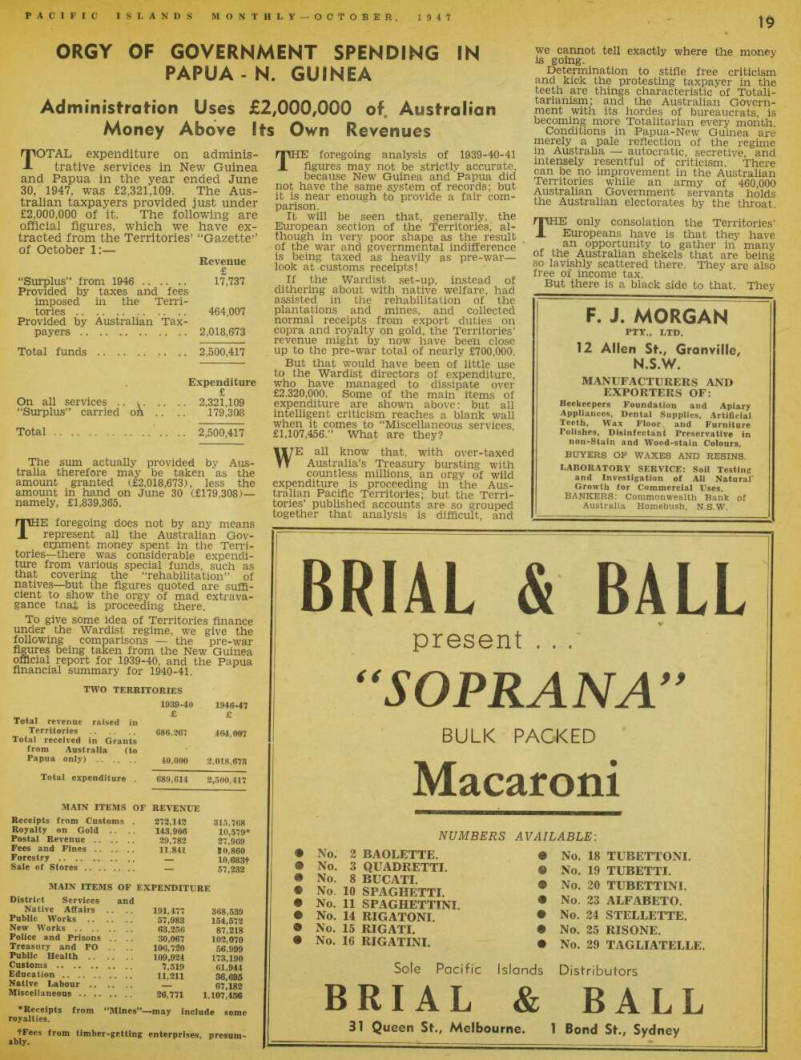
rTAL expenditure on adminis trative services in New Guinea and Papua in the year ended June 30, 1947, was £2,321,109. The Aus tralian taxpayers provided just under £2,000,000 of it. The following are official figures, which we have ex tracted from the Territories’ “Gazette’’ of October 1:
The sum actually provided by Aus tralia therefore may be taken as the amount granted (£2,018,673), less the amount in hand on June 30 (£179,308) namely, £1,839,365. fITHE foregoing does not by any means X represent all the Australian Gov . eminent money spent in the Terri tories—there was considerable expendi ture from various special funds, such as that covering the “rehabilitation” of natives—but the figures quoted are suffi cient to show the orgy of mad extrava gance tnat is proceeding there.
To give some idea of Territories finance under the Wardist regime, we give the following comparisons the pre-war figures being taken from the New Guinea official report for 1939-40, and the Papua financial summary for 1940-41.
fIIHE foregoing analysis of 1939-40-41 JL figures may not be strictly accurate, because New Guinea and Papua did not have the same system of records; but it is near enough to provide a fair com parison.
It will be seen that, generally, the European section of the Territories, al though in very poor shape as the result of the war and governmental indifference is being taxed as heavily as pre-war— look at customs receipts!
If the Wardist set-up. instead of dithering about with native welfare, had assisted in the rehabilitation of the plantations and mines, and collected normal receipts from export duties on copra and royalty on gold, the Territories’ revenue might by now have been close up to the pre-war total of nearly £700,000.
But that would have been of little use to the Wardist directors of expenditure, who have managed to dissipate over £2,320,000. Some of the main items of expenditure are shown above: but all intelligent criticism reaches a blank wall when it comes to “Miscellaneous services. £1,107,456.” What are they?
WE all know that, with over-taxed Australia’s Treasury bursting with countless millions, an orgy of wild expenditure is proceeding in the Aus tralian Pacific Territories; but the Terri tories’ published accounts are so grouped together that analysis is difficult, and
we cannot tell exactly where the money is going.
Determination to stifle free criticism and kick the protesting taxpayer in the teeth are things characteristic of Totali tarianism; and the Australian Govern ment with its hordes of bureaucrats, is becoming more Totalitarian every month Conditions in Papua-New Guinea are merely a pale reflection of the regime in Australia autocratic, secretive, and intensely resentful of criticism. There can be no improvement in the Australian Territories while an army of 460,000 Australian Government servants holds the Australian electorates by the throat.
THE only consolation the Territories’
Europeans have is that they have an opportunity to gather in many of the Australian shekels that are being so lavishly scattered there. They are also free of income tax.
But there is a black side to that. They
“Surplus” from 1946 Provided by taxes and fees imposed in the Territories Provided by Australian Taxpayers Revenue £ 17,737 464,007 2,018,673 Total funds 2.500,417 On all services .. i. .
“Surplus” carried on .
Expenditure £ . .. 2,321,109 . .. 179,308 Total 2,500,417
Two Territories
1939-40 1946-47 £ £ Total revenue raised in Territories 686,367 464,007 Total received in Grants from Australia (to Papua only) 40,000 2,018,673 Total expenditure . 689,614 2,500,417
Main Items Of
Revenue
Receipts from Customs .
Royalty on Gold Postal Revenue Fees and Fines Forestry Sale of Stores 272,142 143,906 29,782 11,841 315,768 10,579* 27,969 110,860 10,683t 57,232
Main Items Of Expenditure
District Services and Native Affairs Public Works New Works Police and Prisons ..
Treasury and PO . .
Public Health Customs Education Native Labour Miscellaneous .. .. .. 191,477 57,983 63,256 30,067 106,720 109,924 7,519 11,211 26,771 368,539 154,572 87,218 102,070 56,999 173,190 61,944 36,695 67,182 1,107,456 ♦Receipts from “Mlnes”royalties. -may include some tFees from timber-getting enterprises, ably. presum-
may not pay tax on income—but they are all being ferociously taxed on all their daily requirements which are im ported—that is, on at least 90 per cent, of all requirements. Meanwhile (see article elsewhere) the Australian Govern ment is grabbing some £3 or £4 per ton at least of the money that should be going to copra-growers in the Territories.
If this orgy of spending in the Aus tralian Territories had been attended by encouragement of private enterprise, it might have achieved ultimate good. The European individualists there could have used the money that came their way to establish some flourishing industries.
But the Wardist regime hates private enterprise and individualism in all its forms; and mainly by withholding transport and labour it has contrived to knock the spirit out of most of the Territories non-official white civilians.
It is a fantastic set-up but it will go on so long as there is Socialist control' in Australia.
Miss Vivian Thwaite, a well-known identity in Administration circles before the war, and who now is connected with the National Library movement in the Territory, arrived in Sydney recently on leave.
Captain Sandy Meldrum brought MV “Salamaua” to Sydney on October 9 with a cargo of disposals goods from Madang, New Guinea.
Mr. C. W. Rothe, general manager of the Colonial Sugar Refining Company, has been in Fiji to inspect the company’s activities in the Colony. Although this is his first visit since he became general manager three years ago, Mr. Rothe is no stranger to Fiji. He was on the staff of the company’s Lautoka mill in 1914 and 1915 and has paid two brief visits to the Colony since then.