International Monopoly
pp. 7-8 · Read in the full issue
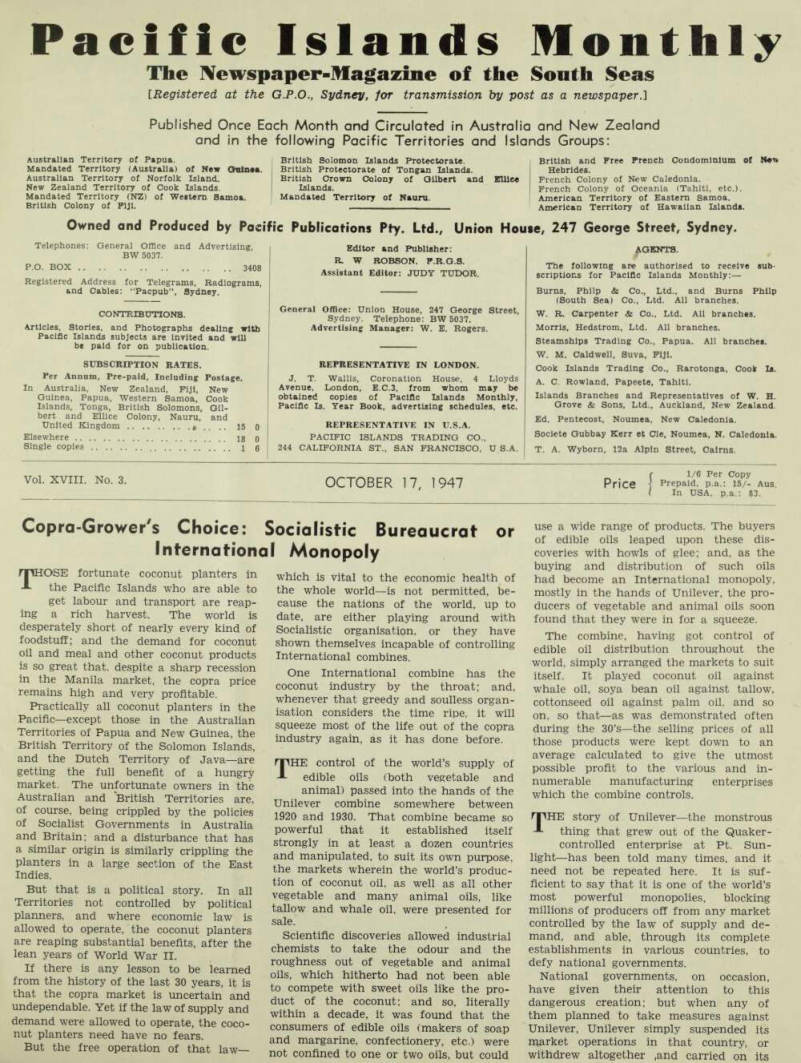
Copra-Grower's Choice: Socialistic Bureaucrat or International Monopoly
rOSE fortunate coconut planters in the Pacific Islands who are able to get labour and transport are reap ing a rich harvest. The world is desperately short of nearly every kind of foodstuff; and the demand for coconut oil and meal and other coconut products is so great that, despite a sharp recession in the Manila market, the copra price remains high and very profitable.
Practically all coconut planters in the Pacific—except those in the Australian Territories of Papua and New Guinea, the British Territory of the Solomon Islands, and the Dutch Territory of Java —are getting the full benefit of a hungry market. The unfortunate owners in the Australian and British Territories are, of course, being crippled by the policies of Socialist Governments in Australia and Britain; and a disturbance that has a similar origin is similarly crippling the planters in a large section of the East Indies.
But that is a political story. In all Territories not controlled by political planners, and where economic law is allowed to operate, the coconut planters are reaping substantial benefits, after the lean years of World War 11.
If there is any lesson to be learned from the history of the last 30 years, it is that the copra market is uncertain and undependable. Yet if the law of supply and demand were allowed to operate, the coco nut planters need have no fears.
But the free operation of that law—
which is vital to the economic health of the whole world—is not permitted, be cause the nations of the world, up to date, are either playing around with Socialistic organisation, or they have shown themselves incapable of controlling International combines.
One International combine has the coconut industry by the throat; and, whenever that greedy and soulless organ isation considers the time ripe, it will squeeze most of the life out of the copra industry again, as it has done before.
THE control of the world’s supply of edible oils (both vegetable and animal) passed into the hands of the Unilever combine somewhere between 1920 and 1930. That combine became so powerful that it established itself strongly in at least a dozen countries and manipulated, to suit its own purpose, the markets wherein the world’s produc tion of coconut oil, as well as all other vegetable and many animal oils, like tallow and whale oil, were presented for sale.
Scientific discoveries allowed industrial chemists to take the odour and the roughness out of vegetable and animal oils, which hitherto had not been able to compete with sweet oils like the pro duct of the coconut; and so, literally within a decade, it was found that the consumers of edible oils (makers of soap and margarine, confectionery, etc.) were not confined to one or two oils, but could
use a wide range of products. The buyers of edible oils leaped upon these dis coveries with howls of glee; and, as the buying and distribution of such oils had become an International monopoly, mostly in the hands of Unilever, the pro ducers of vegetable and animal oils soon found that they were in for a squeeze.
The combine, having got control of edible oil distribution throughout the world, simply arranged the markets to suit itself. It played coconut oil against whale oil, soya bean oil against tallow, cottonseed oil against palm oil, and so on, so that —as was demonstrated often during the 30’s —the selling prices of all those products were kept down to an average calculated to give the utmost possible profit to the various and in numerable manufacturing enterprises which the combine controls.
HHHE story of Unilever—the monstrous A thing that grew out of the Quaker controlled enterprise at Pt. Sun light—has been told many times, and it need not be repeated here. It is suf ficient to say that it is one of the world’s most powerful monopolies, blocking millions of producers off from any market controlled by the law of supply and de mand, and able, through its complete establishments in various countries, to defy national governments.
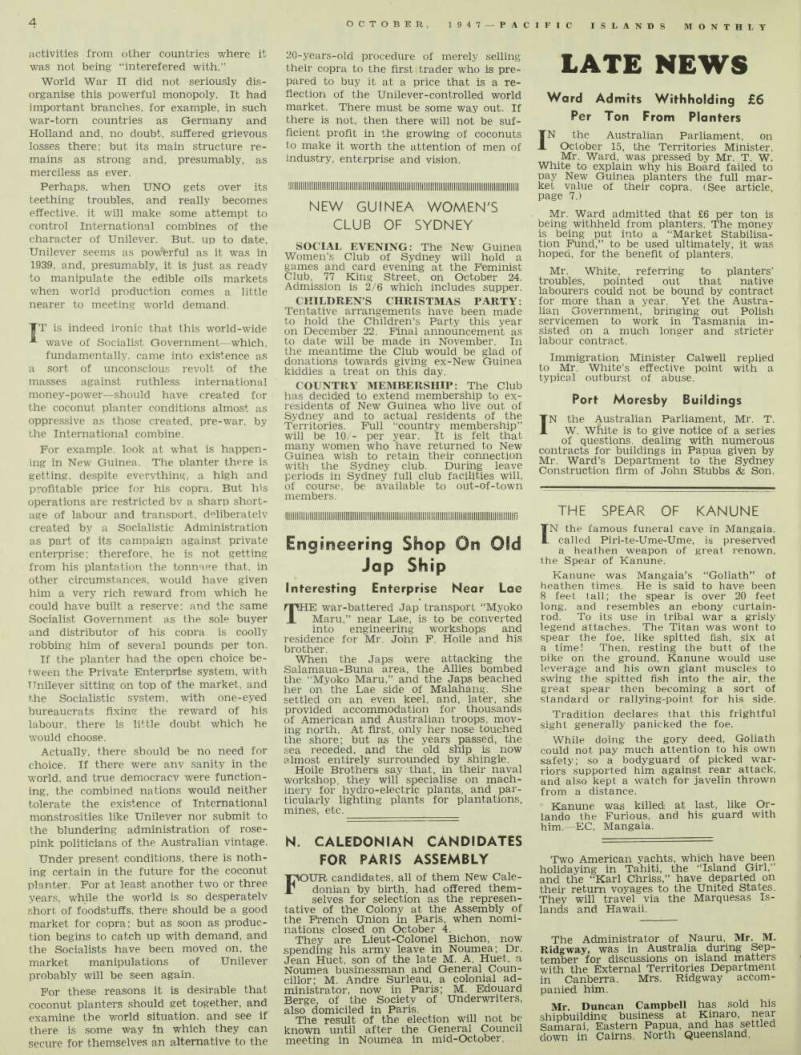
National governments, on occasion, have given their attention to this dangerous creation; but when any of them planned to take measures against Unilever, Unilever simply suspended its market operations in that country, or withdrew altogether ,and carried on its
activities from other countries where it was not being “interefered with.”
World War II did not seriously dis organise this powerful monopoly. It had important branches, for example, in such war-torn countries as Germany and Holland and, no doubt, suffered grievous losses there: but its main structure re mains as strong and, presumably, as merciless as ever.
Perhaps, when UNO gets over its teething troubles, and really becomes effective, it will make some attempt to control International combines of the character of Unilever. But. up to date, Unilever seems as powerful as it was in 1939, and, presumably, it is just as ready to manipulate the edible oils markets when world production comes a little nearer to meeting world demand.
TT is indeed ironic that this world-wide * wave of Socialist Government —which, fundamentally, came into existence as a sort of unconscious revolt of the masses against ruthless international money-power—should have created for the coconut planter conditions almost as oppressive as those created, pre-war, by the International combine.
For example, look at what is happen ing in New Guinea. The nlanter there is getting, despite everything, a high and profitable price for his copra. But his operations are restricted bv a sharp short age of labour and transport, deliberate!v created by a Socialistic Administration as part of its campaign against private enterprise: therefore, he is not getting from his plantation the tonnage that, in other circumstances, would have given him a very rich reward from which he could have built a reserve: and the same Socialist Government as the sole buyer and distributor of his copra is coolly robbing him of several pounds per ton.
If the planter had the open choice be tween the Private Enterprise system, with Unilever sitting on top of the market, and the Socialistic system, with one-eyed bureaucrats fixing the reward of his labour, there is little doubt which he would choose.
Actually, there should be no need for choice. If there were anv sanity in the world, and true democracy were function ing, the combined nations would neither tolerate the existence of International monstrosities like Unilever nor submit to the blundering administration of rose pink politicians of the Australian vintage.
Under present conditions, there is noth ing certain in the future for the coconut planter. For at least another two or three years, while the world is so desperatelv short of foodstuffs, there should be a good market for copra: but as soon as produc tion begins to catch up with demand, and the Socialists have been moved on, the market manipulations of Unilever probably will be seen again.
For these reasons it is desirable that coconut planters should get together, and examine the world situation, and see if there is some way in which they can secure for themselves an alternative to the
20-years-old procedure of merely selling their copra to the first trader who is pre pared to buy it at a price that is a re flection of the Unilever-controlled world market. There must be some way out. If there is not, then there will not be suf ficient profit in the growing of coconuts to make it worth the attention of men of industry, enterprise and vision.