Bus Driver
p. 78 · Read in the full issue
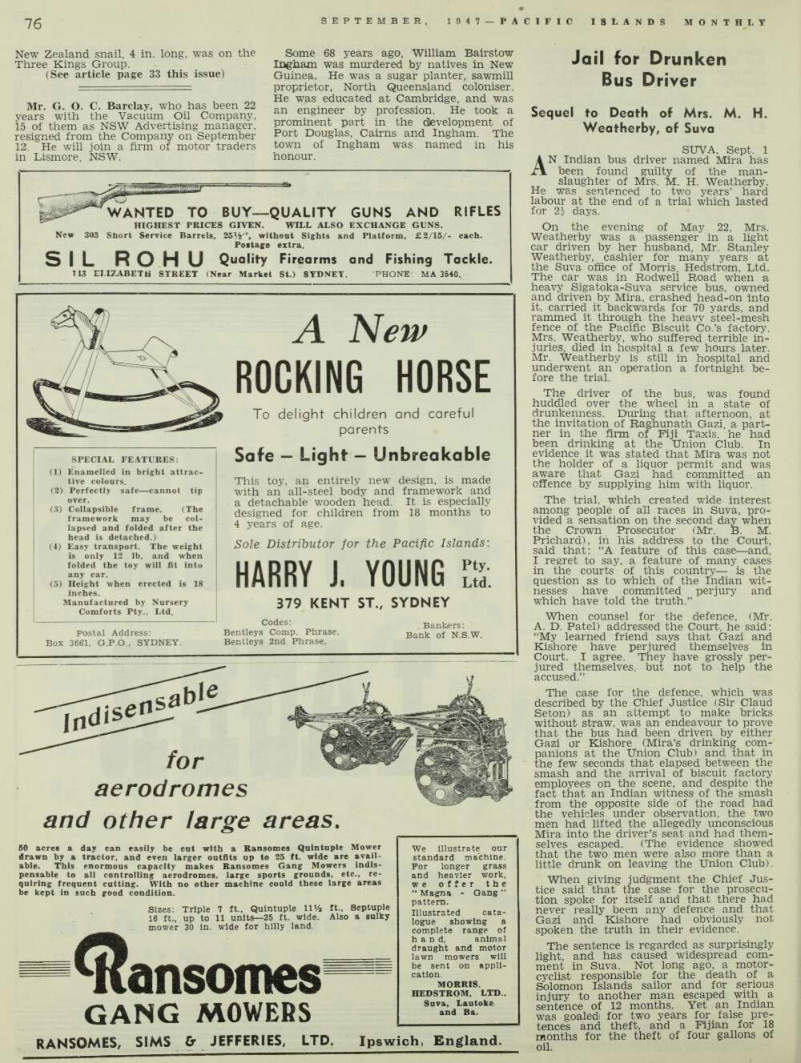
Jail for Drunken Bus Driver Sequel to Death of Mrs. M. H.
Weatherby, of Suva
SUVA, Sept. 1 AN Indian bus driver named Mira has been found guilty of the man slaughter of Mrs. M. H. Weatherby.
He was sentenced to two years’ hard labour at the end of a trial which lasted for 21 days.
On the evening of May 22, Mrs.
Weatherby was a passenger in a light car driven by her husband, Mr. Stanley Weatherby, cashier for many years at the Suva office of Morris, Hedstrom, Ltd.
The car was in Rodwell Road when a heavy Sigatoka-Suva service bus, owned and driven by Mira, crashed head-on into it, carried it backwards for 70 yards, and rammed it through the heavy steel-mesh fence of the Pacific Biscuit Co.’s factory.
Mrs. Weatherby, who suffered terrible in juries, died in hospital a few hours later.
Mr. Weatherby is still in hospital and underwent an operation a fortnight be fore the trial.
The driver of the bus, was found huddled over the wheel in a state of drunkenness. During that afternoon, at the invitation of Raghunath Gazi, a part ner in the firm of Fiji Taxis, he had been drinking at the Union Club. In evidence it was stated that Mira was not the holder of a liquor permit and was aware that Gazi had committed an offence by supplying him with liquor.
The trial, which created wide interest among people of all races in Suva, pro vided a sensation on the second day when the Crown Prosecutor (Mr. B. M.
Prichard), in his address to the Court, said that; “A feature of this case—and, I regret to say, a feature of many cases in the courts of this country— is the question as to which of the Indian wit nesses have committed perjury and which have told the truth.”
When counsel for the defence, (Mr.
A. D. Patel) addressed the Court, he said: “My learned friend says that Gazi and Kishore have perjured themselves in Court. I agree. They have grossly per jured themselves, but not to help the accused.”
The case for the defence, which was described by the Chief Justice (Sir Claud Seton) as an attempt to make bricks without straw, was an endeavour to prove that the bus had been driven by either Gazi or Kishore (Mira’s drinking com panions at the Union Club) and that in the few seconds that elapsed between the smash and the arrival of biscuit factory employees on the scene, and despite the fact that an Indian witness of the smash from the opposite side of the road had the vehicles under observation, the two men had lifted the allegedly unconscious Mira into the driver’s seat and had them selves escaped. (The evidence showed that the two men were also more than a little drunk on leaving the Union Club).
When giving judgment the Chief Jus tice said that the case for the prosecu tion spoke for itself and that there had never really been any defence and that Gazi and Kishore had obviously not spoken the truth in their evidence.
The sentence is regarded as surprisingly light, and has caused widespread com ment in Suva. Not long ago, a motor cyclist responsible for the death of a Solomon Islands sailor and for serious injury to another man escaped with a sentence of 12 months. Yet an Indian was goaledi for two years for, false pre tences and theft, and a Fijian for 18 months for the theft of four gallons of oil.