Knew Thakombau!
pp. 63-64 · Read in the full issue
Old Resident of Sydney
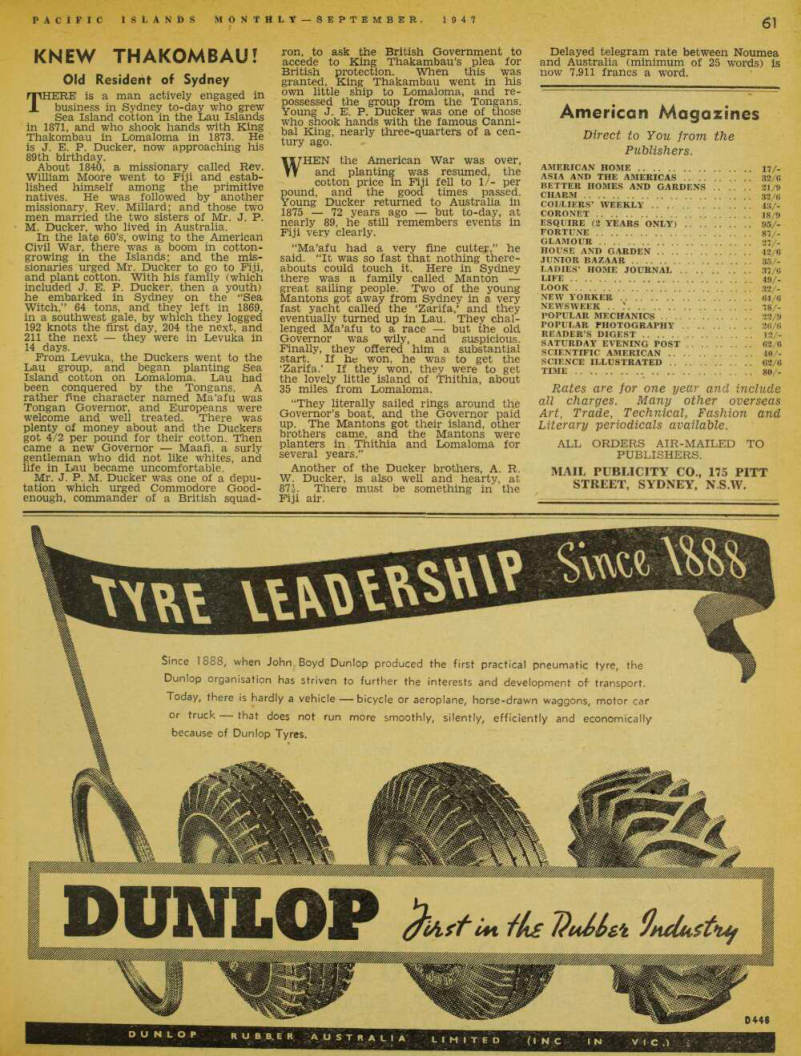
THERE is a man actively engaged in business in Sydney to-day who grew Sea Island cotton in the Lau Islands in 1871, and who shook hands with King Thakombau in Lomaloma in 1873. He is J. E. P. Ducker, now approaching his 89th birthday.
About 1840, a missionary called Rev.
William Moore went to Fiji and estab lished himself among the primitive natives. He was followed by another missionary, Rev. Millard; and those two men married the two sisters of Mr. J. P.
M. Ducker, who lived in Australia.
In the late 60’s, owing to the American Civil War, there was a boom in cotton growing in the Islands; and the mis sionaries urged Mr. Ducker to go to Fiji, and plant cotton. With his family (which included J. E. P. Ducker, then a youth) he embarked in Sydney on the “Sea Witch,” 64 tons, and they left in 1869, in a southwest gale, by which they logged 192 knots the first day. 204 the next, and 211 the next they were in Levuka in 14 days.
From Levuka, the Duckers went to the Lau group, and began planting Sea Island cotton on Lomaloma. Lau had been conquered by the Tongans. A rather fine character named Ma’afu was Tongan Governor, and Europeans were welcome and well treated. There was plenty of money about and the Duckers got 4/2 per pound for their cotton. Then came a new Governor Maafi. a surly gentleman who did not like whites, and life in Lau became uncomfortable.
Mr. J. P. M. Ducker was one of a depu tation which urged Commodore Good enough, commander of a British squad
ron, to ask the British Government to accede to King Thakambau’s plea for British protection. When this was granted, King Thakambau went in his own little ship to Lomaloma, and re possessed the group from the Tongans.
Young J. E. P. Ducker was one of those who shook hands with the famous Canni bal King, nearly three-quarters of a cen tury ago.
WHEN the American War was over, and planting was resumed, the cotton price in Fiji fell to 1/- per pound, and the good times passed.
Young Ducker returned to Australia in 1875 72 years ago but to-day, at nearly 89, he still remembers events in Fiji very clearly.
“Ma’afu had a very fine cutter,” he said. “It was so fast that nothing there abouts could touch it. Here in Sydney there was a family called Manton great sailing people. Two of the young Mantons got away from Sydney in a very fast yacht called the ‘Zarifa,' and they eventually turned up in Lau. They chal lenged Ma’afu to a race but the old Governor was wily, and suspicious.
Finally, they offered him a substantial start. If he won, he was to get the ‘Zarifa.’ If they won, they were to get the lovely little island of Thithia, about 35 miles from Lomaloma.
“They literally sailed rings around the Governor’s boat, and the Governor paid up. The Mantons got their island, other brothers came, and the Mantons were planters in Thithia and Lomaloma for several years.”
Another of the Ducker brothers, A. R.
W. Ducker, is also well and hearty, at 871. There must be something in the Fiji air.
Delayed telegram rate between Noumea and Australia (minimum of 25 words) is now 7.911 francs a word.
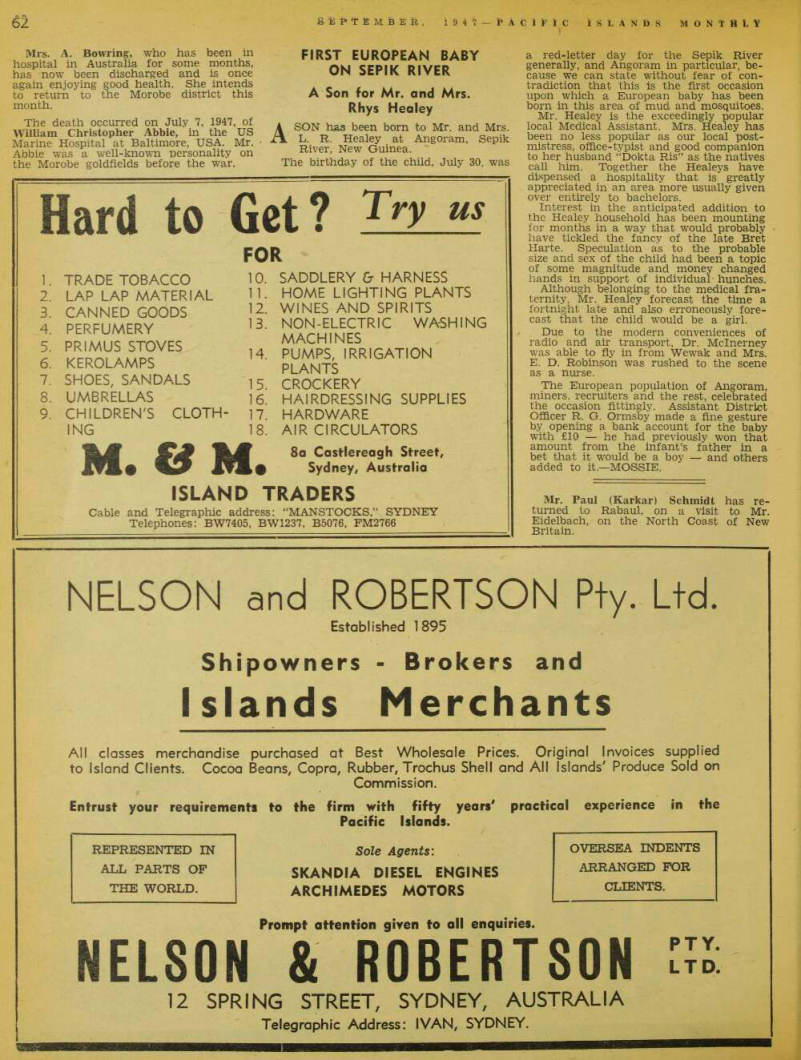
Mrs, A. Bowring, who has been in hospital in Australia for some months, has now been discharged and is once again enjoying good health. She intends to return to the Morobe district this month.
The death occurred on July 7, 1947, of William Christopher Abbie, in the US Marine Hospital at Baltimore, USA. Mr.
Abbie was a well-known personality on the Morobe goldfields before the war.