Guinea
pp. 57-59 · Read in the full issue
North To New
"Morning Star," New Mission Ship, Has a Quick Run
[From notes made by Cecil O’Dea, Sydney solicitor and yachtsman, who skippered the “Morning Star” from Taree, NSW, to Eastern Papua].
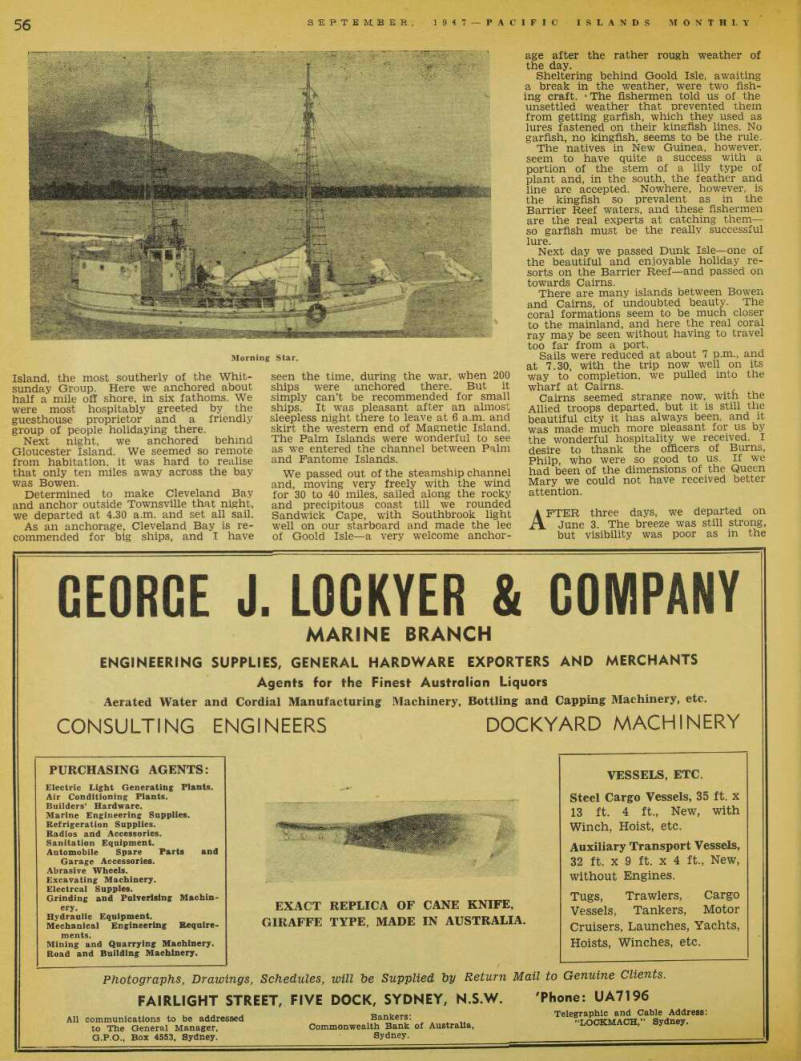
“H/|ORNING Star” she was called, and It! there she was alongside the old wharf at Harrington (at the entrance of the Manning River, on the North Coast of New South Wales), as sturdily built as any such craft could be, embodying ideas which should make her an ideal all-purpose vessel for the Catholic Mission in waters of Eastern Papua.
Here was the culmination of many months of planning by Rev. Father J.
Dwyer, MSC, in charge of Eastern Papuan Catholic Mission, and of good, honest, solid work put into her by Mr, Bill Ryan, boat-builder, of Taree. who accompanied us on our trip to Sidea, where she was handed on to the Mission.
The bar at Harrington, in a stiff breeze, is rather dangerous. So. anxious to leave whilst the light south-easterly made the bar passable, we worked dav and night loading stores. On May 12, 1947, at high tide, we stemmed the swell on the bar and, at 1,30 p.m., set a course up the coast for Bundaberg, Queensland.
For three nights and days we had a grey sky, with frequent rain squalls and a rising wind and sea. Apart from a roll expected in a small craft, the “Star” (as we called her) convinced us of her sea worthy qualities.
It was with relief, howeven that we approached the leads at Wide Bay, which guided us over the bar into still waters of that beautiful water-wav separating Great Sandy (or Fraser) Island from the coast of Queensland.
The Straits lead to Hervey Bay. With sail, and the Vivian engine doing its best, we sailed through and, at 6 p.m., on May 17, crossed the bar at Bunda berg. The rain had ceased, but darkness came quickly: and, as the river had been filled with silt from recent floods, the danger of stranding obliged us to anchor.
Next morning, the pilot took us up stream. We were given a great welcome at Bundaberg, which has a deserved re putation for hospitality.
IT was cold and misty on May 21 when we left Bundaberg. The sea was still rough, and the wind fresh. Under main and mizzen, jib and forestaysail, we were soon logging over eight knots.
At 5.30 p.m., sail was taken off and we approached that beautiful small-boat anchorage. Pancake Creek, in the lee of Bustard Head, upon which the light house is perched, a guide to all ships passing or making for Gladstone Harbour.
Next day, in cloudy weather and dis turbed water, our course took us to the lee of Keppel Islands, where we anchored at 5 p.m. in 3 fms. This was a good holding ground but a most uncomfort able anchorage.
On the evening of the 23rd, we anchored in the quiet and peaceful waters of Port Clinto, after an anxious crossing of a very disturbed bar.
Rain still persisted next day and pre vented us from appreciating the beauty of the Islands we were coming to. and the grand ruggedness of the coast. The Percys, and especially Middle Islands, are a favourite anchorage for fishing folk and there was a new boat of the kingfish fleet in the bay when we dropped our pick at 4 p.m.
After tea, the owner of the craft came
over in his dinghy and, as usual, was a great type of small-boat man. He told us of the tragic sight he witnessed when a boat in the fleet, which was trolling a school of kingfish, struck a floating mine and, with a terrific explosion, boat and the three men were blown to pieces.
WHAT an enchanting spot we anchored in next night, at Scawfel Island!
It is one of many islands in a group that stretches to the Whitsunday Group.
The bay is about two miles long, by one mile wide, with sandy beaches on the southern and eastern sides, and there is perfect protection from the south westerly or easterly or southerly winds, with a good holding bottom of mud in four to five fathoms, half a mile off a sandy beach.
The thickly-wooded hills, which easily might be called small-timbered mountains, were made more pleasant by the de parture of the rain and the call of in numerable birds from the hill-sides, and
the flight of myriads of ducks as they passed overhead into the centre of the isle.
Next morning, May 26, only a short journey lay ahead of us to Lindeman
Island, the most southerly of the Whit- Sunday Group. Here we anchored about half a mile off shore, in six fathoms. We were most hospitably greeted by the guesthouse proprietor and a friendly group of people holidaying there.
Next night we anchored behind Gloucester Island We seemed so remote from habitation, it was hard to realise that only ten miles away across the bay was Bowen.
Determined to make Cleveland Bay and anchor outside Townsville that night, we departed at 4.30 a.m. and set all sail.
As an anchorage, Cleveland Bay is recommended for big ships, and I have
seen the time, during the war, when 200 ships were anchored there. But it simply can’t be recommended for small ships. It was pleasant after an almost sleepless night there to leave at 6 a.m. and skirt the western end of Magnetic Island.
The Palm Islands were wonderful to see as we entered the channel between Palm and Fantome Islands. we passed out of the steamship channel and, moving very freely with the wind for 30 to 40 miles, sailed along the rocky and precipitous coast till we rounded Sandwick Cape, with Southbrook light well on our starboard and made the lee of Goold Isle—a very welcome anchor-
age after the rather rough weather of the day.
Sheltering behind Goold Isle, awaiting a break in the weather, were two fish ing craft. -The fishermen told us of the unsettled weather that prevented them from getting garfish, which they used as lures fastened on their kingfish lines. No garfish, no kingfish, seems to be the rule.
The natives in New Guinea, however, seem to have quite a success with a portion of the stem of a lily type of plant and, in the south, the feather and line are accepted. Nowhere, however, is the kingfish so prevalent as in the Barrier Reef waters, and these fishermen are the real experts at catching them — so garfish must be the really successful lure.
Next day we passed Dunk Isle—one of the beautiful and en.ioyable holiday re sorts on the Barrier Reef—and passed on towards Cairns.
There are many islands between Bowen and Cairns, of undoubted beauty. The coral formations seem to be much closer to the mainland, and here the real coral ray may be seen without having to travel too far from a port.
Sails were reduced at about 7 p.m., and at 7.30, with the trip now well on its way to completion, we pulled into the wharf at Cairns.
Cairns seemed strange now, with the Allied troops departed, but it is still the beautiful city it has always been, and it was made much more pleasant for us by the wonderful hospitality we received. I desire to thank the officers of Burns, Philp, who were so good to us. If we had been of the dimensions of the Queen Mary we could not have received better attention, AFTER three days, we departed on June 3. The breeze was still strong, but visibility was poor as in the
Morning Star.
out of Cairns, and 25 days from Taree, having spent seven days of this in port.
short, rough chop, we ran through Graf ton Passage. Having been warned about the inconsistencies of the set near Bougainville Reef, I set a course to pass 20 miles off. We travelled well at night, the fresh wind sending us along in great style, with a considerable roll to let us know we were at sea.
By noon on June 5, the breeze had dropped and the sea was getting smoother.
I hoped early in the morning to pick ujd_ South Cape.
At 7 o’clock on June 6, land was sighted on our starboard bow—the eastern end of Papua. The wind had dropped, but it was still cloudy and over cast with intermittent showers. It was difficult to pick up the lighthouse on Badila Bedda Bedda and, in order to be on tne safe side, we ran in behind Suau and were very pleased we did so, for what a beautiful Strait it is, coming through this deep, narrow passage. A most fertile island, peopled by friendly folk —our first glimpse of the inhabitants of New Guinea. We towed a becalmed lakatoi round to Suau on our way, about two miles, and at the village there was another craft desirous of a tow to Samarai.
It was a wet trip, what with the surge and speed of our craft and the chop of the waves, and the frequent torrential down-pours, but they didn’t seem to mind. Their destination was Kwato Mission and, in spite of the towed craft coming adrift on one occasion, we brought them safely to their friends. We passed through the almost unbelievable beauty of the passage between Kwato and Rogeia, with the f ertile hilly volcanic soil of the green hills. We rounded Rogeia, and there was Samarai, with Father J. Dwyer, MSC, and Father J.
Loomey, MSO, to welcome us. We had arrived at our destination three days